
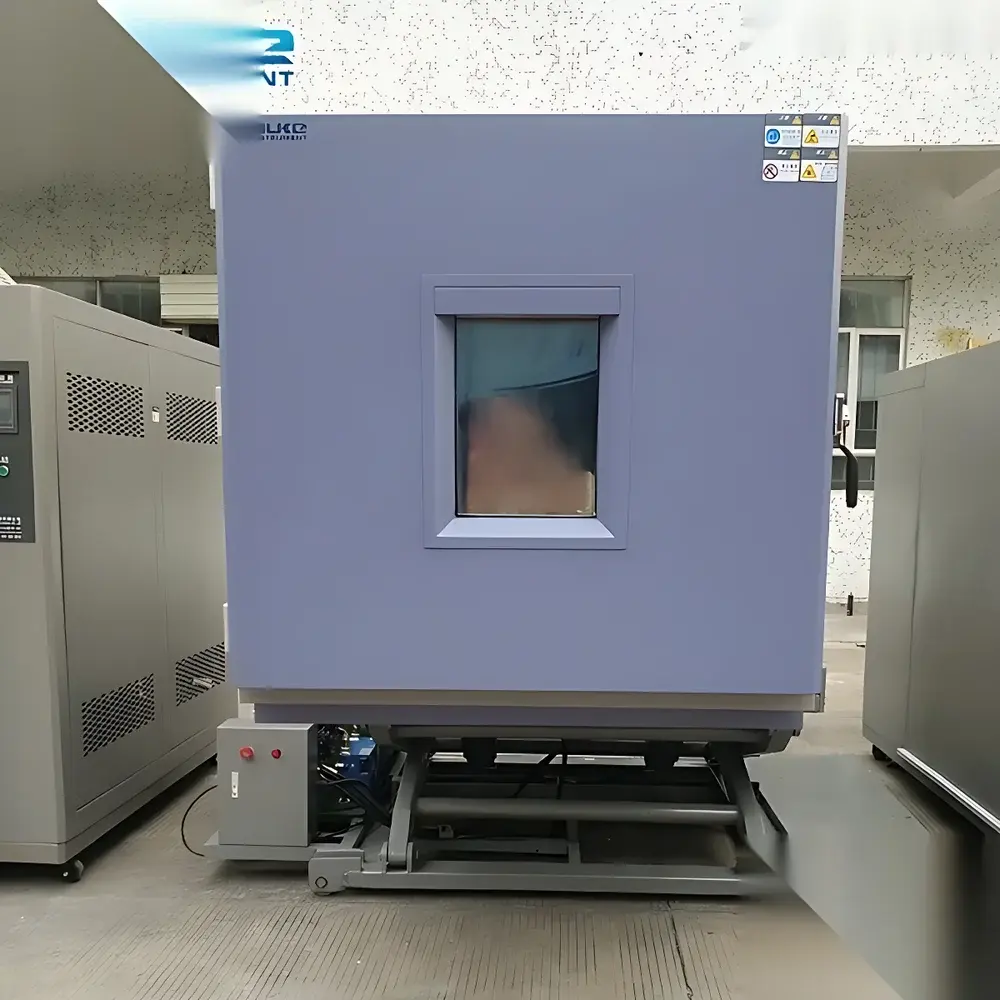
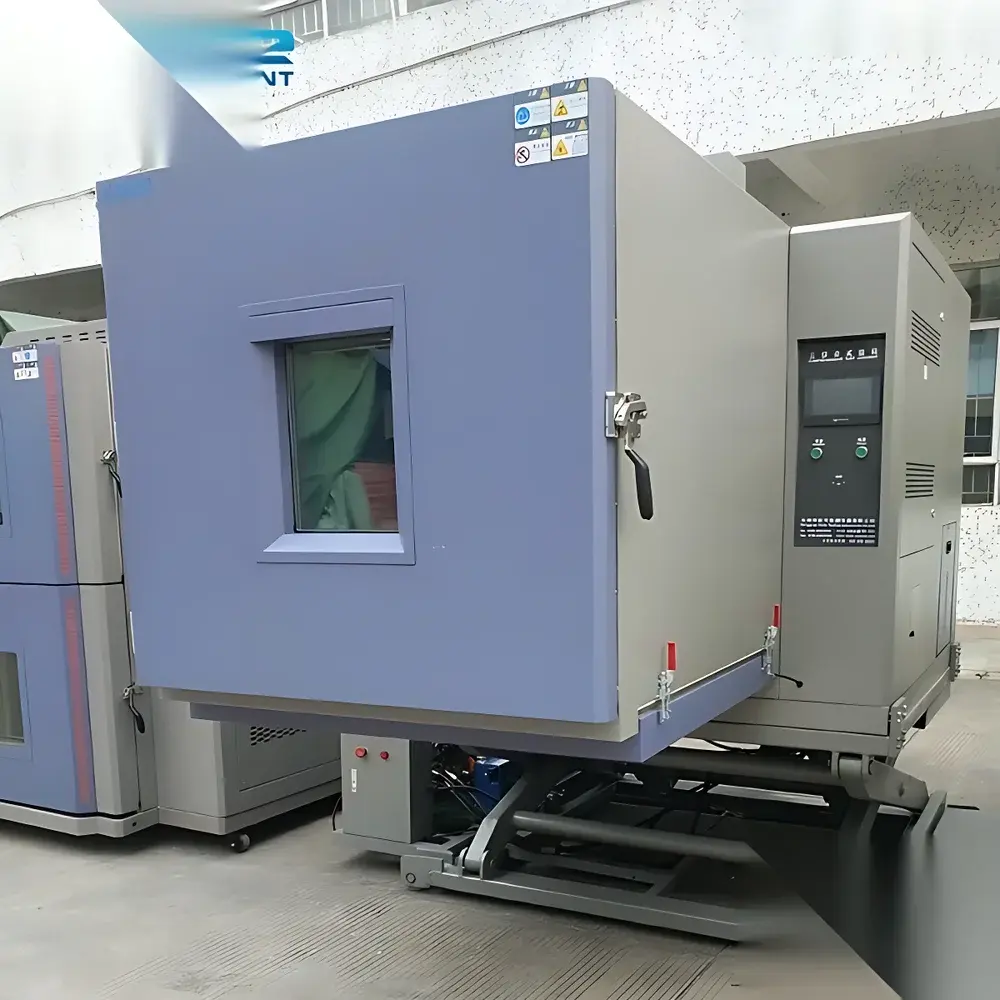
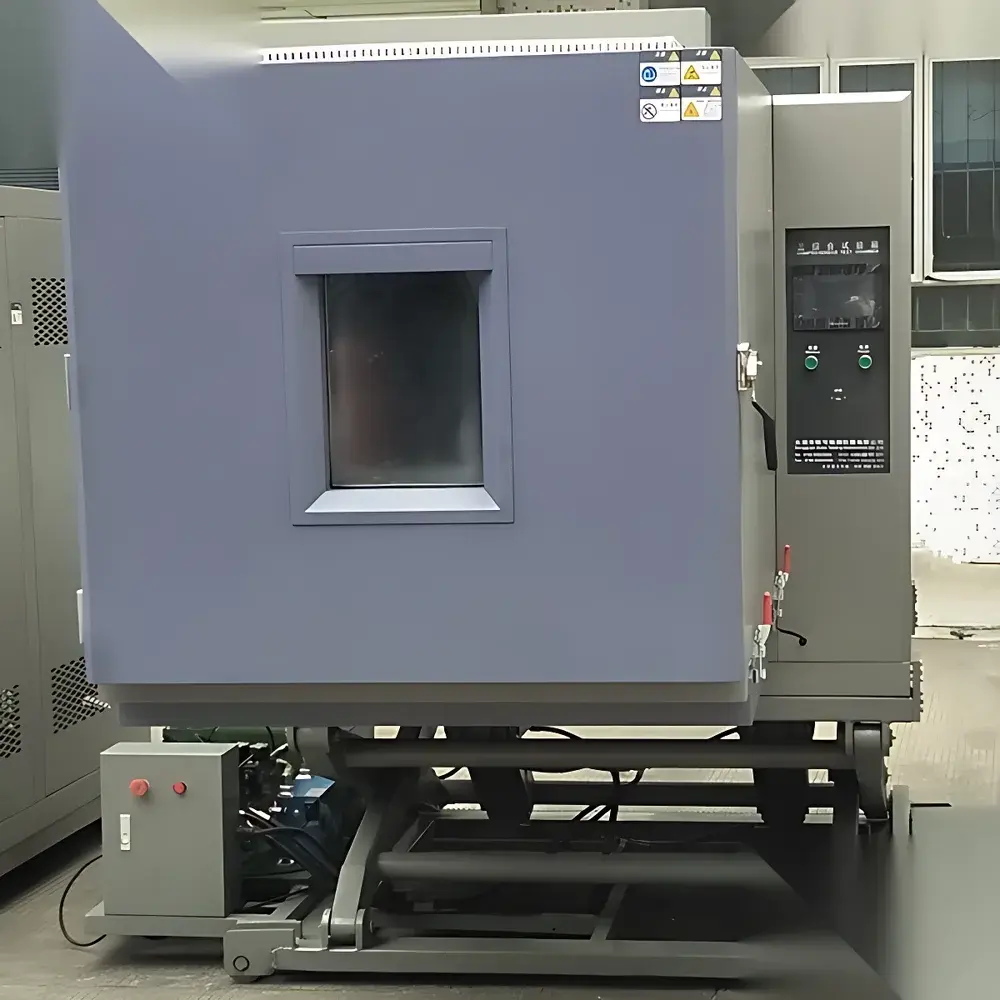
OK-ZTH Series Combined Temperature-Humidity-Vibration Environmental Test Chamber
| Brand | Other Brands |
|---|---|
| Origin | Imported |
| Manufacturer Type | Authorized Distributor |
| Temperature Range | -70 °C to +150 °C |
| Temperature Uniformity | ≤2 °C |
| Temperature Fluctuation | ≤±0.5 °C |
| Temperature Deviation | ≤±2 °C |
| Humidity Range | 20–98 %RH (at +20 °C to +80 °C) |
| Humidity Deviation | ≤±3 %RH (≤75 %RH), ≤±5 %RH (>75 %RH) |
| Ramp Rate Options | 5 °C/min or 10 °C/min |
| Cooling System | Dual-stage mechanical refrigeration with Copeland semi-hermetic compressors |
| Refrigerants | HFC-R404A / HFC-R23 |
| Condenser | Stainless steel brazed plate heat exchanger |
| Cooling Method | Water-cooled |
| Air Circulation | Forced convection via stainless steel centrifugal fan, bottom-in/top-out airflow |
| Humidification | Internal reservoir with booster pump |
| Control System | PLC-based controller with bilingual (English/Chinese) color touchscreen interface (OYO or TIME) |
| Vibration Integration | Optional electrodynamic or servo-hydraulic shaker system (custom-configured per user specification) |
| Compliance | GB/T 5170.2, GB/T 2423.1–2423.3, GJB 150.3–150.4 |
Overview
The OK-ZTH Series Combined Temperature-Humidity-Vibration Environmental Test Chamber is an integrated reliability validation platform engineered for simultaneous application of thermal, hygroscopic, and dynamic mechanical stress on electronic components, aerospace subsystems, automotive modules, and military-grade enclosures. It operates on the principle of multi-stress synergistic acceleration—where temperature cycling, controlled humidity exposure, and broadband vibration are precisely coordinated in real time to replicate field-service degradation mechanisms that cannot be isolated using single-stress test methods. Unlike sequential environmental testing, this chamber enables true triaxial stress coupling under programmable profiles, supporting accelerated life testing (ALT), HALT/HASS development, and qualification per MIL-STD-810 and RTCA DO-160 frameworks. Its architecture integrates a dual-stage refrigeration loop, precision dew-point-controlled humidification, and mechanically decoupled vibration interface—ensuring minimal cross-talk between environmental and dynamic excitation domains.
Key Features
- Dual-stage mechanical refrigeration system utilizing Copeland semi-hermetic compressors and environmentally compliant HFC-R404A/R23 refrigerant blend for stable operation across -70 °C to +150 °C.
- High-fidelity humidity control with ±3 %RH accuracy below 75 %RH and ±5 %RH above, achieved via internal stainless steel water reservoir, diaphragm pump delivery, and PID-regulated steam generator.
- Programmable thermal ramp rates of 5 °C/min or 10 °C/min across full temperature span, configurable in either linear or average-rate mode per IEC 60068-2-14.
- Bilingual (English/Chinese) PLC-based control interface with OYO or TIME industrial-grade controllers, supporting up to 999 segments, 99 cycles, and real-time data logging at 1 Hz resolution.
- Structurally isolated vibration interface accommodating electrodynamic shakers (up to 10 kN peak force) or servo-hydraulic systems (up to 25 kN), with sealed mounting plates and dynamic load compensation algorithms.
- Forced air circulation via stainless steel centrifugal blower with wide-band airflow distribution (bottom-in/top-out), ensuring uniform thermal/hygrometric distribution per ISO 16750-4 and ASTM E1525.
Sample Compatibility & Compliance
The OK-ZTH chamber accommodates DUTs ranging from PCB assemblies and sensor housings to full avionics racks (customizable internal volume). All operational parameters adhere to internationally recognized validation standards: temperature performance certified per GB/T 5170.2 (equivalent to IEC 60068-3-5); low/high temperature testing aligned with GB/T 2423.1 and GB/T 2423.2 (identical to IEC 60068-2-1 and -2-2); damp heat testing compliant with GB/T 2423.3 (IEC 60068-2-30); and military environmental protocols per GJB 150.3–150.4 (MIL-STD-810G Methods 502.5 & 501.5). The system supports audit-ready documentation including calibration certificates traceable to NIST or CNAS-accredited labs, and optional GLP-compliant electronic signatures and 21 CFR Part 11–enabled audit trails upon software configuration.
Software & Data Management
Control firmware supports native export of CSV-formatted test logs containing timestamped temperature, humidity, vibration acceleration (X/Y/Z axes), and chamber status flags. Optional Ethernet/IP or Modbus TCP integration enables SCADA-level monitoring and centralized fleet management via third-party MES platforms. Historical profile libraries can be version-controlled, backed up to network drives, and restored without reconfiguration. For regulatory environments, optional validation packages include IQ/OQ documentation templates, alarm response logic verification reports, and deviation tracking logs—all structured to support FDA, EMA, or DoD quality system audits.
Applications
- Qualification of automotive ECUs subjected to thermal shock and road-induced vibration under humid conditions.
- Reliability screening of satellite payload electronics during combined thermal vacuum-vibration simulation (with optional vacuum adapter).
- Failure mode analysis of battery management systems exposed to cyclic condensation and mechanical resonance.
- Design verification of medical device enclosures per IEC 60601-1 Clause 11 (environmental requirements).
- Process validation of conformal coating adhesion under thermo-mechanical fatigue.
FAQ
Can the chamber operate vibration and humidity simultaneously without condensation interference on the shaker mechanism?
Yes—the vibration interface is physically isolated from the humidity chamber via a double-seal dynamic feedthrough and actively dehumidified purge air channel, preventing moisture ingress into actuator components.
Is remote monitoring supported over standard industrial networks?
Standard Ethernet connectivity enables read-only access to live setpoints, actual values, alarms, and event logs via web browser; write access requires authenticated TLS 1.2 session.
What is the maximum allowable DUT mass for integrated electrodynamic shaker configurations?
Depends on selected shaker model—standard configurations support up to 100 kg at 5 g RMS (20–2000 Hz); higher payloads require hydraulic integration and structural reinforcement assessment.
Are calibration intervals defined by international standards?
Per ISO/IEC 17025 and ANSI/NCSL Z540, temperature and humidity sensors require annual calibration; vibration transducers must be recalibrated before each critical test campaign or every six months, whichever occurs first.
Does the system support custom test profile scripting beyond pre-defined standards?
Yes—PLC ladder logic and script-based profile sequencing (via embedded BASIC interpreter) allow conditional branching, external trigger inputs, and real-time parameter modulation based on sensor feedback loops.



