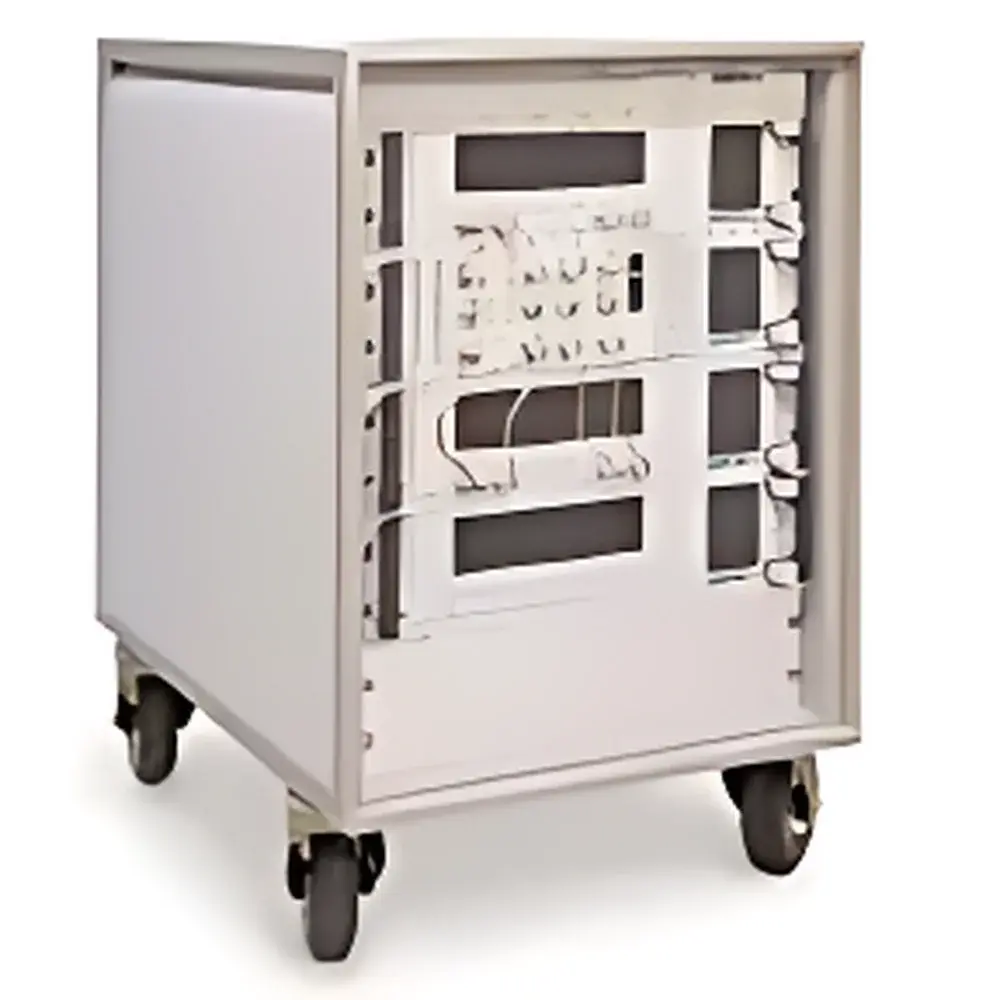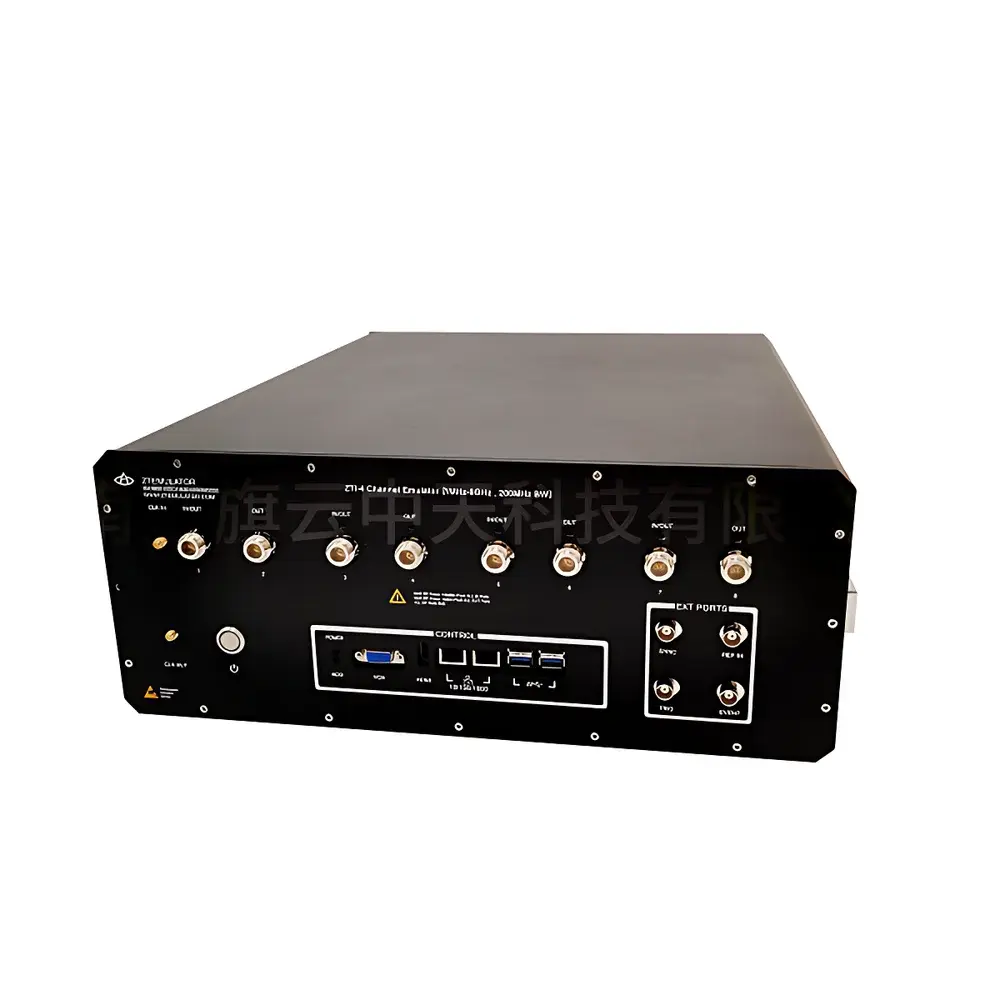
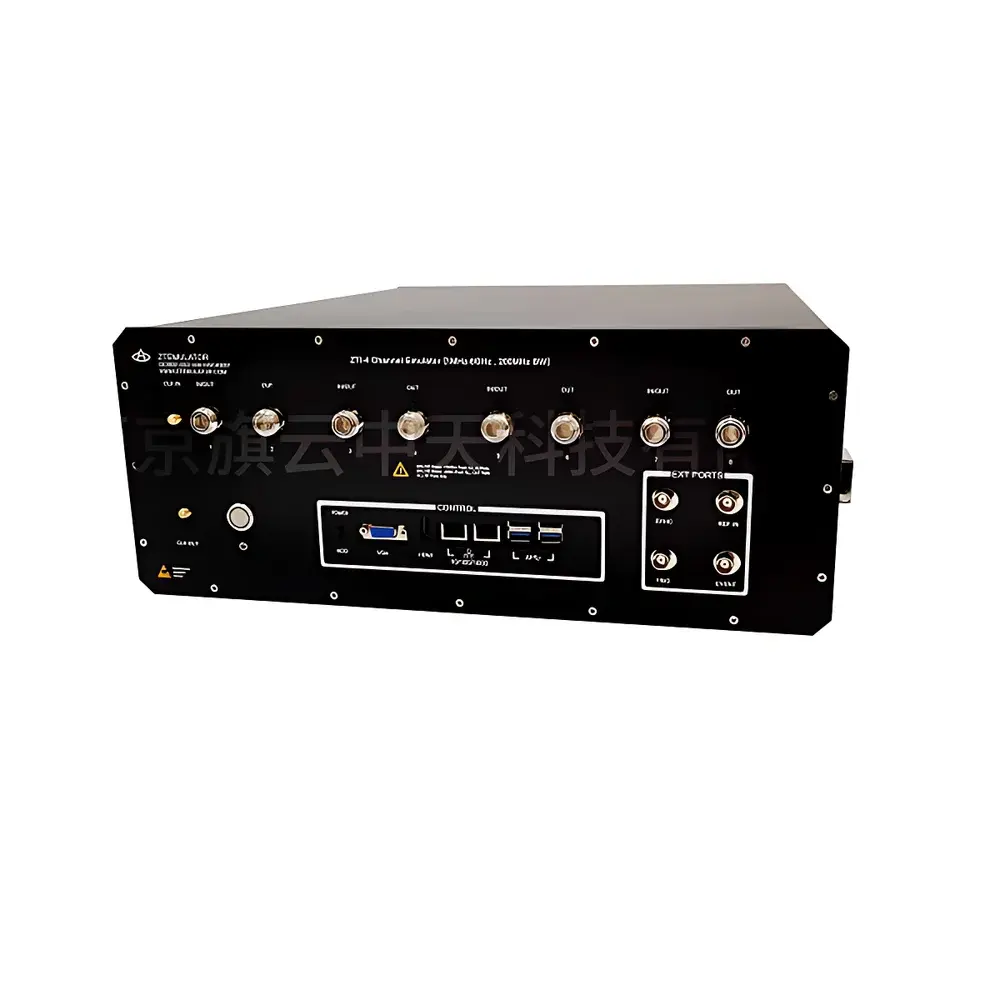
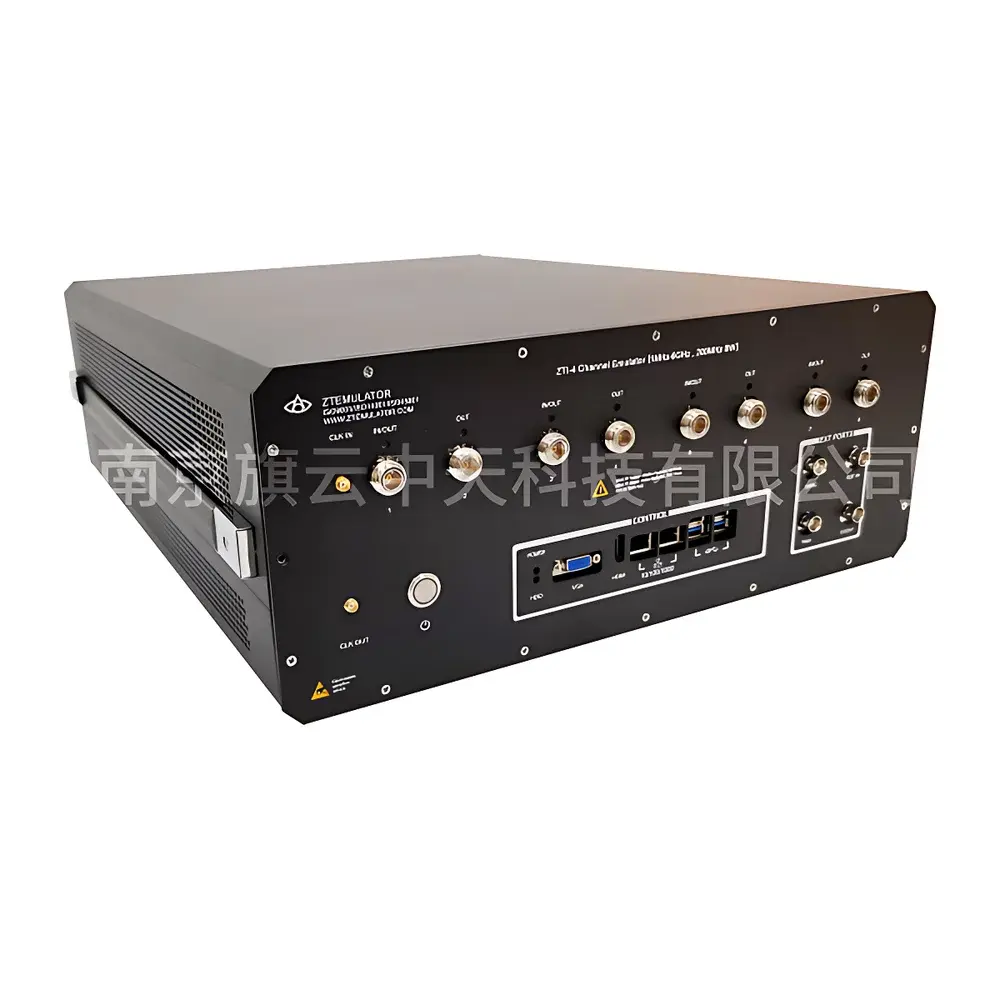
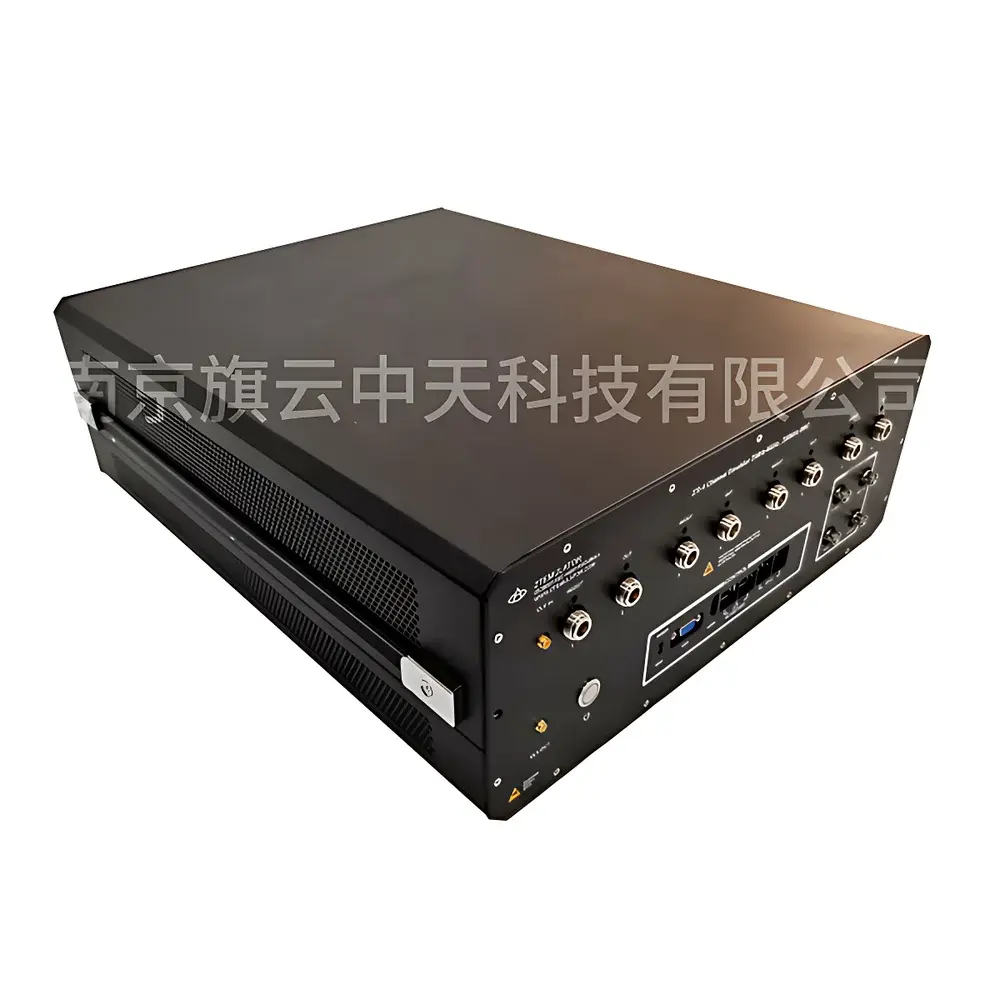
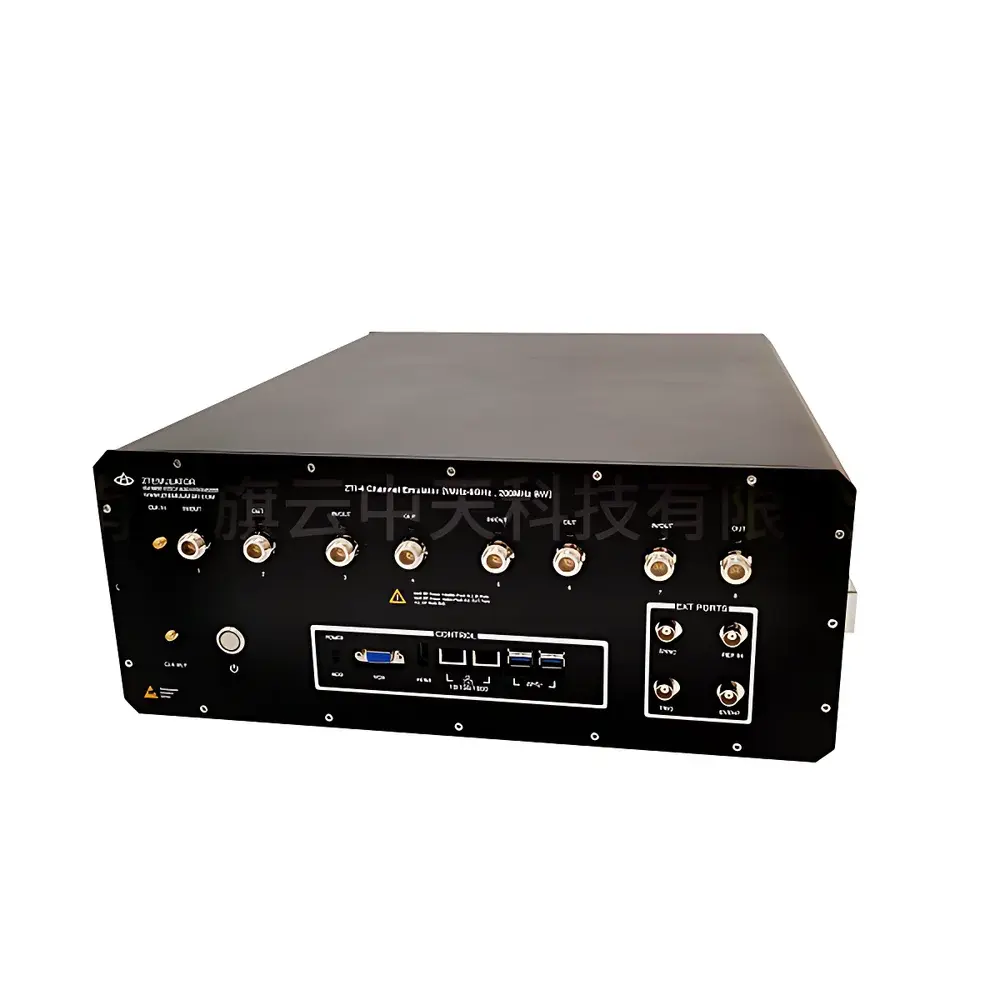
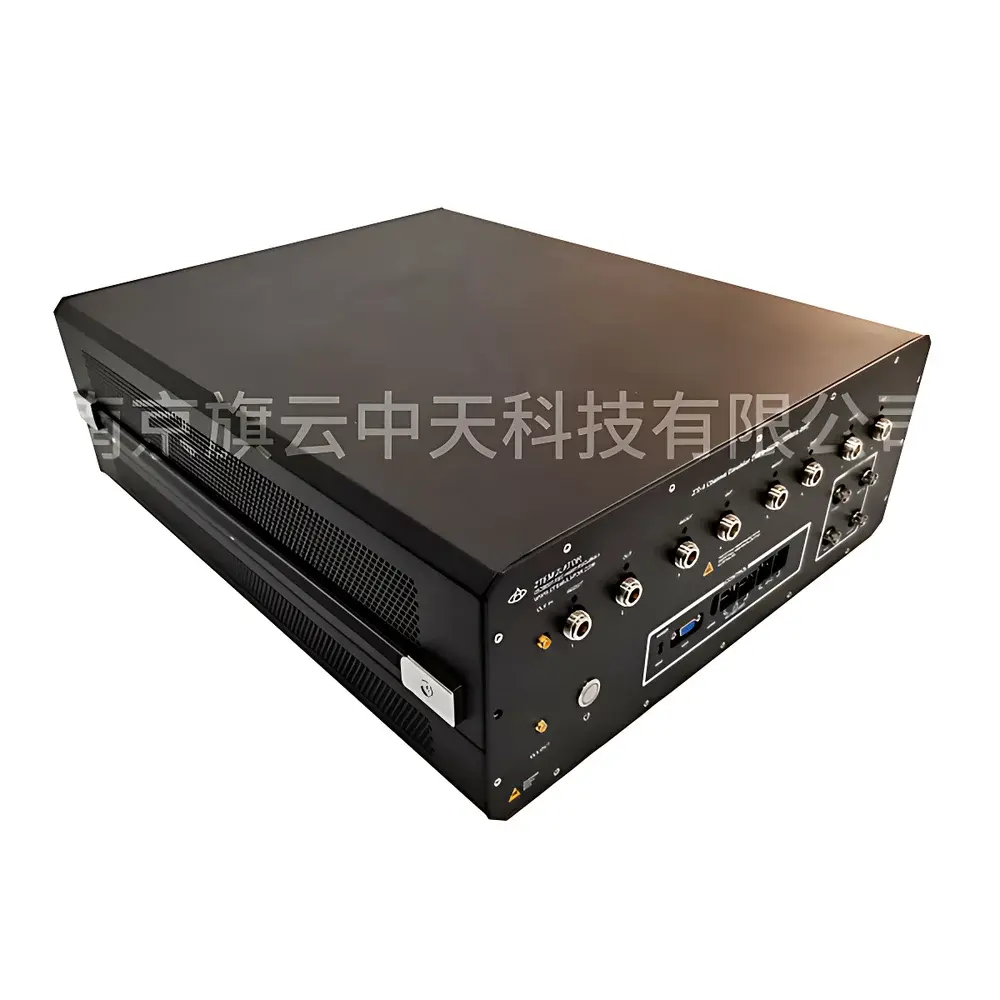
ZTWEATHER ZTI-32 Advanced Wireless Channel Emulator
| Brand | ZTWEATHER |
|---|---|
| Origin | Jiangsu, China |
| Manufacturer Type | Original Equipment Manufacturer (OEM) |
| Country of Origin | China |
| Model | ZTI-32 |
| Pricing | Upon Request |
| RF Frequency Range | 1 MHz – 6 GHz (40–44 GHz mmWave optional with adapter) |
| Signal Bandwidth | Up to 200 MHz |
| Max Fading Channels | 1024 (32×32 MIMO) |
| Max Delay Spread | 20 ms |
| Delay Resolution | 4.07 ns @ 200 MHz |
| Path Count per Channel | Up to 48 |
| Max Doppler Shift | ±5 MHz (2 Hz resolution step) |
| Fading Types | Rayleigh, Rice, Nakagami, Log-Normal, Suzuki, Jakes, Flat, Gaussian, Circular, Classical 3/6 dB, Constant, Pure Doppler, and User-Defined |
| Output Power Range | −120 dBm to −14 dBm |
| Output Level Accuracy | < ±2 dB |
| Channel Isolation | 110 dB |
| Local Clock Stability | < 0.05 ppm |
| Dimensions (W×H×D) | 600 × 850 × 600 mm |
| AC Power | 220 V, 50 Hz |
| MTBF | >5000 h |
| MTTR | <2 h |
| Management Interface | Ethernet + SCPI-compliant remote control |
Overview
The ZTWEATHER ZTI-32 Advanced Wireless Channel Emulator is a high-fidelity, multi-channel RF channel simulation platform engineered for rigorous over-the-air (OTA) interface validation in modern wireless communication systems. It implements real-time, deterministic digital baseband emulation combined with analog RF up/down-conversion to replicate complex propagation effects—including multipath delay spread, time-varying fading, Doppler spectral broadening, shadowing, and large-scale path loss—between transmitter and receiver under controlled laboratory conditions. Unlike simplified attenuator-based test setups, the ZTI-32 applies physically consistent channel impulse response (CIR) synthesis across all 32 bidirectional RF ports, enabling accurate characterization of MIMO spatial correlation, antenna array response, and beamforming performance in 5G NR, LTE-A Pro, satellite links, airborne telemetry, and high-mobility tactical networks. Its architecture supports both standardized and scenario-specific channel models defined by 3GPP TR 38.901, ITU-R M.2135, and proprietary aerospace profiles—making it suitable for pre-compliance verification, PHY-layer algorithm development, and system-level interoperability testing prior to field deployment.
Key Features
- 32 fully independent, bidirectional RF channels with 64 synthesized local oscillators—enabling true full-duplex MIMO emulation up to 32×32 configurations
- 1024 concurrent fading paths (32 channels × up to 48 paths each), with programmable relative delays up to 19 ms and sub-nanosecond timing resolution (4.07 ns at 200 MHz bandwidth)
- Comprehensive fading model library: Rayleigh, Rice, Nakagami-m, Log-Normal, Suzuki, Jakes, Gaussian, circular, flat, and user-defined custom profiles with real-time parameter modulation
- Standardized channel support: 3GPP 5G NR TDL/TDS/EPA/ETU, LTE PedA/B, VehA/B, 3GPP2 CDMA2000, ITU pedestrian/vehicular/hilly terrain, and aviation-specific models (e.g., fighter maneuvering, rotor-blade occlusion, hypersonic entry)
- High-dynamic-range signal generation: −120 dBm to −14 dBm output power with < ±2 dB amplitude accuracy and 110 dB inter-channel isolation
- Integrated precision timing subsystem: oven-controlled crystal oscillator (OCXO) with < 0.05 ppm long-term stability, synchronized across all channels for coherent multi-antenna testing
- SCPI-compliant remote control via Ethernet interface; compatible with MATLAB, Python (PyVISA), LabVIEW, and automated test executive frameworks
Sample Compatibility & Compliance
The ZTI-32 supports seamless integration into regulated R&D and production environments requiring traceable, auditable test procedures. It complies with electromagnetic compatibility (EMC) standards IEC 61000-4 series and safety requirements per GB 4943.1–2022 (equivalent to IEC 62368-1). While not certified as medical or avionics-grade hardware, its deterministic channel modeling engine aligns with functional verification methodologies referenced in 3GPP TS 38.141-1 (Base Station Conformance), TS 36.141 (LTE BS conformance), and ETSI EN 301 908 (IMT systems). The device supports GLP/GMP-aligned logging through timestamped configuration snapshots and binary CIR export—facilitating audit-ready documentation for internal QA or third-party certification bodies. All channel parameter sets can be version-controlled and exported in JSON or XML format for cross-platform reproducibility.
Software & Data Management
ZTI-32 operates with ZTWEATHER’s ChannelStudio™ GUI and command-line SDK, providing hierarchical configuration management for channel topologies (SISO/MISO/SIMO/MIMO), fading parameter assignment, and real-time waveform injection control. The software enables batch loading of 3GPP TR 38.901-compliant channel files, manual editing of delay-power profiles, and dynamic switching between static and time-variant scenarios during active test sessions. Raw channel impulse responses and demodulated metrics (EVM, throughput, BLER) are logged in HDF5 format with embedded metadata (timestamp, seed value, configuration hash) to ensure data integrity. Remote orchestration via SCPI allows integration into CI/CD pipelines for regression testing of modem firmware revisions. Audit trails—including user login history, parameter change logs, and firmware version stamps—are retained for ≥90 days and exportable for regulatory review.
Applications
- 5G NR and 6G physical layer (PHY) validation: beam sweep analysis, CSI feedback accuracy assessment, and massive MIMO precoding robustness under mobility-induced Doppler spread
- Satellite-to-ground link emulation: LEO/MEO orbital dynamics, ionospheric scintillation, and rain fade modeling for Ka-band and Q/V-band terminals
- Aerospace telemetry systems: high-G maneuver simulation (e.g., missile guidance loop testing), rotorcraft multipath interference, and UAV swarm coordination under non-stationary channel conditions
- High-speed rail communications: handover latency measurement, cell-edge SINR degradation analysis, and adaptive modulation resilience in Doppler-intensive environments
- Defense electronic warfare (EW) evaluation: jammer-to-target channel fidelity, radar cross-section (RCS) correlated fading, and cognitive radio environment adaptation testing
- Academic research: reproducible channel dataset generation for deep learning-based channel estimation and reinforcement learning-based resource allocation algorithms
FAQ
What frequency bands does the ZTI-32 support natively?
The base configuration covers 1 MHz to 6 GHz. Millimeter-wave operation from 40–44 GHz is available via optional external frequency conversion modules.
Can the ZTI-32 emulate time-varying channels with realistic Doppler spectra?
Yes—it supports configurable Doppler shift up to ±5 MHz with 2 Hz resolution, including Jakes, Gaussian, and user-defined spectral shapes aligned with 3GPP TR 38.901 Annex B.
Is the device compliant with FDA 21 CFR Part 11 or similar electronic record regulations?
While not formally validated for Part 11, its audit-trail logging, electronic signature-capable user authentication, and immutable configuration export meet foundational ALCOA+ principles for regulated lab use.
How is synchronization maintained across all 32 RF channels?
A master OCXO distributes phase-coherent clock signals to all channel processing units, ensuring sub-picosecond jitter and deterministic inter-channel timing alignment.
Does ZTWEATHER provide application-specific channel model templates?
Yes—preloaded profiles include 3GPP 5G NR TDL, ITU-R M.2135 urban microcell, aviation maneuvering models, and high-speed train corridor scenarios, all editable and extensible via ChannelStudio™.