
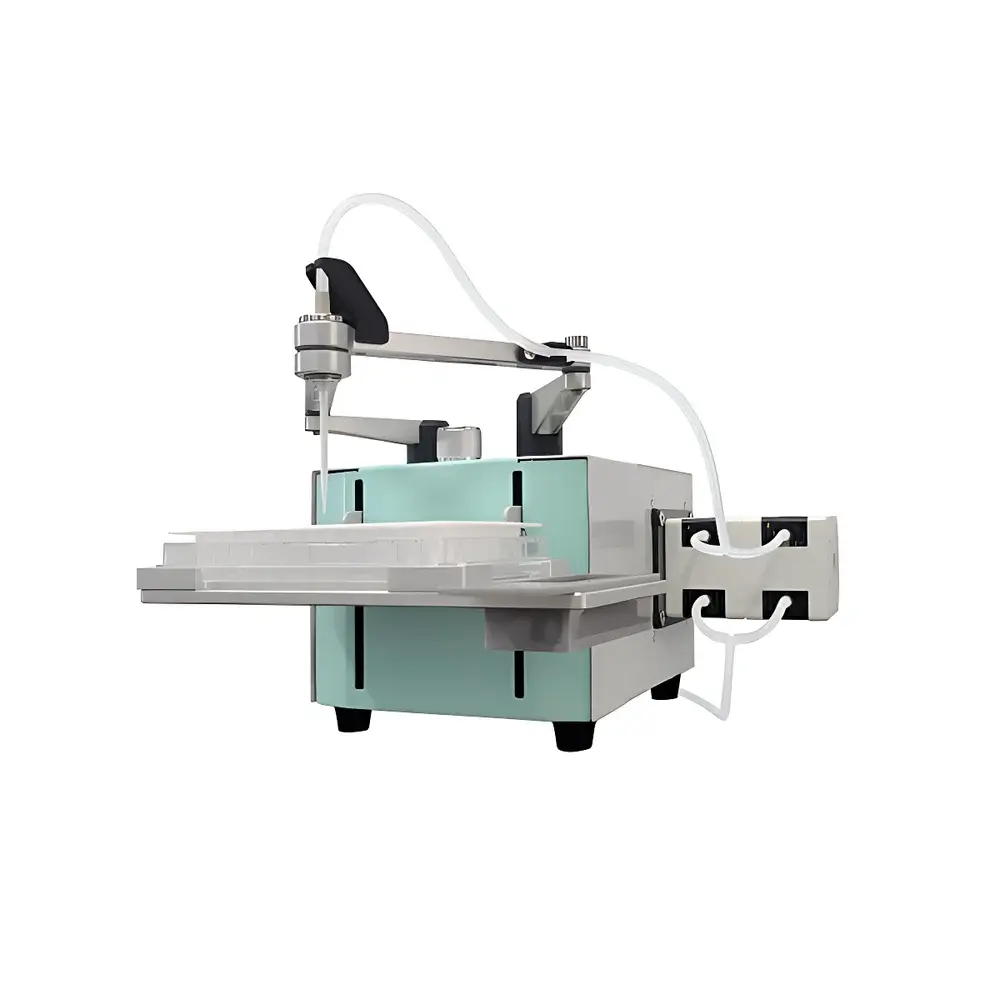
Zuofei Bifang Automated Single-Channel Microplate Dispenser
| Brand | Zuofei |
|---|---|
| Origin | Shanghai, China |
| Manufacturer Type | Direct Manufacturer |
| Region of Origin | Domestic (China) |
| Model | Bifang |
| Instrument Type | Automated |
| Dispensing Range | 10 µL – 9999 µL |
| Dispensing Accuracy | ±1% @ 100 µL |
| Dispensing Precision | 2% CV @ 100 µL |
| Sample Throughput | Compatible with one standard SBS-format microplate footprint |
| Dispensing Method | Single-channel |
| Dispensing Principle | Peristaltic Pump |
| Plate Height Adjustment | Manual |
| Dispensing Speed | 250 µL/sec |
| Operating Temperature | 5–35 °C |
| Input Voltage | 100–240 V, 50–60 Hz |
| Dimensions (L×W×H) | 290 × 245 × 300 mm |
| Net Weight | 4 kg |
Overview
The Zuofei Bifang Automated Single-Channel Microplate Dispenser is an engineered solution for precise, repeatable liquid handling in regulated and research-intensive life science laboratories. Built upon a peristaltic pump-based fluid delivery architecture, the system delivers volumetric accuracy and operational robustness across diverse biological and diagnostic workflows. Unlike positive-displacement or air-displacement systems, peristaltic pumping ensures complete isolation between drive mechanism and fluid path—eliminating cross-contamination risk and enabling safe handling of viscous, foaming, or particulate-laden reagents including cell suspensions, magnetic beads, and nutrient-rich culture media. Its compact footprint (290 × 245 × 300 mm) and 4 kg net weight allow seamless integration into biosafety cabinets, laminar flow hoods, or crowded benchtop environments without compromising accessibility or serviceability.
Key Features
- Peristaltic pump core with field-replaceable, autoclavable or chemically sterilizable tubing—supports rapid tube swap and validated decontamination protocols per ISO 13485 and GLP-compliant lab practices.
- SCARA (Selective Compliance Assembly Robot Arm) motion architecture enables precise X-Y-Z positioning over standard SBS-format plates (24-, 48-, 96-, and 384-well), with manual Z-axis height adjustment to accommodate variable plate heights and custom labware.
- Android-based embedded HMI with intuitive graphical interface—supports protocol creation, parameter validation, and real-time status monitoring without external PC dependency.
- User-definable consumables mapping allows calibration and tip/plate recognition for non-standard reservoirs, deep-well blocks, and specialty assay plates—extending utility beyond conventional microplate formats.
- Modular design permits future integration of alternative dispensing modules, including syringe-driven piston pumps and low-volume microfluidic dispensers—ensuring long-term adaptability to evolving assay requirements.
- Firmware-upgradable architecture supports remote OTA (Over-The-Air) updates, ensuring continued compliance with evolving data integrity standards such as FDA 21 CFR Part 11 Annex 11 audit trail requirements.
Sample Compatibility & Compliance
The Bifang dispenser accommodates a broad spectrum of liquid types: aqueous buffers, glycerol-containing reagents, serum-supplemented media, cell suspensions (including primary and adherent-derived cells), and bead-based reagents (e.g., streptavidin-coated magnetic particles). All wetted components are constructed from USP Class VI-certified materials, and tubing meets ISO 10993 biocompatibility criteria. The system operates within ambient temperature ranges compliant with CLSI EP15-A3 and ISO 8655-7 verification guidelines for volumetric performance. While not pre-certified to IEC 61010-1, its electrical safety design conforms to universal AC input specifications (100–240 V, 50–60 Hz) and includes internal overcurrent and thermal protection circuits.
Software & Data Management
The onboard Android OS hosts a dedicated dispensing application supporting protocol import/export via USB or network share, timestamped run logs, and user-level access control (admin/operator roles). All dispensing events—including volume setpoints, actual dispensed volumes (where calibrated), plate IDs, operator login, and error codes—are recorded with immutable timestamps. Audit trails meet ALCOA+ principles (Attributable, Legible, Contemporaneous, Original, Accurate, Complete, Consistent, Enduring, Available) and can be exported in CSV or PDF format for regulatory submission. Optional cloud synchronization enables centralized fleet management across multi-site laboratory networks.
Applications
- High-throughput screening (HTS) assay setup requiring consistent reagent addition across 96- or 384-well plates.
- Diagnostic sample preparation in public health labs—including PCR master mix dispensing for infectious disease surveillance (e.g., influenza, SARS-CoV-2, foodborne pathogens).
- Veterinary and agricultural testing—antibiotic residue quantification, ELISA kit reconstitution, and vaccine titer dilution series.
- Cell-based assay development—media replenishment, transfection reagent distribution, and co-culture setup with minimal shear stress.
- Quality control in biomanufacturing—buffer exchange validation, QC standard dilution, and stability study sample preparation under GMP-aligned conditions.
FAQ
What is the minimum and maximum dispensing volume supported by the Bifang system?
The system is validated for accurate dispensing from 10 µL to 9999 µL per aspiration/dispense cycle.
Does the instrument support traceable calibration and verification?
Yes—users may perform gravimetric verification per ISO 8655-7 using certified weights and analytical balances; calibration curves and verification reports are stored locally and exportable.
Can the Bifang dispense into non-SBS plates or custom labware?
Yes—through user-defined plate maps and adjustable Z-height, it supports deep-well plates, PCR strips, vial racks, and other non-standard containers with appropriate mounting fixtures.
Is the peristaltic tubing compatible with common sterilization methods?
Tubing is rated for repeated autoclaving (121°C, 15 psi, 20 min) and compatible with 70% ethanol, 0.5% sodium hypochlorite, and hydrogen peroxide vapor decontamination cycles.
How is data integrity ensured during routine operation?
All user actions, dispensing events, and system errors generate time-stamped, non-erasable entries in a local database; export files include digital signatures and hash verification metadata.
Related Products




