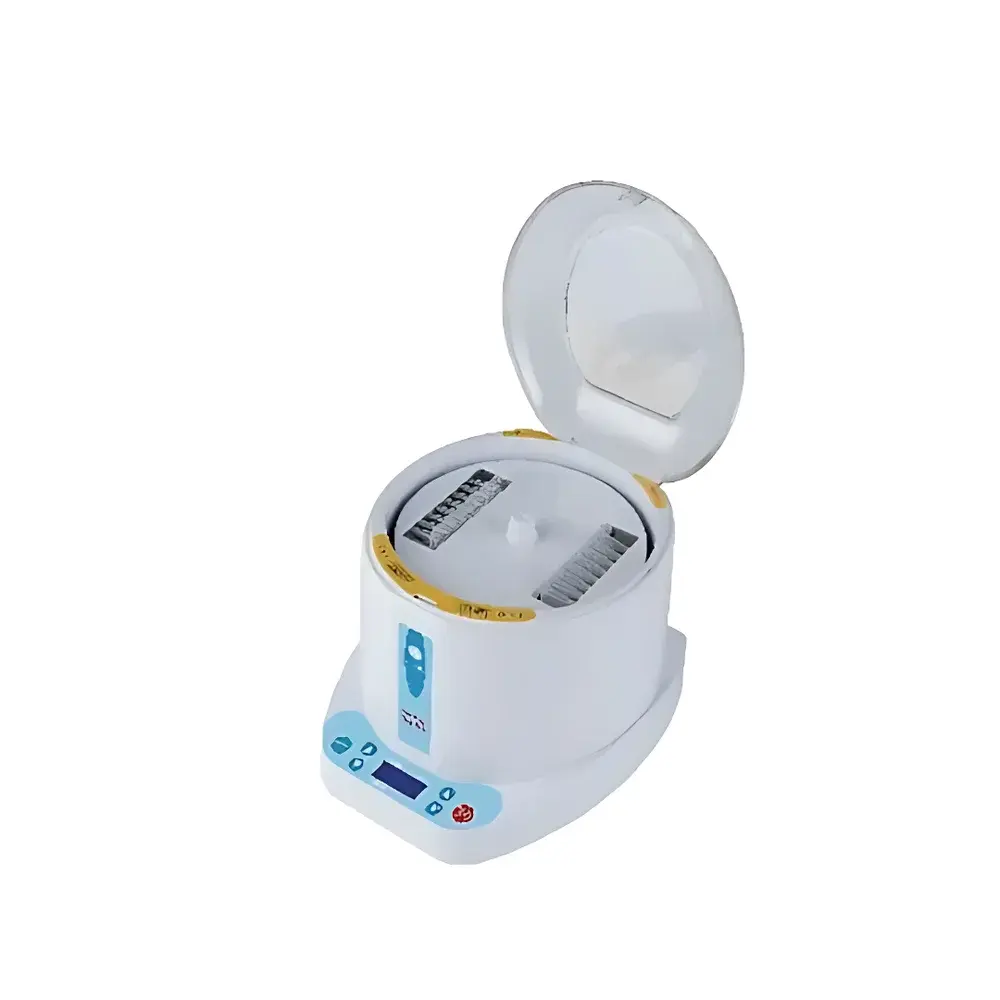
Zuofei LX-B Mini Microplate Centrifuge
| Brand | Zuofei |
|---|---|
| Origin | Shanghai, China |
| Manufacturer Type | Direct Manufacturer |
| Regional Classification | Domestic (China) |
| Model | LX-B |
| Instrument Type | Palm-Sized Microplate Centrifuge |
| Function | General-Purpose Microplate Centrifuge |
| Max RCF | 600 × g |
| Speed Range | 500–3000 rpm |
| Sample Capacity | 2 × 96-well PCR or ELISA plates |
| Acceleration/Deceleration Timing | 1 s–99 s or 1 min–99 min |
Overview
The Zuofei LX-B Mini Microplate Centrifuge is a compact, benchtop centrifugal instrument engineered specifically for rapid, low-force pelleting of liquid samples in standard microplates and PCR tubes. It operates on the principle of radial acceleration to overcome surface tension and gravitational resistance, enabling efficient collection of condensate or residual droplets along well walls—commonly referred to as “spin-down” prior to thermal cycling, detection, or aspiration steps. Designed for integration into high-throughput molecular biology workflows—including qPCR setup, ELISA plate preparation, and NGS library normalization—the LX-B delivers precise, repeatable centrifugation at RCF values up to 600 × g, with speed control spanning 500–3000 rpm. Its footprint (230 × 195 × 195 mm) and weight (2.6 kg) support placement directly beside biosafety cabinets, thermal cyclers, or automated liquid handlers without spatial compromise.
Key Features
- Optimized microplate insertion: Top-loading vertical slot accommodates 96-well and 384-well plates (PCR or ELISA format) without adapter plates; capillary retention ensures no leakage during loading or operation.
- Three operational modes: Pulse (instant-on/off), time-controlled (1 s–99 s or 1 min–99 min), and speed-controlled (user-defined rpm within 500–3000 range).
- Real-time parameter adjustment: LCD display enables modification of speed, duration, or mode during active rotation—critical for iterative protocol optimization.
- Brushless DC motor architecture: Eliminates carbon brush wear, reduces electromagnetic interference, and ensures stable torque delivery across the full speed range with acoustic output <45 dB(A) at 1 m distance.
- Rapid dynamic response: Achieves target speed in <1.5 s (at 3000 rpm) and halts within 2 s via regenerative braking—minimizing thermal load and preserving sample integrity.
Sample Compatibility & Compliance
The LX-B supports standardized microformats used across regulated and academic laboratories: ANSI/SBS-compliant 96-well and 384-well PCR plates (full-skirted, semi-skirted, and unskirted), flat-bottom and U/V-bottom ELISA plates, 8-tube PCR strips (0.2 mL), and individual 0.2 mL PCR tubes. All rotor interfaces are chemically resistant to common laboratory solvents (e.g., 70% ethanol, isopropanol, dilute sodium hypochlorite). While not certified for IVD or clinical diagnostic use, the device conforms to IEC 61010-1:2010 (Safety Requirements for Electrical Equipment for Measurement, Control, and Laboratory Use) and meets EMC compliance per CISPR 11 Group 1, Class B. Its design supports GLP-aligned documentation practices through traceable parameter logging (via optional USB data export firmware upgrade).
Software & Data Management
The LX-B operates as a standalone instrument with embedded firmware—no host PC or proprietary software required. All user inputs and runtime events (start time, final speed, elapsed duration, pulse count) are stored in non-volatile memory for up to 500 cycles. Optional firmware version v2.1+ enables USB-C connectivity for CSV-formatted session logs compliant with 21 CFR Part 11 audit trail requirements (user ID tagging, timestamping, immutable record generation). No cloud synchronization or remote access functionality is implemented—ensuring full data sovereignty and alignment with institutional cybersecurity policies.
Applications
- Pre-amplification spin-down of qRT-PCR master mixes to eliminate air bubbles and ensure uniform well distribution.
- Post-wash centrifugation of ELISA plates to remove residual buffer before substrate addition—reducing background noise and improving signal-to-noise ratio.
- Routine consolidation of lysates or supernatants from high-density cell culture plates prior to downstream analysis (e.g., cytokine profiling, metabolite quantification).
- Low-g conditioning of cryopreserved cell suspensions in 96-well formats to re-suspend pellets without shear-induced membrane damage.
- Quality control verification of pipetting accuracy by centrifuging dye-labeled standards and measuring post-spin volume consistency across wells.
FAQ
What microplate standards does the LX-B accept?
The instrument accepts ANSI/SBS-1-2004–compliant 96-well and 384-well plates (PCR and ELISA), including full-, semi-, and unskirted variants, as well as 8-tube PCR strips and single 0.2 mL tubes.
Is the LX-B suitable for use with volatile organic solvents?
The housing and plate chamber materials are compatible with aqueous buffers, 70% ethanol, and ≤10% isopropanol solutions; prolonged exposure to chloroform, DMSO >20%, or acetone is not recommended.
Does the LX-B support regulatory-compliant data archiving?
With firmware v2.1+, USB-exported logs include ISO 8601 timestamps, operator IDs, and immutable cycle metadata—satisfying baseline requirements for GLP/GMP audit readiness.
Can the LX-B be integrated into automated workstations?
No native robotic interface (e.g., RS-232, TTL, or Ethernet) is provided; however, its compact form factor and silent operation allow co-location with third-party deck-mounted automation systems.
What maintenance is required for long-term reliability?
Zero scheduled maintenance: The brushless DC motor contains no consumable parts; periodic cleaning of the chamber with lint-free wipes and 70% ethanol is sufficient for routine upkeep.