
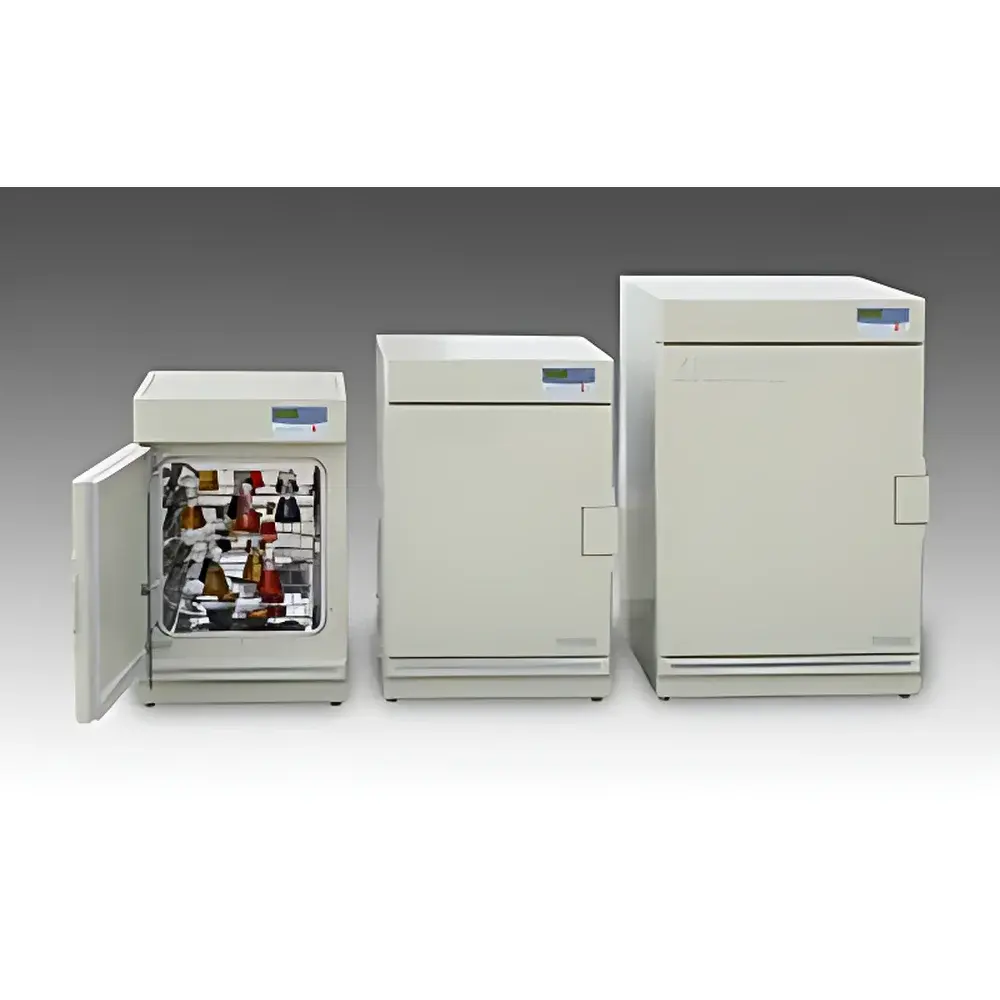
ZWF-331B Single-Layer Reciprocating Orbital Shaker
| Origin | Shanghai |
|---|---|
| Manufacturer Type | Authorized Distributor |
| Origin Category | Domestic (China) |
| Model | ZWF-331B |
| Pricing | Available Upon Request |
| Control Method | PID Microprocessor-Based Environmental Scan Controller |
| Display | Backlit LCD Screen |
| Air Circulation | Natural Convection |
| Oscillation Mode | Reciprocating Orbital |
| Drive Mechanism | Track-Driven |
| Ambient Temperature Range | 5–50 °C |
| Speed Range | 30–300 rpm |
| Speed Accuracy | ±1 rpm |
| Orbit Diameter Adjustment | 0–50 mm (Continuously Variable) |
| Timer Range | 0–500 h |
| Features | Auto Stop/Restart, Monitoring Timer, Parameter Memory & Encryption, Power-Failure Recovery |
| Platform Dimensions | 800 × 600 mm |
| Platform Quantity | 1 |
| Net Weight | 290 kg |
| Gross Weight | 340 kg |
| External Dimensions (W×D×H) | 900 × 640 × 540 mm |
| Packing Dimensions (W×D×H) | 1020 × 760 × 710 mm |
| Power Consumption | 400 W |
| Electrical Supply | AC 220 V, 50/60 Hz |
Overview
The ZWF-331B Single-Layer Reciprocating Orbital Shaker is an open-platform laboratory shaker engineered for high-throughput, temperature-stable incubation environments where uniform, low-shear mixing of biological and biochemical samples is required. Unlike centrifugal or rotary shakers, the ZWF-331B employs a precisely controlled reciprocating orbital motion—generated via a robust track-driven mechanism—to induce gentle yet effective suspension and aeration of cultures in flasks, bottles, and multi-well plates. Its design prioritizes mechanical stability, operational continuity, and long-term reliability under continuous duty cycles typical in fermentation labs, QC microbiology suites, and upstream bioprocess development workflows. The unit operates without forced air circulation; instead, it relies on natural convection within a shared ambient-controlled chamber (e.g., an incubator room or climate-stabilized lab space), making it ideal for clustered deployment where multiple units operate synchronously under identical environmental conditions.
Key Features
- PID-based microprocessor controller with real-time environmental scanning ensures stable speed regulation across the full 30–300 rpm range, with ±1 rpm repeatability—critical for reproducible cell growth kinetics and metabolic profiling.
- Large backlit LCD display presents setpoints and real-time values for speed, time, and system status, supporting rapid visual verification during GLP-compliant documentation procedures.
- Parameter encryption function prevents unauthorized modification of critical operating conditions—a requirement for audit-ready workflows under ISO 17025, USP , or FDA 21 CFR Part 11–aligned environments.
- Integrated power-failure recovery logic restores pre-interruption settings automatically upon grid restoration, eliminating manual reconfiguration and minimizing process deviation risk.
- Soft-start acceleration profile mitigates mechanical shock to culture vessels and sensitive biological matrices—particularly important when handling fragile suspension cells or low-volume inocula.
- Structural integrity is ensured by precision-machined cast iron and die-cast aluminum components, including the load-bearing base frame and drive assembly, delivering vibration-damped operation even at maximum orbit amplitude (Φ50 mm).
- Single-tier platform (800 × 600 mm) accommodates standard Erlenmeyer flasks (up to 5 L), stacked bottle racks, or modular tray systems—optimized for scalability in pilot-scale microbial cultivation and enzyme assay setups.
Sample Compatibility & Compliance
The ZWF-331B supports a broad range of sample containers—from 50 mL centrifuge tubes to 5 L baffled flasks—without requiring adapter kits. Its reciprocating orbital motion generates consistent shear profiles suitable for aerobic bacterial and yeast cultivations (e.g., E. coli, S. cerevisiae), mammalian suspension cell lines, and enzymatic reaction mixtures where oxygen transfer efficiency and homogeneity are paramount. The device complies with IEC 61010-1:2010 safety standards for laboratory equipment and meets electromagnetic compatibility (EMC) requirements per EN 61326-1. While not an enclosed incubator, its natural-convection design aligns with ASTM E1788-21 guidelines for non-climate-controlled shaker validation protocols. For regulated environments, optional calibration certificates traceable to NIST standards can be provided for speed and timer performance verification.
Software & Data Management
The ZWF-331B operates as a standalone instrument with embedded firmware—no external PC connection or proprietary software is required for basic operation. However, its parameter memory and encrypted configuration storage support seamless integration into centralized lab management systems via RS-232 or optional RS-485 interfaces (available upon request). All runtime logs—including start/stop timestamps, speed deviations, and alarm events—are retained in non-volatile memory for post-run review. When deployed in GMP-aligned facilities, the device’s auto-stop-on-timer-completion and power-recovery functions contribute to ALCOA+ data integrity principles by ensuring unambiguous event attribution and preventing undocumented manual intervention.
Applications
- Microbial fermentation process development and scale-down modeling in pharmaceutical biomanufacturing
- Aerobic cultivation of recombinant protein-expressing strains under defined DO-sensitive conditions
- Preparation of standardized inocula for antimicrobial susceptibility testing (AST) per CLSI M07-A11
- Enzyme kinetic assays requiring uniform mixing without foaming or shear-induced denaturation
- Cell lysis optimization studies using chemical or detergent-based methods
- Environmental microbiology applications, including wastewater treatment consortium enrichment and bioremediation screening
- Academic research in molecular biology labs conducting plasmid propagation, phage amplification, or hybridoma culture
FAQ
Is the ZWF-331B suitable for use inside a CO₂ incubator?
No—it is designed for ambient-temperature environments only and lacks sealed construction or gas-tight enclosures required for CO₂ or humidified incubation.
Can the orbit diameter be calibrated or verified independently?
Yes; users may perform mechanical verification using a certified dial indicator or laser displacement sensor aligned with the platform center—recommended annually or after transport-related impact.
Does the unit support external triggering or analog signal output?
Standard configuration includes no analog I/O; however, optional digital interface modules (RS-485 Modbus RTU) enable remote monitoring and PLC integration.
What maintenance is required beyond routine cleaning?
None—the brushless AC induction motor requires zero scheduled lubrication or carbon brush replacement over its rated service life (>20,000 hours).
How is compliance with 21 CFR Part 11 addressed for electronic records?
While the ZWF-331B itself does not generate electronic records, its parameter encryption, audit-trail-capable timer log, and deterministic restart behavior support predicate rule implementation when paired with validated third-party data acquisition systems.




