
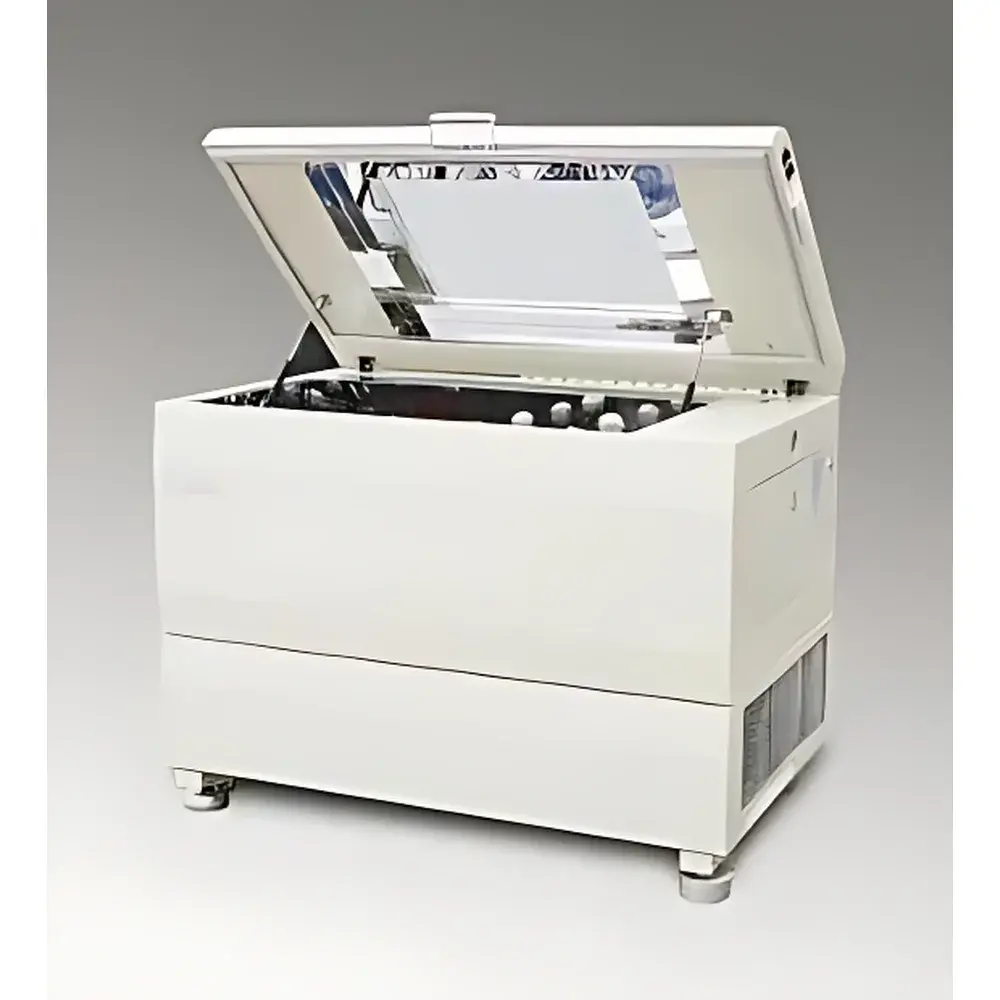
ZWF-C211 Horizontal Reciprocating Programmable Temperature- and Humidity-Controlled Shaker
| Origin | Shanghai, China |
|---|---|
| Manufacturer Type | Authorized Distributor |
| Origin Category | Domestic (China) |
| Model | ZWF-C211 |
| Pricing | Available Upon Request |
| Control Method | PID Microprocessor with Environmental Scanning Chip |
| Display | Backlit LCD |
| Air Circulation | Forced Convection |
| Oscillation Mode | Reciprocating |
| Drive Mechanism | Orbital Track Drive |
| Door Operation | Manual |
| Ambient Temp. Range | 5–35 °C |
| Temp. Control Range | 4–60 °C |
| Temp. Resolution | 0.1 °C |
| Temp. Stability | ≤±0.5 °C (at 37 °C) |
| Temp. Uniformity | ≤±1 °C (at 37 °C) |
| Humidity Control Range | 45–90 %RH |
| Humidity Resolution | 0.1 %RH |
| Humidity Stability | ≤±2 %RH |
| Humidity Uniformity | ≤5 %RH |
| Speed Range | 30–240 rpm |
| Speed Accuracy | ±1 rpm |
| Programmability | 6 segments × 12 steps per segment |
| Max. Segment Duration | 100 h |
| Platform Amplitude | Φ0–50 mm (infinitely adjustable) |
| Chamber Volume | 285 L |
| Internal Dimensions (W×D×H) | 1005×610×465 mm |
| Platform Size | 970×480 mm |
| Net Weight | 275 kg |
| External Dimensions (W×D×H) | 1260×830×1010 mm |
| Power Supply | AC 220 V, 50/60 Hz |
| Rated Power | 1380 W |
| Cooling System | Air-cooled, R134a refrigerant, frost-free, power-regulated compression |
| Humidification System | Integrated micro-humidifier with patented design |
| Safety Systems | Dual independent overtemperature cut-offs (adjustable & fixed), over-speed detection, low-water-level sensing with auto-refill & alarm, power-failure alarm, sensor fault detection, humidity limit alarms, earth-leakage protection, circuit breaker, compressor overload protection |
| Auxiliary Functions | Auto-restart after power recovery, scheduled start/stop, real-time monitoring timer, parameter encryption & memory, temperature/humidity calibration offset adjustment, RS-232 serial interface, embedded thermal micro-printer |
Overview
The ZWF-C211 Horizontal Reciprocating Programmable Temperature- and Humidity-Controlled Shaker is an engineered platform for precise, reproducible cultivation and incubation of biological samples under dynamically controlled environmental conditions. Designed for rigorous life science laboratories, it integrates reciprocating oscillation mechanics with high-fidelity PID-controlled thermal and hygrometric regulation—enabling simultaneous control of temperature (4–60 °C), relative humidity (45–90 %RH), and orbital speed (30–240 rpm) within a single-chamber, single-tier configuration. Its forced-convection airflow architecture ensures uniform heat and moisture distribution across the 285 L chamber volume, while the reciprocating motion—driven by a brushless AC induction motor—delivers consistent shear profiles essential for suspension cultures, microbial fermentation, and hybridization kinetics. The system’s microprocessor core continuously scans ambient and internal sensor inputs to adjust heating, cooling, humidification, and drive output in real time, minimizing thermal lag and humidity drift. This architecture supports GLP-compliant workflows where traceability, repeatability, and environmental fidelity are critical—particularly in cell line expansion, recombinant protein expression, and stability-indicating assay development.
Key Features
- Reciprocating oscillation with infinitely adjustable amplitude (Φ0–50 mm) and speed precision (±1 rpm), optimized for shear-sensitive mammalian or insect cell cultures.
- Integrated dual-mode climate control: Peltier-assisted air-cooled refrigeration (R134a, frost-free) paired with a patented built-in micro-humidifier delivering stable RH regulation (±2 %RH) across the full 45–90 %RH range.
- Six-segment, twelve-step programmable logic supporting complex multi-phase protocols—including temperature ramping, humidity stepping, speed cycling, and timed hold stages—each configurable up to 100 hours.
- Comprehensive safety architecture: triple-redundant overtemperature protection (fixed cutoff, adjustable limiter, and independent overheat preventer), earth-leakage circuit interruption, compressor overload monitoring, and real-time water-level sensing with auto-refill and audible/visual alerting.
- Brushless AC induction motor with constant-torque output across the full speed range; zero carbon wear, no routine maintenance, and silent operation at low frequencies.
- Backlit LCD interface with simultaneous display of setpoints and real-time values for temperature, humidity, speed, elapsed time, and alarm status; all parameters stored in non-volatile memory with password-protected access.
- Structural integrity: electrostatically powder-coated steel chassis, electropolished stainless-steel interior chamber and platform, tempered glass observation window, and corrosion-resistant spring-loaded flask clamps.
Sample Compatibility & Compliance
The ZWF-C211 accommodates standard microbiological and molecular biology vessels—including Erlenmeyer flasks (up to 5 L), baffled culture bottles, multi-well plates (via optional adapters), and custom bioreactor sleeves—on its 970 × 480 mm stainless-steel platform. Its 285 L working volume supports high-density parallel experiments without compromising airflow uniformity (≤±1 °C / ≤5 %RH deviation at 37 °C/60 %RH). The system complies with IEC 61000-6-3 (EMC emissions) and IEC 61010-1 (safety requirements for laboratory equipment). Its embedded RS-232 interface enables integration into centralized lab management systems and supports audit-trail-capable data logging when paired with compliant third-party software—facilitating alignment with FDA 21 CFR Part 11 principles for electronic records and signatures. All safety interlocks and alarm events are timestamped and retainable for regulatory review.
Software & Data Management
While the ZWF-C211 operates autonomously via its onboard microcontroller, its RS-232 port allows bidirectional communication with external PCs running validated data acquisition software. Real-time telemetry—including temperature, humidity, speed, and alarm flags—is streamable at user-defined intervals (1–60 s resolution). The integrated thermal micro-printer provides immediate hardcopy output of protocol headers, setpoint logs, and event-triggered alerts (e.g., low water, overtemp, power loss), satisfying paper-trail requirements for ISO 17025-accredited testing labs. Parameter encryption prevents unauthorized modification; all settings—including calibration offsets for temperature and humidity sensors—are retained through power cycles and support factory-reset recovery. Firmware updates are performed via serial interface using signed binaries, ensuring version control and integrity verification.
Applications
The ZWF-C211 serves as a foundational instrument in academic research, pharmaceutical process development, and quality control laboratories. It is routinely deployed in: aerobic bacterial culture (E. coli, Bacillus spp.) under defined O2/humidity regimes; fungal fermentation requiring prolonged high-RH exposure; hybridization kinetics for DNA microarray preparation; enzymatic reaction profiling across thermal gradients; and long-term stability studies of biologics in liquid formulation. Its programmable humidity ramping capability enables simulation of diurnal moisture cycles in environmental microbiology, while its precise speed control supports rheological assessment of biofilm formation in flow-cell analogues. In QC environments, it supports USP sterility test incubation under humidified conditions and EP 2.6.27 microbial enumeration validation protocols.
FAQ
Does the ZWF-C211 support CO₂ control?
No—the ZWF-C211 is configured exclusively for temperature and humidity regulation. For applications requiring CO₂ supplementation, refer to the ZW-D series variant.
Is the humidification system self-draining or requires manual descaling?
The integrated micro-humidifier uses demineralized water and features an anti-scale ceramic element; no periodic descaling is required under normal operation with recommended water quality (conductivity <5 µS/cm).
Can multiple ZWF-C211 units be synchronized for parallel protocol execution?
Units operate independently, but external PLC-level synchronization is achievable via RS-232 command scripting and master-slave timing coordination using external clock signals.
What is the validation support package available for GMP environments?
Factory-issued IQ/OQ documentation templates, sensor calibration certificates (NIST-traceable), and FAT/SAT checklists are provided; PQ execution requires site-specific media fill and environmental mapping per ISO 14644-1 Class 7 criteria.
How does the auto-refill water system interface with facility plumbing?
The unit includes a dedicated inlet port compatible with standard 6 mm OD polyurethane tubing; connection to a pressurized deionized water loop (0.1–0.3 MPa) is required—no pump or reservoir is included.





