
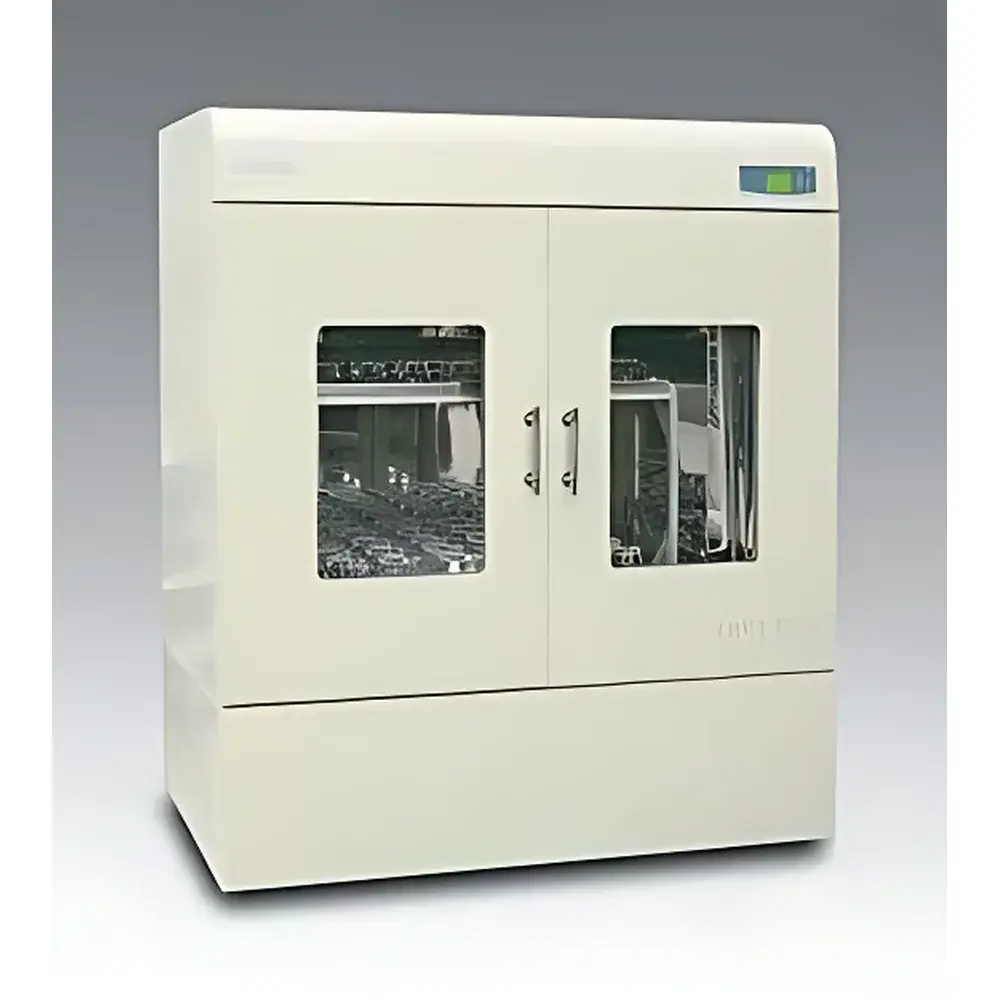
ZWF-C2112 Dual-Layer Reciprocating Programmable Temperature- and Humidity-Controlled Shaker
| Origin | Shanghai, China |
|---|---|
| Manufacturer Type | Authorized Distributor |
| Origin Category | Domestic (PRC) |
| Model | ZWF-C2112 |
| Pricing | Available Upon Request |
| Temperature Range | 4–60 °C |
| Temp. Resolution | 0.1 °C |
| Temp. Uniformity | ≤±1 °C (at 37 °C) |
| Temp. Stability | ≤±0.5 °C (at 37 °C) |
| Humidity Range | 45–90 %RH |
| Humidity Resolution | 0.1 %RH |
| Humidity Stability | ≤±2 %RH |
| Humidity Uniformity | ≤5 %RH |
| Oscillation Mode | Reciprocating |
| Drive Mechanism | Orbital Track Drive |
| Speed Range | 30–240 rpm |
| Speed Accuracy | ±1 rpm |
| Amplitude Adjustment | Φ0–50 mm, infinitely variable |
| Programming Capacity | 6 segments × 12 steps per segment |
| Max. Segment Duration | 100 h |
| Chamber Volume | 788 L |
| Internal Dimensions (W×D×H) | 1165 × 680 × 995 mm |
| External Dimensions (W×D×H) | 1400 × 785 × 1760 mm |
| Net Weight | 516 kg |
| Power Supply | AC 220 V, 50/60 Hz |
| Total Power Consumption | 1420 W |
| Refrigerant | R134a |
| Cooling Method | Air-cooled, frost-free, power-regulated |
| Humidification System | Integrated micro-humidifier with patented design |
| Safety Systems | Dual independent overtemperature cutoffs (adjustable and fixed), over-speed detection, low-water-level sensing with auto-refill & alarm, leakage current protection, circuit breaker, compressor overload protection, sensor fault monitoring, power-fail recovery, and door-open interlock |
Overview
The ZWF-C2112 Dual-Layer Reciprocating Programmable Temperature- and Humidity-Controlled Shaker is an engineered platform for precise, reproducible cultivation of sensitive biological samples under dynamically controlled environmental conditions. Designed for high-throughput microbiological, cellular, and biochemical applications, it integrates reciprocating orbital motion with tightly regulated thermal and hygroscopic parameters—enabling long-term incubation without sample desiccation or condensation-induced variability. Its dual-layer chamber architecture supports parallel experiments across two independently monitored decks, each equipped with a stainless-steel electro-polished tray and adjustable amplitude control (Φ0–50 mm). The system employs PID-controlled forced-air convection for uniform temperature distribution (≤±1 °C at 37 °C) and a proprietary integrated humidification module maintaining 45–90 %RH with ≤±2 %RH stability. Unlike conventional shakers relying on passive humidity retention, the ZWF-C2112 actively regulates vapor saturation via real-time feedback from capacitive RH sensors and adaptive power modulation of its sealed micro-humidifier—critical for extended fungal cultures, mammalian cell suspension growth, and enzymatic assays requiring strict water activity control.
Key Features
- Dual independent shaker decks (2 × 940 × 580 mm trays) with synchronized or asynchronous programming capability
- 6-segment × 12-step programmable logic supporting complex profiles: temperature/humidity ramps, stepwise oscillation speed transitions, dwell periods, and cyclic repetition
- High-resolution LCD interface with backlighting displaying real-time setpoints and measured values for temperature, humidity, speed, time, and water level
- Comprehensive safety architecture: triple-redundant thermal protection (fixed overheat cutoff, adjustable limit, and independent over-rise prevention), automatic low-water refill with audible/visual alert, leakage current interruption, and compressor overload monitoring
- Brushless AC induction motor delivering constant torque across full speed range (30–240 rpm, ±1 rpm accuracy), maintenance-free operation, and smooth acceleration/deceleration to prevent culture shear damage
- Frost-free refrigeration using environmentally compliant R134a, enabling stable sub-ambient operation down to 4 °C in ambient environments up to 35 °C
- Electrostatically coated steel exterior, mirror-finish stainless-steel interior, and tempered glass observation window for durability and contamination control
Sample Compatibility & Compliance
The ZWF-C2112 accommodates standard laboratory vessels—including Erlenmeyer flasks (up to 5 L), baffled bottles, deep-well plates, and custom bioreactor bags—via interchangeable spring-loaded clamps and universal platform adapters. Its large internal volume (788 L) and vertical clearance support multi-tiered flask arrangements while maintaining airflow integrity. All wetted components are corrosion-resistant and autoclavable where applicable. From a regulatory standpoint, the device meets essential requirements for GLP-compliant laboratories: audit-trail-capable parameter logging (via RS-232 interface), password-protected parameter encryption, calibration traceability for temperature and humidity sensors, and configurable alarm thresholds aligned with ISO 17025 documentation practices. While not certified to FDA 21 CFR Part 11 out-of-the-box, its data export functionality (including embedded thermal printer output) supports integration into validated electronic lab notebook (ELN) systems meeting ALCOA+ principles.
Software & Data Management
Data acquisition and configuration are managed through the front-panel interface and external PC connectivity. The built-in RS-232 port enables bidirectional communication with host software for remote monitoring, batch parameter upload/download, and automated report generation. Real-time operational data—including temperature, humidity, speed, elapsed time, and alarm status—is continuously logged to non-volatile memory and can be exported in CSV format. The integrated thermal printer provides hard-copy records of program execution, deviations, and system events—supporting manual review during QA audits. Optional firmware upgrades extend protocol storage capacity and introduce enhanced curve-fitting algorithms for predictive humidity compensation based on ambient dew point. All user-modifiable parameters—including sensor offset correction, alarm hysteresis, and auto-recovery behavior—are stored in EEPROM with write-protection to prevent accidental overwrite.
Applications
This shaker serves as a core platform in academic research labs, pharmaceutical QC units, and bioprocess development facilities. Typical use cases include aerobic bacterial fermentation (e.g., E. coli expression systems), filamentous fungal cultivation (e.g., Aspergillus spp. enzyme production), suspension-based mammalian cell expansion (CHO, HEK293), yeast hybridization studies, and environmental microbiology (soil slurry respiration assays). Its precise humidity control makes it uniquely suited for protocols where evaporation-induced osmotic stress must be eliminated—such as long-duration biofilm formation studies, lignocellulosic hydrolysis kinetics, and plant tissue culture under agitation. In food safety testing, it facilitates standardized enrichment of Salmonella and Listeria in buffered peptone water under regulated moisture conditions to improve detection sensitivity and inter-laboratory reproducibility.
FAQ
What is the maximum flask size supported on each deck?
Standard configurations accommodate up to four 5 L Erlenmeyer flasks per deck when using reinforced dual-clamp fixtures; total load capacity per deck is 30 kg.
Does the system support CO₂ supplementation?
No—the ZWF-C2112 does not include gas inlet ports or CO₂ monitoring; for CO₂-controlled applications, consider the ZW-D series variant.
Can humidity be maintained below 45 %RH?
The unit is optimized for humidification only; dehumidification requires external desiccant or chilled-mirror systems.
Is validation documentation available for IQ/OQ protocols?
Yes—factory-generated test certificates, sensor calibration reports, and installation qualification checklists are provided upon request.
How is temperature uniformity verified across the chamber?
Uniformity is confirmed per ASTM E145 Annex A3 using nine-point thermocouple mapping at 37 °C and 50 °C, with results documented in the performance verification report.





