
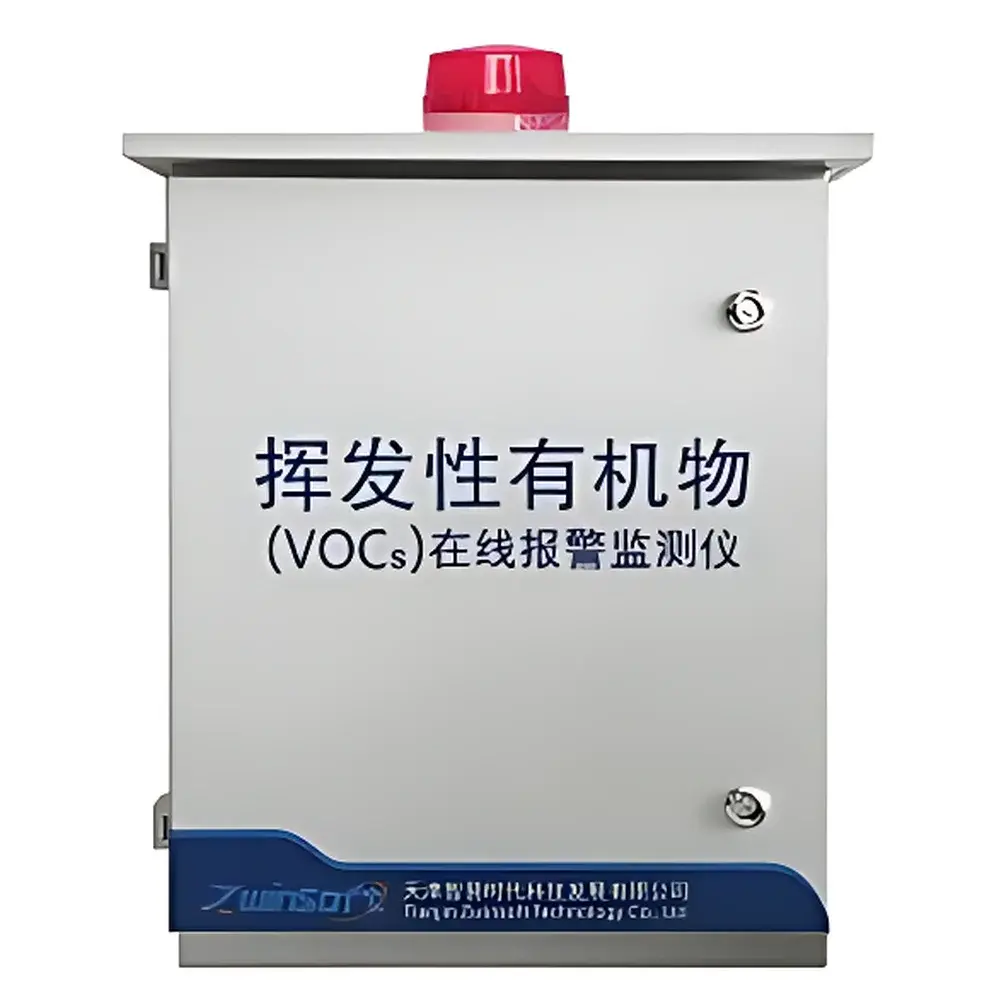
ZWIN-VOCS Online VOC Monitoring System for Gas Stations
| Brand | ZWINSoft |
|---|---|
| Origin | Tianjin, China |
| Manufacturer Type | OEM Manufacturer |
| Regional Classification | Domestic (China) |
| Model | ZWIN-VOCS |
| Price Range | USD 1,400 – 7,000 |
| Detection Principle | Photoionization Detection (PID) |
| Instrument Type | Continuous Online Analyzer |
| Typical Configuration | Total VOC (TVOC) Monitor |
| Measurement Range | 0–1000 ppm |
| Resolution | 0.01 ppm |
| Accuracy | ≤ ±5% FS |
| Response Time | T90 < 5 s |
Overview
The ZWIN-VOCS Online VOC Monitoring System is a purpose-engineered continuous emission monitoring solution designed specifically for gasoline retail facilities, including service stations, fuel depots, and vapor recovery zones. It employs photoionization detection (PID) technology to deliver real-time, quantitative measurement of total volatile organic compounds (TVOC) in ambient air or process exhaust streams. PID operates by exposing sampled gas to high-energy ultraviolet (UV) photons—typically from a 10.6 eV lamp—causing ionization of VOC molecules with ionization energies below the photon energy threshold. The resulting ion current is linearly proportional to analyte concentration, enabling robust, non-destructive, and repeatable quantification across thousands of organic species—including benzene, toluene, xylene, formaldehyde, acetone, alcohols, and halogenated hydrocarbons—without chemical consumption or sensor degradation. Unlike flame ionization (FID) or metal oxide semiconductor (MOS) sensors, PID provides ppb-level sensitivity, sub-5-second response, and immunity to permanent poisoning, making it ideal for regulatory compliance monitoring under dynamic environmental conditions.
Key Features
- Third-generation intrinsically safe PID sensor with patented self-cleaning mechanism, extending operational lifetime and minimizing drift-induced recalibration frequency
- Integrated pump-suction sampling architecture ensuring consistent volumetric flow, rapid gas exchange, and representative time-series data acquisition
- 3G open-air-path design doubling effective detection range while reducing condensation-related interference and maintenance intervals
- Intelligent temperature and zero-point compensation algorithms enabling stable performance across -20 °C to +50 °C ambient operating conditions
- Multi-protocol communication support: configurable RS485 Modbus RTU, isolated 4–20 mA analog output (3-wire), and dry-contact alarm relays
- GPRS/3G cellular telemetry with automatic data buffering during network outages and scheduled or event-triggered transmission
- On-device LCD interface with local configuration, real-time parameter display, and diagnostic status indicators
- Modular hardware architecture supporting field-swappable sensors without tools or firmware reprogramming
- Offline calibration capability using certified standard gases, traceable to NIST-certified reference materials
Sample Compatibility & Compliance
The ZWIN-VOCS system is validated for continuous monitoring of hydrocarbon-rich vapors typical of gasoline handling environments—specifically targeting C4–C12 aliphatic and aromatic compounds emitted during tank truck unloading (“large breathing”) and vehicle refueling (“small breathing”). It complies with the technical requirements outlined in GB 20952–2007 (Emission Standard of Atmospheric Pollutants for Gasoline Service Stations) and aligns with the methodological framework of HJ 1012–2018 (Technical Specification for Online Monitoring Systems of Volatile Organic Compounds in Ambient Air). While not certified to ISO/IEC 17025 for accredited testing, its measurement uncertainty profile (≤±5% FS) satisfies routine compliance verification thresholds defined in China’s Ministry of Ecology and Environment (MEE) Technical Policy on VOC Pollution Prevention and Control (Announcement No. 31, 2013). The system supports audit-ready data logging compliant with GLP principles, including timestamped raw values, calibration records, alarm events, and operator actions—all retained for ≥18 months per internal flash storage and mirrored to central databases.
Software & Data Management
The ZWIN-VOCS software platform comprises three interoperable layers: (1) Edge firmware managing sensor excitation, signal conditioning, and local preprocessing; (2) Centralized cloud-hosted database built on PostgreSQL with distributed file storage (HDFS-compatible) for raw time-series ingestion at 1 Hz resolution; and (3) Web-based application layer delivering role-based dashboards via HTML5. Core functionalities include real-time spatial mapping using geotagged station metadata, Gaussian plume dispersion modeling for source attribution, automated exceedance alerts (email/SMS/push) with configurable duration hysteresis, and batch statistical reporting (e.g., 1-hr max, 8-hr TWA, rolling 30-day averages). All data exchanges adhere to RESTful JSON APIs and optional SOAP-based Web Services, facilitating integration with municipal environmental information systems (EIS), provincial ecological monitoring platforms, and third-party SCADA architectures. Audit trails record every configuration change, user login, and alarm acknowledgment—supporting basic FDA 21 CFR Part 11 alignment through electronic signature logging and immutable event timestamps.
Applications
The ZWIN-VOCS system serves as a foundational component in regulatory-driven VOC management programs across downstream petroleum infrastructure. Primary deployment scenarios include: continuous fence-line monitoring at service stations to verify vapor recovery system efficiency; stack-level compliance verification at bulk terminals subject to GB 20950–2007; fugitive emission screening in tank farm perimeters; and mobile monitoring during leak detection and repair (LDAR) campaigns. Secondary applications extend to indoor air quality assessment in maintenance workshops, solvent-handling areas, and underground utility vaults where hydrocarbon accumulation poses explosion or chronic exposure risks. Its broad-spectrum detection capability also supports comparative studies of abatement technologies—such as activated carbon adsorption breakthrough profiling or catalytic oxidizer efficiency validation—by tracking pre- and post-treatment TVOC loadings under controlled flow conditions.
FAQ
What VOC compounds does the ZWIN-VOCS system detect?
It detects >95% of common VOCs with ionization energies <10.6 eV—including benzene, toluene, xylenes, ethylbenzene, styrene, formaldehyde, acetaldehyde, acetone, MEK, isopropanol, chlorinated solvents, and terpenes—via broadband PID response calibrated to isobutylene equivalents.
Is the system suitable for hazardous area installation?
Yes. The PID sensor module carries intrinsic safety certification (Ex ib IIB T4 Gb), permitting direct mounting in Zone 1 classified locations per IEC 60079-0 and GB 3836.4 standards.
How frequently does the sensor require calibration?
Factory calibration remains valid for 6 months under normal operation; field verification with 100 ppm isobutylene standard gas is recommended quarterly. Automatic zero-tracking algorithms reduce manual intervention frequency.
Can the system integrate with existing SCADA or EMS platforms?
Yes. Native Modbus RTU over RS485 and HTTP-based JSON API enable seamless connectivity with Siemens Desigo, Honeywell Experion, ABB Ability, and custom-built environmental management systems.
Does the platform support remote firmware updates?
Yes. Over-the-air (OTA) updates are supported via secure TLS 1.2 encrypted GPRS channel, with version rollback capability and SHA-256 signature verification to ensure integrity.







