
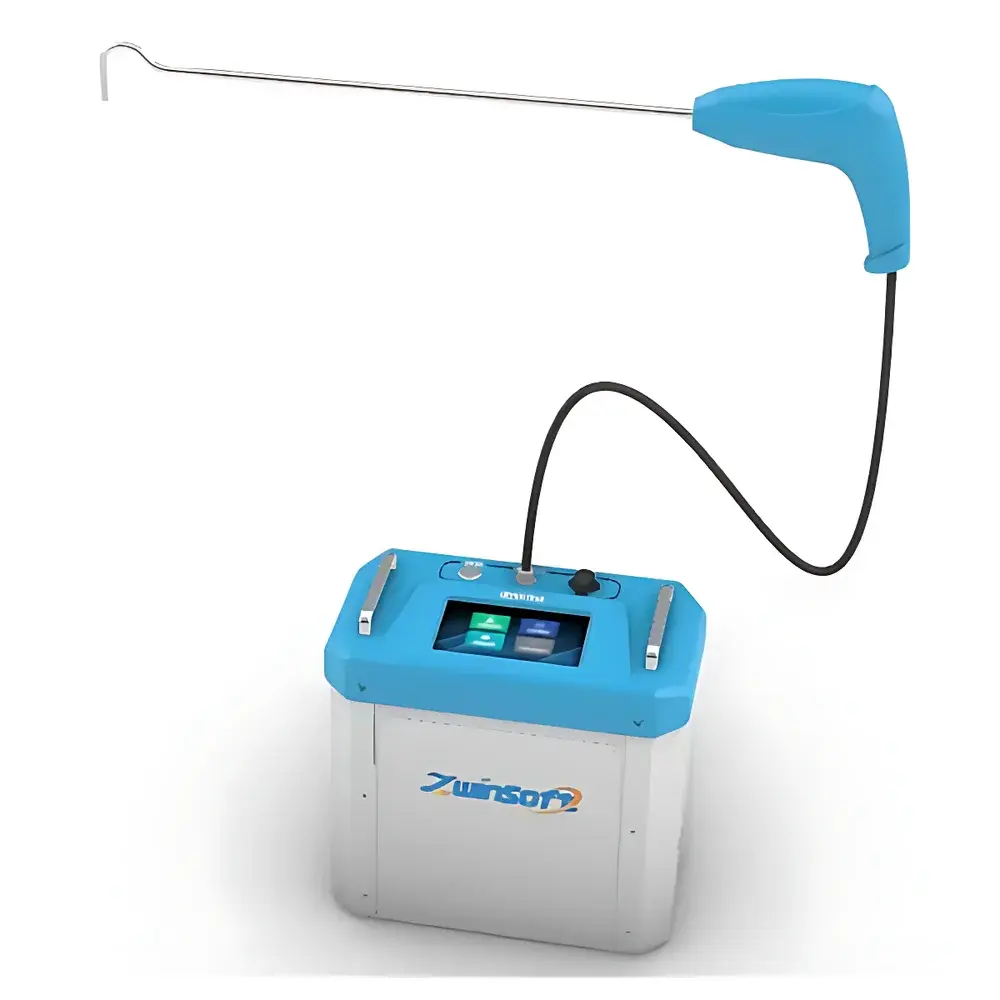
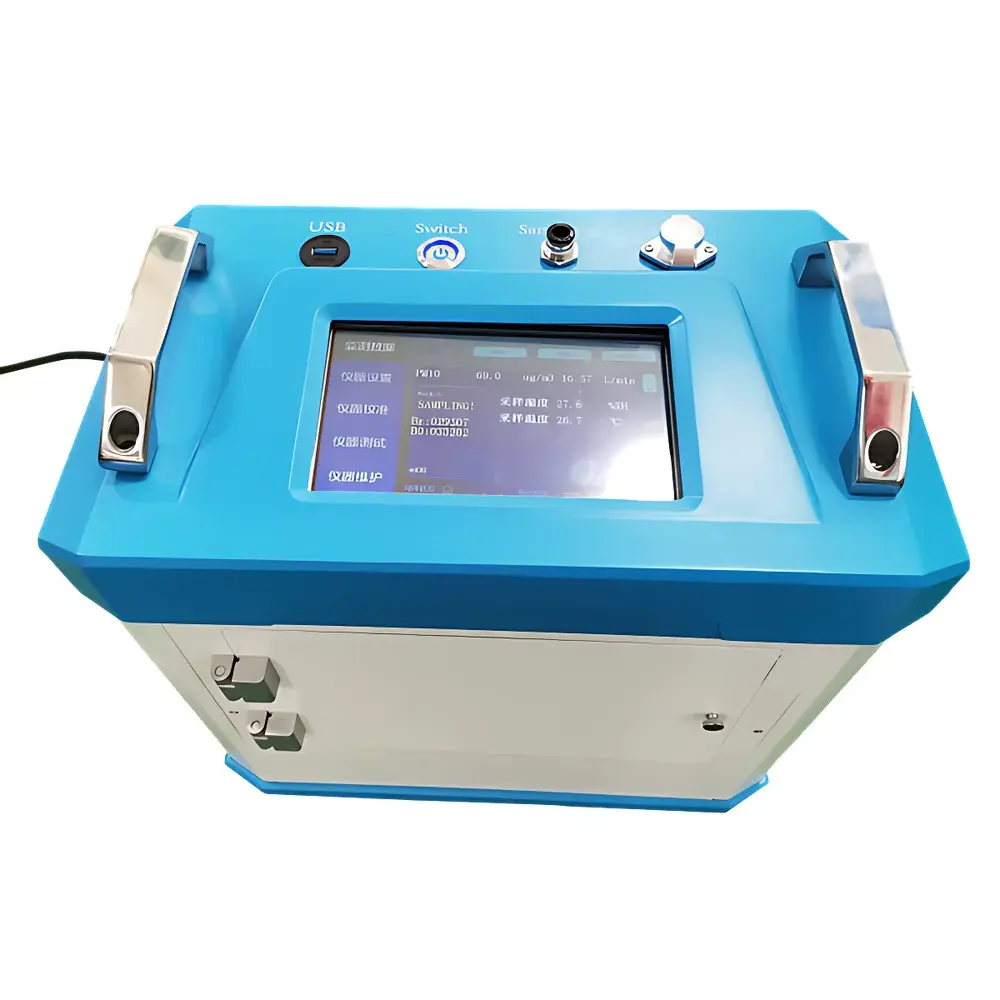
ZWIN-YCB06 Portable Beta-Ray Based Particulate Matter (PM10) Monitor
| Brand | ZWINSoft |
|---|---|
| Origin | Tianjin, China |
| Manufacturer Type | Direct Manufacturer |
| Country of Origin | China |
| Model | ZWIN-YCB06 |
| Instrument Type | Portable |
| Measurement Principle | Beta-Ray Absorption |
| Measured Parameter | PM10 |
| Measurement Range | (0–1000) µg/m³ or (0–10000) µg/m³ (selectable) |
| Sampling Flow Rate | 16.7 L/min |
| Minimum Detection Limit | ≤2 µg/cm² |
| Filter Spot Area | 1.68 cm² |
| Spot Center-to-Center Spacing | ~18.84 mm ± 0.5 mm |
| Full-Scale Loading | 1.5 mg/cm² |
| Resolution | ±2% |
| Max. Permissible Error | ≤±20% |
| Sampling Tube Material | Stainless Steel (Note: “Drill alloy” in source is nonstandard |
| Sampling Tube Length | 500 cm |
| Operating Temperature | 0–300 °C |
| Relative Humidity | ≤80% RH |
| Flue Gas Pressure Range | −10 to +10 kPa |
| Power Supply | AC 220 V ±10%, 50 Hz ±1 Hz |
| Detector | Scintillation Detector with Photomultiplier Tube |
| Data Update Interval | 5 s |
| Data Storage | Onboard non-volatile memory |
| Repeatability | ≤±2% |
| Flow Accuracy | ±2% (at nominal 16.7 L/min) |
| Timing Drift | <10 s per 24 h |
| Acoustic Noise | ≤65 dB(A) |
| System Leak Rate | <200 Pa pressure decay within 1 min after sealing at −5 kPa vacuum |
| Ambient Operating Conditions | Indoor/outdoor portable deployment |
Overview
The ZWIN-YCB06 Portable Beta-Ray Based Particulate Matter (PM10) Monitor is an industrial-grade, field-deployable instrument engineered for real-time, quantitative measurement of airborne particulate mass concentration in flue gas streams and stack emissions. It operates on the well-established beta-ray absorption principle—where beta particles (electrons) emitted from a 14C or 85Kr radioactive source traverse a continuously advancing filter tape that collects particulate matter from the sampled gas stream. As particle mass accumulates on the tape, attenuation of the beta radiation intensity is measured by a scintillation detector coupled to a photomultiplier tube. This attenuation is linearly correlated to deposited mass via the Beer–Lambert law, enabling traceable, gravimetric-equivalent quantification without reliance on optical proxies or calibration drift-prone scattering models. Designed for compliance monitoring and process optimization, the ZWIN-YCB06 meets functional requirements aligned with EPA Method PS-11, ISO 20581:2020 (stationary source emissions — determination of PM10/PM2.5 by beta attenuation), and Chinese HJ 653–2013 standards for ambient and stack particulate monitoring.
Key Features
- True gravimetric equivalence: Beta-ray attenuation provides direct, physics-based mass loading measurement—eliminating assumptions inherent in optical or tapered element oscillating microbalance (TEOM) methods.
- Field-optimized portability: Integrated battery-ready power architecture (AC 220 V input, compatible with portable generators), 5-m stainless steel heated sampling probe, and ruggedized IP54 housing enable rapid deployment in stacks, ducts, and mobile emission audits.
- Adaptive range selection: Dual-range configuration (0–1000 µg/m³ and 0–10000 µg/m³) supports both low-concentration ambient background assessments and high-load industrial combustion sources (e.g., cement kilns, coal-fired boilers).
- Thermally stabilized sampling: Heated sampling line (up to 300 °C operational limit) prevents condensation and volatilization losses of semi-volatile compounds during transport, preserving PM10 integrity.
- High temporal resolution: 5-second data reporting interval enables dynamic emission profiling, including start-up/shutdown transients and load-following characterization.
- Robust metrological performance: ≤±2% repeatability, ≤±20% maximum permissible error (per HJ 653–2013), and ≤2 µg/cm² minimum detection limit ensure regulatory-grade data fidelity under variable field conditions.
Sample Compatibility & Compliance
The ZWIN-YCB06 is validated for continuous, isokinetic sampling of hot, humid, and corrosive flue gases across diverse industrial sectors—including thermal power generation, waste incineration, iron & steel production, and building materials manufacturing. Its stainless steel probe (500 cm length), temperature-rated filtration system, and sealed beta source chamber comply with safety and environmental protection requirements for Class II radioactive device handling (CNIC certification applicable). The instrument satisfies data integrity prerequisites for GLP-aligned reporting and supports audit-ready documentation through timestamped onboard storage. While not pre-certified to EN 15267 or MCERTS, its measurement methodology and uncertainty profile align with the technical basis of those frameworks for PM10 CEMS verification.
Software & Data Management
Data acquisition and local visualization are handled via an embedded Linux-based controller with a monochrome LCD interface. All measurements—including raw beta counts, calculated PM10 concentration, flow rate, temperature, pressure, and system diagnostics—are time-stamped and stored in non-volatile memory (≥30 days at 5-s resolution). Export is supported via USB 2.0 to CSV-formatted files compatible with Excel, MATLAB, or LIMS platforms. No cloud connectivity or proprietary software installation is required; however, optional RS-485/Modbus RTU output enables integration into SCADA or DCS systems for centralized telemetry. Firmware updates are performed offline via USB drive, ensuring air-gapped security in regulated environments. Audit trail functionality includes power-on/off logs and calibration event timestamps—supporting basic 21 CFR Part 11 readiness when paired with procedural controls.
Applications
- Regulatory stack testing per national emission standards (e.g., China’s GB 13223, EU IED Annex V)
- Process optimization in cement clinker coolers and rotary kilns
- Performance validation of electrostatic precipitators (ESPs) and fabric filters
- Mobile source emission surveys using vehicle-mounted deployment rigs
- Construction site dust control verification (PM10 boundary monitoring)
- Research-grade particulate emission factor development for life-cycle assessment (LCA)
FAQ
What radioactive source is used, and is licensing required?
The ZWIN-YCB06 employs a 14C or 85Kr beta source compliant with Class V exemption thresholds under IAEA SSG-46. Local regulatory approval (e.g., NNSA registration in China, NRC general license in the US) may be required depending on jurisdictional classification—users must consult national radiation safety authorities prior to operation.
Can the instrument measure PM2.5 or TSP?
No. The ZWIN-YCB06 is configured exclusively for PM10 cut-point compliance using a standardized cyclone inlet meeting ISO 20581 and HJ 653 specifications. PM2.5 measurement requires a separate impactor stage and recalibration protocol not included in this model.
How often does the filter tape require replacement?
Under typical sampling at 16.7 L/min and 500 µg/m³ average concentration, the 1.68 cm² spot area supports ≥30 days of continuous operation before reaching the 1.5 mg/cm² full-scale loading limit. Tape consumption is programmable and monitored in real time.
Is isokinetic sampling automatically maintained?
Yes—the integrated flow control system dynamically adjusts suction to match stack velocity (measured separately with pitot tube or supplied velocity sensor), maintaining isokinetic sampling accuracy within ±2% deviation as specified in EPA Method 5 and ISO 9096.
Related Products







