
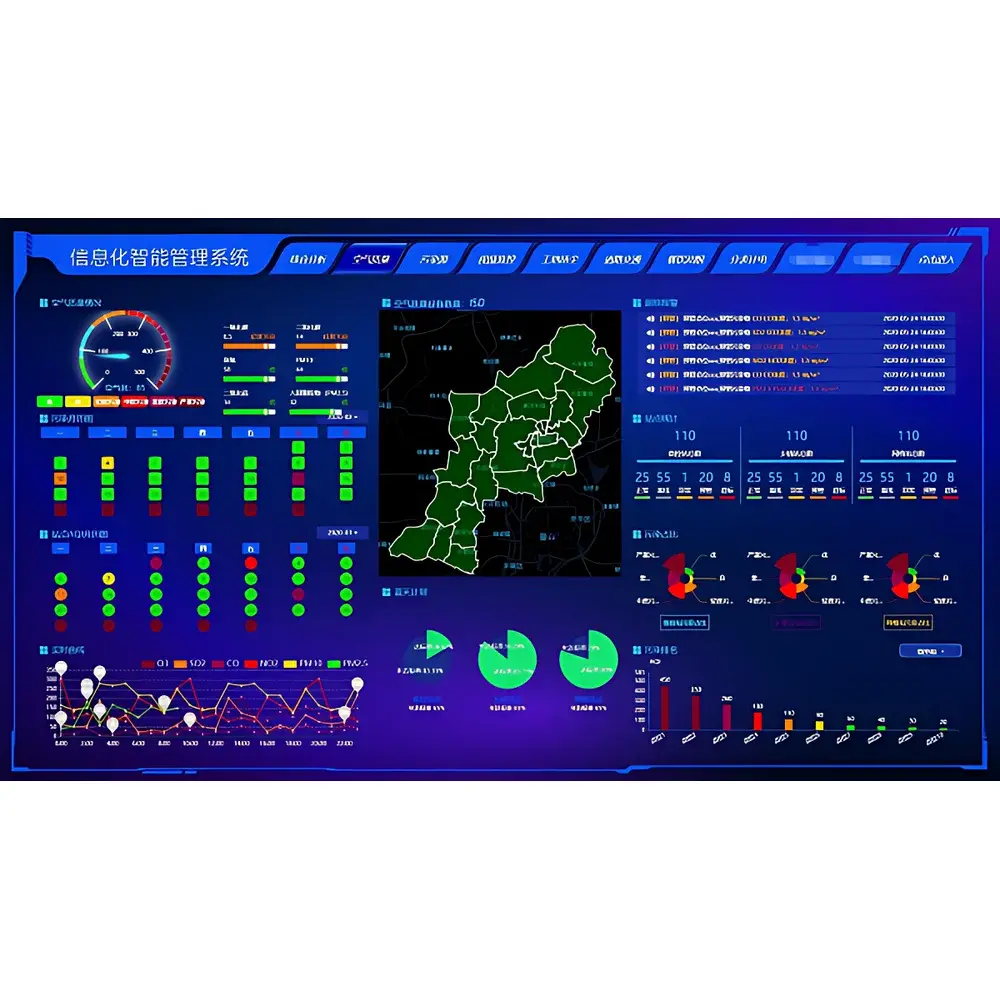
ZWINSOFT Z WIN-AQMS-PLAT Intelligent Integrated Environmental Monitoring & Regulatory Platform
| Brand | ZWINSOFT |
|---|---|
| Origin | Tianjin, China |
| Manufacturer Type | Original Equipment Manufacturer (OEM) |
| Country of Origin | China |
| Model | Z WIN-AQMS-PLAT |
| Pollutant Parameters | SO₂, NO₂, CO, O₃, PM₂.₅, PM₁₀ |
| Compliance Framework | Designed for integration with China’s National Environmental Monitoring Network (CNEMN), aligned with HJ 653–2013, HJ 654–2013, and GB 3095–2012 standards |
Overview
The ZWINSOFT Z WIN-AQMS-PLAT is an enterprise-grade Intelligent Integrated Environmental Monitoring & Regulatory Platform engineered for centralized acquisition, real-time visualization, multi-dimensional analytics, and regulatory decision support in ambient air quality management. Built upon a modular, service-oriented architecture, it implements continuous monitoring data ingestion from fixed-site automatic monitoring stations, mobile sensors, and remote emission sources—conforming to the physical-layer protocols defined in HJ 212–2017 (China’s Data Transmission Protocol for Environmental Monitoring Instruments). The platform operates on a unified time-synchronized data lake, enabling second-level temporal resolution for event-triggered analysis and sub-hourly trend modeling. Its core function extends beyond passive data aggregation: it embeds deterministic dispersion modeling (e.g., Gaussian plume approximations), spatial interpolation algorithms (IDW, Kriging), and rule-based alert logic to transform raw sensor outputs into actionable environmental intelligence—supporting statutory compliance reporting, source attribution, and dynamic priority assignment for enforcement personnel.
Key Features
- Multi-source data fusion engine supporting heterogeneous inputs: EPA-certified reference analyzers (e.g., chemiluminescence NOx, UV photometry O3, beta attenuation PM), low-cost sensor networks, meteorological towers, and satellite-derived AOD layers.
- GIS-powered operational dashboard with georeferenced layering: real-time pollutant concentration heatmaps, facility-level compliance status overlays, enforcement officer GPS tracking, and historical trajectory replay—rendered via OpenLayers 7 with WMS/WFS interoperability.
- Automated alerting system with configurable thresholds: tiered notifications (email/SMS/API webhook) for exceedance events, instrument fault detection, calibration drift alerts, and data completeness anomalies (per HJ 655–2013 QA/QC requirements).
- Source apportionment module integrating receptor modeling (PMF, UNMIX) and backward trajectory analysis (HYSPLIT coupling) for quantitative contribution estimation by sector (industrial, traffic, dust, biomass).
- Regulatory workflow engine compliant with China’s “Dual Random, One Open” (Shuang Sui Yi Kai) inspection protocol—automating inspection scheduling, evidence capture, violation classification, and penalty recommendation generation.
Sample Compatibility & Compliance
The Z WIN-AQMS-PLAT is designed exclusively for ambient air and stationary source emission monitoring applications under national and provincial environmental protection authority mandates. It supports full integration with Class I and II automatic monitoring instruments certified per CNEMC Technical Specifications (e.g., CMA accreditation for SO2/NOx analyzers, CPAC verification for PM monitors). All data handling workflows adhere to the metadata schema and transmission security protocols mandated by MEP Order No. 39 and the “Environmental Monitoring Data Quality Management Measures” (2020). Platform audit logs maintain immutable records of user actions, data modifications, and report exports—enabling traceability for GLP-aligned internal audits and provincial EPB supervision inspections.
Software & Data Management
Data ingestion follows ISO/IEC 11179-compliant metadata tagging, with automatic validation against range limits, monotonicity checks, and cross-parameter consistency rules (e.g., NOx/NO2 ratio plausibility). Time-series storage utilizes TimescaleDB for high-throughput write scalability and sub-second query latency over decade-scale archives. Reporting modules generate standardized outputs per HJ 663–2013 (ambient air quality evaluation) and HJ 972–2018 (emission inventory reporting), including daily/annual summary tables, percentile statistics (e.g., 98th percentile O3), and trend significance testing (Mann-Kendall). Role-based access control (RBAC) enforces separation of duties between data operators, analysts, and administrative reviewers—with password policies aligned with GB/T 22239–2019 (Cybersecurity Level Protection 2.0).
Applications
- Municipal ecological environment bureaus performing routine ambient air quality assessment and attainment planning under the Air Pollution Prevention and Control Action Plan.
- Provincial monitoring centers conducting inter-laboratory data consistency validation and cross-regional pollution transport analysis.
- Industrial park management committees implementing real-time fenceline monitoring, VOCs hotspot identification, and emergency response coordination during unplanned releases.
- Research institutions leveraging the platform’s API-first design to extract calibrated time-series for atmospheric chemistry model initialization or machine learning training (e.g., LSTM-based ozone forecasting).
FAQ
Does the platform support integration with third-party meteorological data feeds?
Yes—via standardized RESTful APIs accepting METAR, BUFR, or NetCDF formats; automatic synchronization with China Meteorological Administration (CMA) real-time surface observation datasets is preconfigured.
Can historical data be exported in formats compatible with statistical analysis software?
All time-series and summary reports are exportable in CSV, Excel (.xlsx), and NetCDF4 formats—including embedded CF-conventions metadata for seamless import into R, Python (xarray), or MATLAB.
Is the system validated for use in legally defensible regulatory reporting?
The platform’s data acquisition layer is certified to meet HJ 212–2017 conformance requirements; audit trails and electronic signatures comply with GB/T 19001–2016 Annex A.3 for documented information control in quality management systems.
What cybersecurity certifications does the deployment architecture support?
On-premise deployments follow GB/T 22239–2019 Level 3 controls, including encrypted database storage (AES-256), TLS 1.3 for all external interfaces, and annual penetration testing by CNITSEC-accredited labs.
How frequently is firmware updated for connected field instruments?
Instrument firmware updates are distributed through the platform’s secure OTA (Over-the-Air) channel only after validation against the ZWINSOFT Instrument Certification Library—ensuring backward compatibility and measurement continuity per HJ 654–2013.
Related Products







