
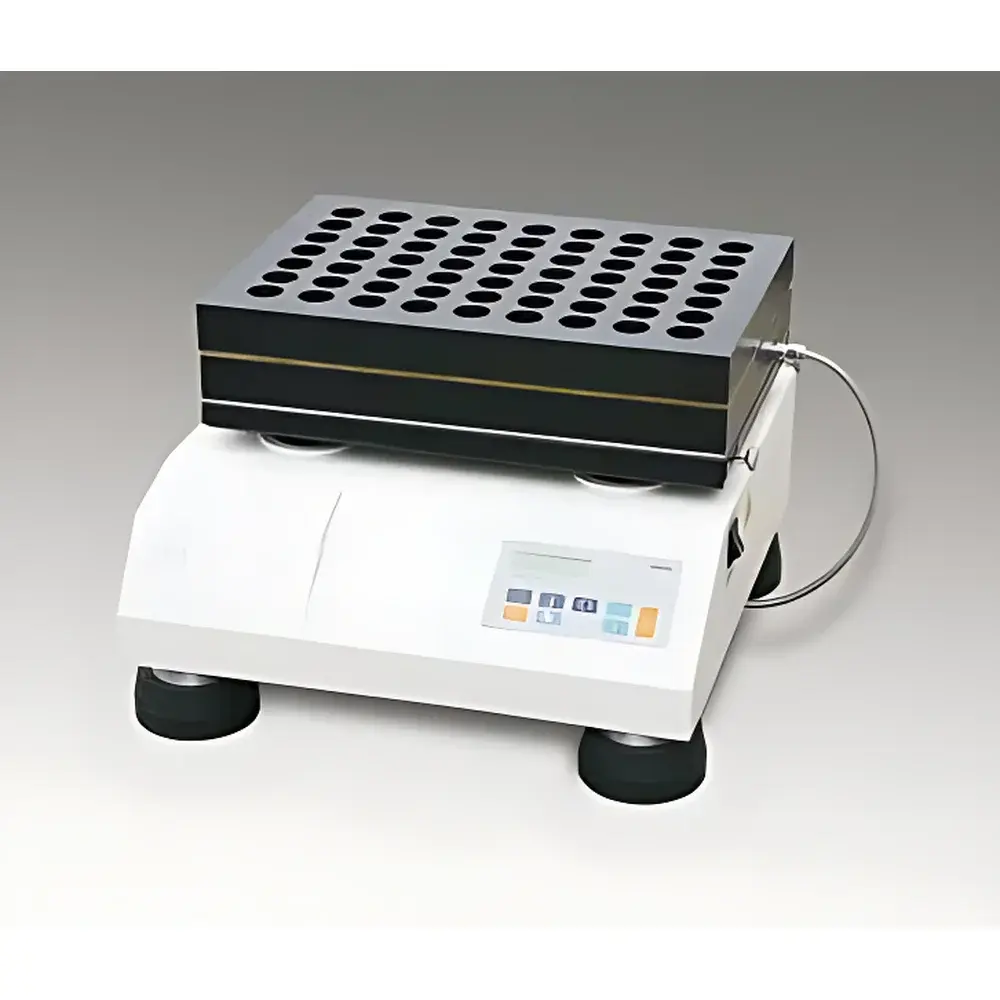
ZWY-113H04 High-Throughput Parallel Synthesis Shaker
| Origin | Shanghai, China |
|---|---|
| Manufacturer Type | Distributor |
| Origin Category | Domestic (China) |
| Model | ZWY-113H04 |
| Quotation | Upon Request |
| Temperature Range | Ambient to 200 °C |
| Temperature Accuracy | ±0.1 °C |
| Timer Range | 0–500 h |
| Orbital Speed | 50–300 rpm |
| Temperature Zones | 1 |
| Water Circulation Channels | 2 |
| Power Consumption | 1300 W |
| Voltage/Frequency | 220 V / 50 Hz |
| Dimensions (W×D×H) | 450×430×265 mm |
| Reaction Plate Size | 420×288 mm |
| Maximum Load Capacity | Φ15 mm × 120 wells |
Overview
The ZWY-113H04 High-Throughput Parallel Synthesis Shaker is an engineered platform for controlled, reproducible multi-reaction experimentation in synthetic chemistry, catalysis development, and formulation science. Designed around orbital shaking dynamics combined with precise conductive heating, it enables simultaneous execution of up to 120 parallel reactions under identical or systematically varied thermal and mixing conditions. Unlike conventional incubator shakers, the ZWY-113H04 integrates dual independent water circulation channels and a high-stability PID-controlled heating system capable of maintaining temperatures from ambient up to 200 °C with ±0.1 °C accuracy—critical for kinetic studies, catalyst screening, and thermally sensitive condensation or coupling reactions. Its rigid aluminum reaction plate (420 × 288 mm) supports standardized 15-mm-diameter reaction vessels across 120 positions, ensuring uniform heat transfer and mechanical agitation across the entire array. The system operates on a single-zone temperature architecture, optimized for homogeneity rather than spatial thermal gradient differentiation—making it particularly suitable for reaction condition replication, stability profiling, and DoE-based optimization workflows.
Key Features
- Orbital shaking mechanism with adjustable speed range of 50–300 rpm, delivering consistent radial acceleration and efficient reagent homogenization without vortexing or splashing.
- High-power (1300 W) resistive heating system with dual-loop water circulation, enabling rapid thermal equilibration and exceptional temperature stability across the full operating range (ambient to 200 °C).
- Digital PID temperature controller with integrated K-type thermocouple feedback loop ensures real-time closed-loop regulation and traceable thermal performance.
- Modular hardware design: reaction plate, controller, thermal actuator, and shaker base are functionally decoupled—facilitating maintenance, calibration, and future upgrades.
- Onboard programmable timer (0–500 h) supports unattended overnight or multi-day reaction sequences; optional 9-segment, 18-step ramp-soak profiles available via external controller module.
- RS232 interface enables bidirectional communication with laboratory PCs for remote monitoring, data logging, and synchronized parameter adjustment using custom or third-party control software.
- Optional accessories include external chiller integration (for sub-ambient operation down to 80 °C), embedded thermal printer (for time-stamped temperature reports), and interchangeable reaction blocks for alternative tube formats.
Sample Compatibility & Compliance
The ZWY-113H04 accommodates standard 15-mm OD borosilicate glass or stainless-steel reaction tubes (up to 120 units per run), compatible with common solvent systems including DMF, DMSO, THF, ethanol, and aqueous buffers. Reaction vessels must be sealed appropriately to prevent evaporation or pressure buildup during elevated-temperature operations. While not certified to IEC 61000-6-3 or UL 61010-1 out-of-the-box, the instrument meets fundamental electrical safety and electromagnetic compatibility requirements for laboratory use in ISO 17025-accredited environments when operated within specified voltage (220 V ±10%, 50 Hz) and ambient conditions (15–30 °C, <80% RH non-condensing). Users performing GLP/GMP-regulated synthesis should implement additional validation protocols—including IQ/OQ/PQ documentation, temperature mapping across the plate surface, and periodic thermocouple calibration traceable to NIST standards.
Software & Data Management
The device operates via embedded firmware with local LCD interface; no proprietary software is required for basic operation. RS232 connectivity allows integration into existing LIMS or ELN ecosystems through ASCII-based command protocols (e.g., “GET_TEMP”, “SET_SP 150”, “START_TIMER 24”). Raw temperature and timer logs can be exported as CSV-compatible streams for post-processing in Python, MATLAB, or JMP. For regulated environments, the optional thermal printer provides auditable hard-copy records aligned with FDA 21 CFR Part 11 principles—provided user-defined access controls, electronic signatures, and audit trail configuration are implemented at the host system level. All parameter changes are timestamped in internal memory, supporting retrospective analysis and compliance with ALCOA+ data integrity guidelines.
Applications
- Rapid screening of homogeneous and heterogeneous catalysts under controlled thermal/mixing conditions (e.g., hydrogenation, Suzuki coupling, asymmetric epoxidation).
- Reaction optimization via Design of Experiments (DoE), varying temperature, residence time, and stoichiometry across parallel vessels.
- Forced degradation and accelerated stability testing of small-molecule APIs per ICH Q1A(R3) guidelines.
- Solubility mapping and co-solvent screening for crystallization process development.
- Library synthesis in medicinal chemistry—particularly for solid-phase supported or solution-phase parallel synthesis workflows.
- Preparative-scale reaction scouting prior to flow chemistry or batch reactor scale-up.
FAQ
What is the maximum recommended operating temperature for continuous use?
The system is rated for sustained operation at up to 200 °C; however, prolonged exposure above 180 °C may accelerate gasket aging in sealed tube configurations.
Can the ZWY-113H04 accommodate microtiter plates (e.g., 96-well)?
No—it is mechanically configured exclusively for 15-mm-diameter cylindrical vessels; adapter plates for other formats are not supported.
Is external cooling mandatory for sub-ambient reactions?
Yes; the base unit lacks active refrigeration. An external chiller (with compatible flow rate and glycol/water mixture) must be connected to the dual water ports to achieve temperatures below ambient.
How is temperature uniformity validated across the reaction plate?
Users should perform a 9-point thermal mapping exercise using calibrated PT100 probes placed at center and corners of the plate under steady-state conditions at representative setpoints (e.g., 60 °C, 120 °C, 180 °C).
Does the RS232 interface support Modbus or SCPI protocols?
No—it implements a proprietary ASCII command set; protocol translation requires middleware or custom scripting.




