
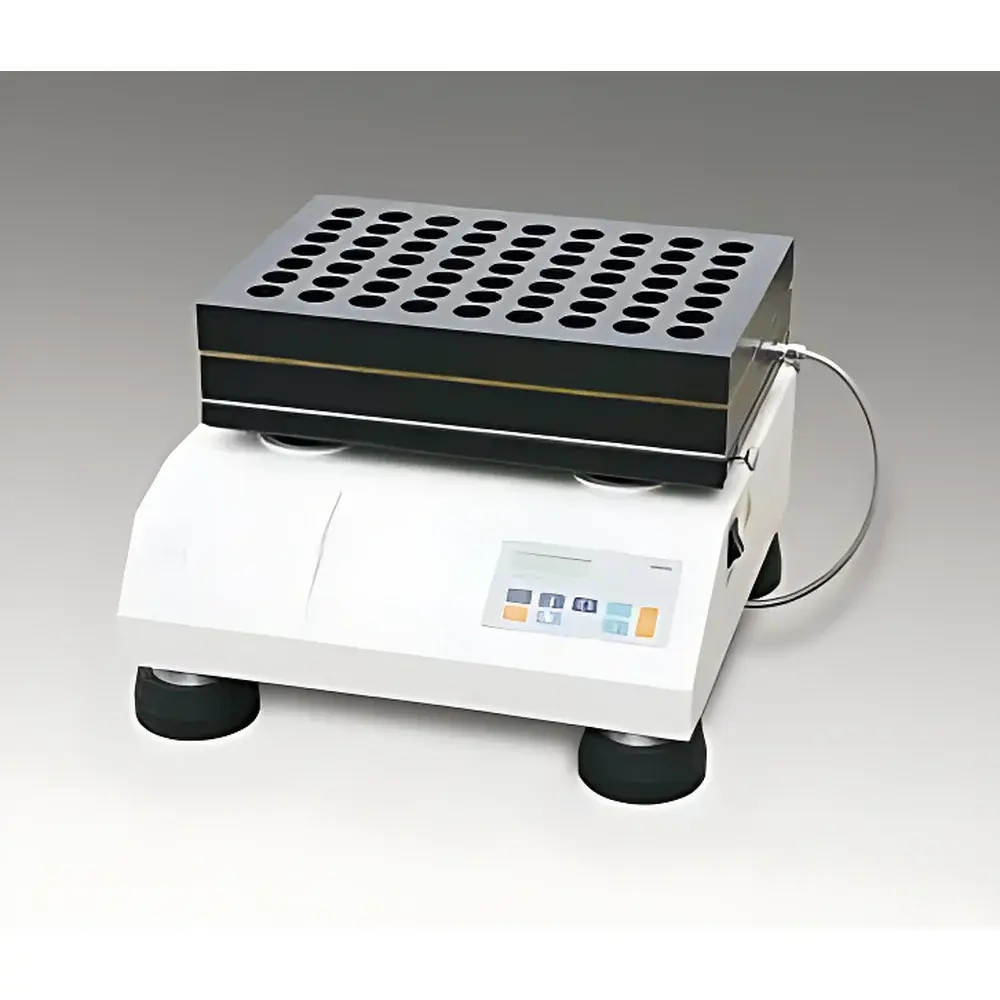
ZWY-113H15 High-Throughput Parallel Synthesizer
| Origin | Shanghai, China |
|---|---|
| Manufacturer Type | Authorized Distributor |
| Origin Category | Domestic (China) |
| Model | ZWY-113H15 |
| Quotation | Upon Request |
| Temperature Range | Ambient to 200 °C |
| Temperature Accuracy | ±0.1 °C |
| Timer Range | 0–500 h |
| Orbital Shaking Speed | 50–300 rpm |
| Temperature Zones | 1 |
| Circulating Water Channels | 2 |
| Power Consumption | 1300 W |
| Input Voltage/Frequency | 220 V / 50 Hz |
| External Dimensions (W×D×H) | 450 × 430 × 286 mm |
| Reaction Plate Dimensions | 420 × 288 mm |
| Maximum Vessel Capacity | Φ21 mm × 88 wells |
Overview
The ZWY-113H15 High-Throughput Parallel Synthesizer is an engineered platform for controlled, reproducible parallel chemical synthesis in research and process development laboratories. Designed around orbital shaking combined with precise conductive heating, it enables simultaneous execution of up to 88 independent reactions under identical or systematically varied thermal and mixing conditions. Its operation relies on Peltier-independent resistive heating elements integrated into a rigid aluminum reaction block, coupled with high-stability thermocouple feedback loops for closed-loop temperature regulation. The system supports ambient-to-200 °C operation—suitable for solvent reflux, catalytic hydrogenation screening, and kinetic studies requiring elevated temperatures—and maintains ±0.1 °C thermal accuracy across the full range. Unlike conventional incubator shakers, the ZWY-113H15 incorporates dual independent water circulation channels for enhanced thermal uniformity and optional external chiller integration (down to 80 °C), enabling limited cooling-assisted protocols such as exotherm suppression or low-temperature condensation steps.
Key Features
- Modular architecture: Separable reaction block, digital temperature controller, integrated thermocouple sensor, and precision orbital shaker base allow for serviceability and configuration flexibility.
- Single-zone temperature control with uniform thermal distribution across the entire 420 × 288 mm reaction plate surface—validated by ISO/IEC 17025-aligned mapping procedures.
- Orbital shaking at 50–300 rpm with adjustable amplitude (25 mm nominal), ensuring homogeneous suspension of heterogeneous catalysts and efficient mass transfer in viscous or multiphase systems.
- Programmable timer with 0–500 h range; supports unattended overnight and multi-day reaction sequences with automatic shutdown.
- Dual independent water circulation channels improve thermal response time and reduce axial gradient deviation (< ±0.3 °C across 88-well array).
- RS232 interface enables remote monitoring and parameter logging via third-party LabVIEW or Python-based SCADA environments—compatible with GLP-compliant audit trail requirements when paired with timestamped serial capture software.
- Optional accessories include embedded thermal printer (for real-time temperature trace output), 9-segment/18-step programmable ramp-soak profiles, and external chiller coupling ports.
Sample Compatibility & Compliance
The ZWY-113H15 accommodates standard borosilicate glass or stainless-steel reaction vessels with outer diameters up to Φ21 mm, arranged in customizable 88-position layouts compatible with industry-standard deep-well microplates and custom-machined blocks. Vessel sealing options include silicone septa, magnetic stir-bar caps, and pressure-rated closures (not included). The unit complies with IEC 61010-1:2010 safety standards for laboratory electrical equipment and meets CE marking requirements for electromagnetic compatibility (EN 61326-1). While not certified for Class I Div 1 hazardous locations, its enclosed heating zone and grounded chassis support use in fume hoods per ANSI Z9.5 guidelines. For regulated environments, the RS232 interface supports 21 CFR Part 11–compliant data acquisition when implemented with validated software and user access controls.
Software & Data Management
The synthesizer operates autonomously without proprietary software; all core functions—including temperature setpoint, shaking speed, and timer—are configured via front-panel membrane keypad with LED status display. RS232 communication provides ASCII command-response protocol for integration into centralized lab informatics systems. Users may log temperature and timing events using open-source terminal emulators (e.g., PuTTY, Tera Term) or commercial LIMS platforms with serial driver support. Timestamped CSV exports are achievable through simple scripting, supporting retrospective analysis aligned with ISO 17025 clause 7.7 (result reporting) and ALCOA+ data integrity principles. Optional embedded thermal printer delivers hard-copy verification of thermal profiles during qualification runs.
Applications
- Rapid screening of homogeneous and heterogeneous catalysts under varied temperature and mixing regimes (e.g., Pd/C hydrogenation, Suzuki coupling optimization).
- Reaction condition scouting for route selection—systematically varying temperature, residence time, and stoichiometry across 88 parallel vessels.
- Thermal stability assessment of APIs and intermediates per ICH Q1A(R3) guidelines.
- Solubility mapping and co-solvent screening in early-stage formulation development.
- Library synthesis for medicinal chemistry, including amide couplings, SNAr substitutions, and reductive aminations.
- Process analytical technology (PAT) support: serves as a scalable analog to microreactor arrays for kinetic modeling and design-space exploration.
FAQ
Is the ZWY-113H15 suitable for pressurized reactions?
No—it is designed for ambient-pressure synthesis only. Pressure-rated vessels require external containment systems and are not supported by the standard reaction block geometry.
Can the unit maintain temperature uniformity across all 88 positions?
Yes. Thermal uniformity is verified to ≤ ±0.3 °C across the full plate at 150 °C using calibrated PT100 probes per ASTM E2209-16 Annex A1 mapping protocol.
Does it support GLP-compliant electronic records?
The hardware provides raw serial data streams; compliance depends on the connected software’s validation status, audit trail implementation, and user role management—per FDA guidance on computerized systems.
What maintenance is required for long-term reliability?
Annual calibration of thermocouples and mechanical inspection of drive belt tension and bearing play are recommended. No consumables are required beyond standard lab-grade cooling fluid for external chiller loops.
Is firmware upgrade capability available?
Firmware updates are performed via RS232 using manufacturer-provided utility tools; version history and release notes are supplied under NDA for regulated users.





