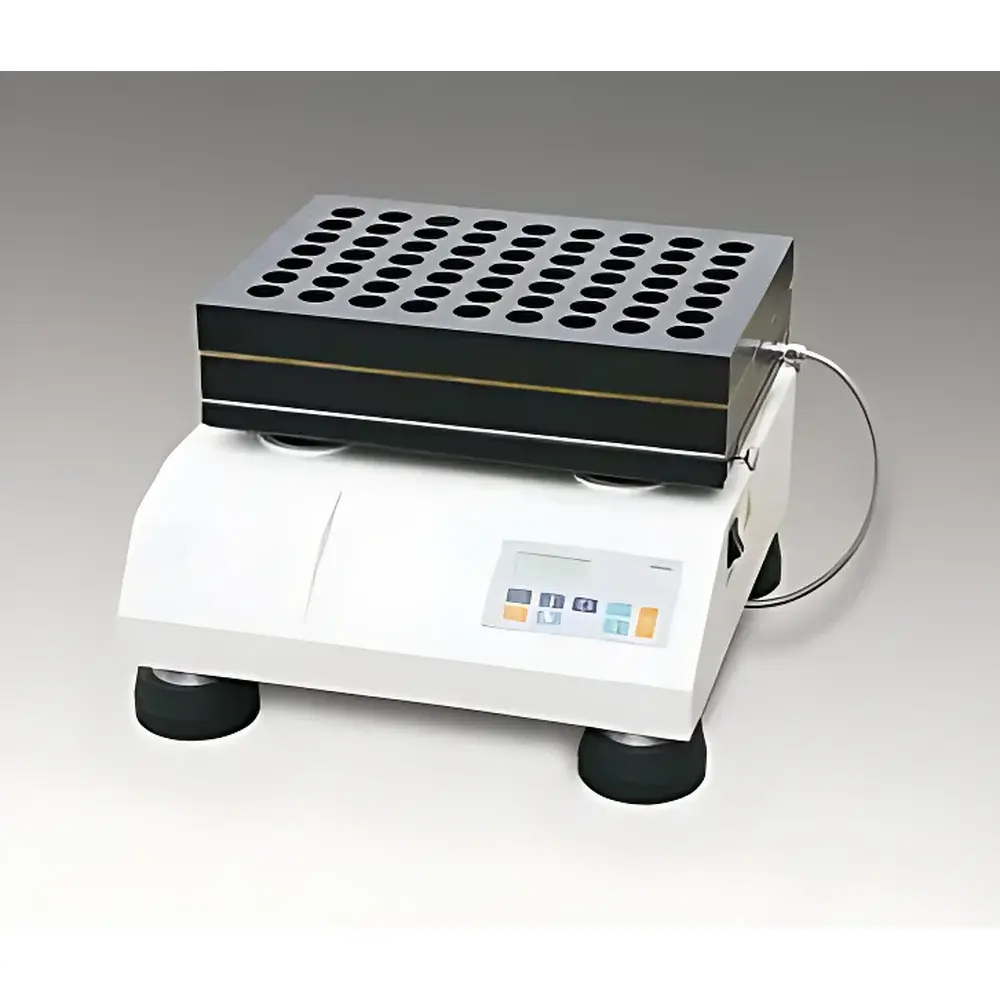
ZWY-113H40 High-Throughput Parallel Synthesizer
| Origin | Shanghai, China |
|---|---|
| Manufacturer Type | Authorized Distributor |
| Origin Category | Domestic (PRC) |
| Model | ZWY-113H40 |
| Quotation | Upon Request |
| Temperature Range | Ambient to 200 °C |
| Temperature Accuracy | ±0.1 °C |
| Timer Range | 0–500 h |
| Orbital Shaking Speed | 50–300 rpm |
| Temperature Zones | 1 |
| Water Circulation Channels | 2 |
| Power Consumption | 1300 W |
| Input Power | 220 V / 50 Hz |
| Dimensions (W×D×H) | 450 × 430 × 296 mm |
| Reaction Plate Size | 420 × 288 mm |
| Maximum Load Capacity | Φ28 mm × 63 wells |
Overview
The ZWY-113H40 High-Throughput Parallel Synthesizer is an engineered platform for controlled, reproducible multi-reaction experimentation in synthetic chemistry, process development, and early-stage catalyst screening. Designed around orbital shaking mechanics and precision conductive heating, it enables simultaneous execution of up to 63 parallel reactions under identical or independently stabilized thermal conditions—depending on configuration—within a single reaction plate. Its core architecture integrates a robust shaker base with a thermally isolated, aluminum-alloy reaction block featuring embedded heating elements and dual independent water circulation channels for enhanced thermal uniformity and rapid heat transfer. Unlike conventional benchtop reactors, the ZWY-113H40 operates on a modular principle: the reaction block, digital temperature controller, thermocouple-based feedback loop, and oscillation drive are functionally decoupled yet synchronized, allowing for system-level calibration traceability and long-term operational stability. This design supports both open-vessel synthesis (e.g., solvent reflux via optional condenser kits) and sealed-vessel protocols under inert atmosphere when coupled with compatible septa and gas manifolds.
Key Features
- Single-zone precision temperature control from ambient to 200 °C with ±0.1 °C accuracy across the full working range, verified per ASTM E220 calibration methodology.
- Orbital shaking mechanism delivering consistent 50–300 rpm motion with adjustable amplitude, ensuring homogeneous mixing without vortexing or splashing in standard 28 mm-diameter reaction vessels.
- Dual-channel water circulation system integrated into the heating block, enabling rapid thermal equilibration and minimizing axial temperature gradients (<0.3 °C deviation across 420 × 288 mm plate surface).
- Embedded programmable timer supporting up to 500 hours of unattended operation, with real-time elapsed time display and automatic shutdown upon cycle completion.
- RS232 serial interface compliant with Modbus RTU protocol for external monitoring, data logging, and remote parameter adjustment using third-party SCADA or LIMS platforms.
- Optional accessories include external chiller integration (down to 80 °C cooling capability), built-in thermal printer for timestamped temperature reports, and multi-segment programmable ramp-soak profiles (9 segments, 18 steps).
Sample Compatibility & Compliance
The ZWY-113H40 accommodates standard borosilicate glass or stainless-steel reaction tubes (Φ28 mm max diameter) arranged in a 63-well grid (7 × 9 layout) on a removable aluminum reaction plate sized 420 × 288 mm. Vessel compatibility extends to screw-cap vials, pressure-rated reactors (with appropriate sealing hardware), and microtiter-format inserts when used with adapter plates. All thermal and mechanical components conform to IEC 61010-1:2010 safety standards for laboratory electrical equipment. The unit supports GLP-compliant workflows through audit-trail-ready timer logs and RS232 data export—enabling alignment with FDA 21 CFR Part 11 requirements when paired with validated software clients. It is routinely deployed in academic synthesis labs, pharmaceutical process R&D groups, and fine chemical manufacturing QA/QC departments where reproducibility across parallel reaction arrays is critical.
Software & Data Management
While the ZWY-113H40 operates autonomously via its front-panel interface, its RS232 port permits bidirectional communication with host computers running custom Python- or LabVIEW-based control scripts, or commercial instrument management suites such as Thermo Fisher’s SampleManager or Agilent’s OpenLab ECM. Temperature setpoints, real-time readings, shaking speed, and timer status are queryable at 1-second intervals. Logged data may be exported in CSV format for statistical analysis in JMP, Minitab, or MATLAB. Optional firmware upgrades support timestamped event logging (e.g., “Setpoint changed at 14:22:07”), facilitating root-cause analysis during method troubleshooting or regulatory audits.
Applications
- Rapid screening of catalytic systems—including hydrogenation, cross-coupling, and asymmetric transformations—across variable temperature and stoichiometric conditions.
- Reaction optimization studies (DoE implementation) involving temperature, time, and concentration matrices within a single experimental run.
- Thermal stability assessment of active pharmaceutical ingredients (APIs) and excipients under accelerated aging protocols (ICH Q1A).
- Solubility mapping and co-solvent screening for crystallization process development.
- Library synthesis in medicinal chemistry, particularly for scaffold diversification and SAR expansion under controlled aerobic or inert atmospheres.
- Preparative-scale parallel synthesis of metal–organic frameworks (MOFs) and porous polymers requiring uniform nucleation kinetics.
FAQ
Is the ZWY-113H40 suitable for exothermic reactions requiring active cooling?
Yes—when connected to an external recirculating chiller (e.g., Huber CC-K series), the dual-channel cooling circuit enables sustained operation down to 80 °C, providing effective thermal management for moderately exothermic transformations.
Can the reaction plate accommodate non-standard tube formats?
The base configuration supports Φ28 mm vessels; however, interchangeable adapter plates (sold separately) allow use of 13 mm, 16 mm, or 20 mm tubes, maintaining positional consistency and thermal coupling efficiency.
Does the device meet electromagnetic compatibility (EMC) requirements for regulated laboratories?
Yes—the unit complies with EN 61326-1:2013 for EMC in laboratory environments and carries CE marking for the European Economic Area.
What maintenance is required to ensure long-term temperature accuracy?
Annual verification using a NIST-traceable dry-block calibrator and reference thermocouple is recommended; no user-serviceable internal recalibration is required under normal operating conditions.
Is remote firmware update supported over RS232?
Firmware updates must be performed locally using the manufacturer-provided utility and USB-to-RS232 converter; network-based updates are not implemented.