
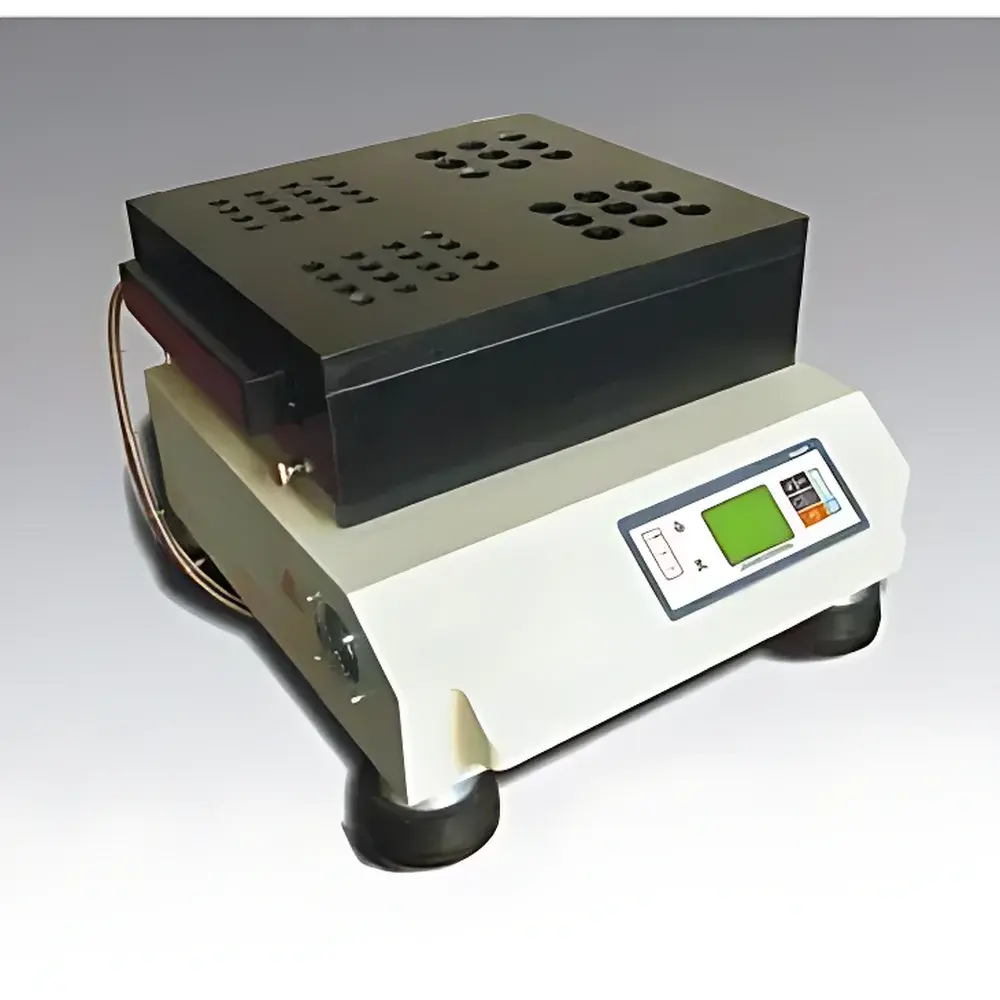
ZWY-113H4F High-Throughput Parallel Synthesis Shaker
| Origin | Shanghai, China |
|---|---|
| Manufacturer Type | Authorized Distributor |
| Origin Category | Domestic (China) |
| Model | ZWY-113H4F |
| Quotation | Upon Request |
| Temperature Range | Ambient to 200 °C |
| Temperature Accuracy | ±0.1 °C |
| Timer Range | 0–500 h |
| Orbital Speed | 50–300 rpm |
| Independent Temperature Zones | 4 |
| Integrated Water Circulation Channels | 1 |
| Power Consumption | 1300 W |
| Electrical Supply | 220 V / 50 Hz |
| Dimensions (W×D×H) | 472 × 525 × 330 mm |
| Reaction Block Dimensions | 170 × 152 × 4 mm (per block) |
| Maximum Vessel Capacity | Φ28 mm × 9 wells OR Φ17 mm × 16 wells OR Φ15 mm × 16 wells |
Overview
The ZWY-113H4F High-Throughput Parallel Synthesis Shaker is an engineered platform for controlled, multi-condition chemical synthesis under simultaneous thermal and mechanical agitation. Designed for combinatorial chemistry, catalyst screening, and reaction optimization in pharmaceutical, fine chemical, and materials research laboratories, it integrates precise orbital shaking with four independently regulated temperature zones—enabling true parallel experimentation across divergent thermal profiles. Its operational principle relies on Peltier-assisted or resistive heating (with optional external chiller integration down to 80 °C), coupled with high-stability DC motor-driven orbital motion (50–300 rpm) and real-time thermocouple feedback per zone. This architecture supports reproducible kinetic control in heterogeneous and homogeneous reactions, particularly where heat transfer uniformity, mixing efficiency, and thermal gradient independence are critical—such as in hydrogenation studies, solvent screening, and stability assessment of active pharmaceutical ingredients (APIs).
Key Features
- Four independent temperature-controlled zones with dedicated PID controllers and embedded K-type thermocouples for real-time monitoring and closed-loop regulation (±0.1 °C accuracy over ambient to 200 °C range)
- Modular reaction block system compatible with multiple vessel configurations: Φ28 mm × 9, Φ17 mm × 16, or Φ15 mm × 16—supporting standard vials, screw-cap tubes, and microtiter-format reactors
- Orbital shaking mechanism delivering consistent 20 mm diameter motion at programmable speeds (50–300 rpm), optimized for suspension homogenization and gas–liquid mass transfer
- Integrated water circulation channel enabling connection to external chillers or recirculating baths for sub-ambient operation (down to 80 °C with auxiliary cooling)
- Programmable 9-segment, 18-step temperature ramping profile (optional accessory), supporting complex thermal protocols such as stepwise crystallization or staged catalytic activation
- Onboard digital timer with 0–500 h range and auto-shutdown function, compliant with GLP-compliant unattended operation requirements
- RS232 interface (not RS322—corrected per industry standard) for bidirectional communication with laboratory PCs; supports remote parameter setting, real-time data logging, and event-triggered alerts
Sample Compatibility & Compliance
The ZWY-113H4F accommodates a broad range of reaction vessels—including borosilicate glass vials, stainless-steel autoclave inserts, and polymer-coated microplates—without cross-zone thermal interference. Each zone operates autonomously, permitting concurrent experiments with differing solvents, catalysts, or substrate concentrations under distinct thermal histories. The system conforms to IEC 61010-1 safety standards for laboratory equipment and meets electromagnetic compatibility (EMC) Class B requirements per EN 61326-1. While not inherently 21 CFR Part 11–certified, its RS232 interface and timestamped event logs support audit-ready data capture when integrated with validated third-party LIMS or ELN platforms adhering to FDA and EMA regulatory expectations.
Software & Data Management
No proprietary software is bundled; instead, the device communicates via ASCII-based serial protocol over RS232, enabling seamless integration with custom Python, LabVIEW, or MATLAB scripts for automated experiment orchestration. Users may configure logging intervals, define alarm thresholds (e.g., temperature deviation >±0.5 °C), and export time-stamped CSV files containing zone-specific temperature, speed, and elapsed time metadata. Optional embedded thermal printer (accessory) provides hard-copy traceability for QA/QC workflows requiring physical records per ISO/IEC 17025 clause 7.8. All firmware updates are delivered via UART bootloader, ensuring version control and revision history tracking.
Applications
- Rapid screening of homogeneous and heterogeneous catalysts under varied temperature–time profiles
- Optimization of reaction yield, selectivity, and byproduct formation in Suzuki, Heck, and Buchwald–Hartwig couplings
- Thermal stability assessment of intermediates and final APIs under ICH Q1A(R3) long-term and accelerated conditions
- Solubility mapping and polymorph screening using solvent-gradient evaporation protocols
- Parallel synthesis of metal–organic frameworks (MOFs) and covalent organic frameworks (COFs) requiring precise nucleation control
- Enzymatic reaction kinetics under non-isothermal conditions mimicking bioreactor thermal gradients
FAQ
Does the ZWY-113H4F support active cooling below ambient temperature?
No—the base configuration provides heating only up to 200 °C. Sub-ambient operation down to 80 °C requires connection to an external recirculating chiller via the integrated water circuit.
Can different vessel types be loaded simultaneously across the four zones?
Yes. Each zone accepts independently selected reaction blocks; users may install Φ28 mm vials in Zone 1 and Φ15 mm microtubes in Zone 3 without mechanical or thermal coupling.
Is calibration traceable to national standards?
Thermocouple inputs are factory-calibrated against NIST-traceable references. End-users may perform field verification using certified dry-block calibrators per ASTM E74-22.
What power protection features are included?
The unit incorporates overcurrent protection, thermal cutoff fuses on each heater circuit, and brownout detection to prevent restart after grid instability—ensuring sample integrity during utility fluctuations.
How is maintenance access designed for long-term reliability?
All thermal modules and drive assemblies are tool-free removable; fan filters are front-accessible; and the main PCB resides behind a hinged service panel compliant with IP2X finger-protection rating.




