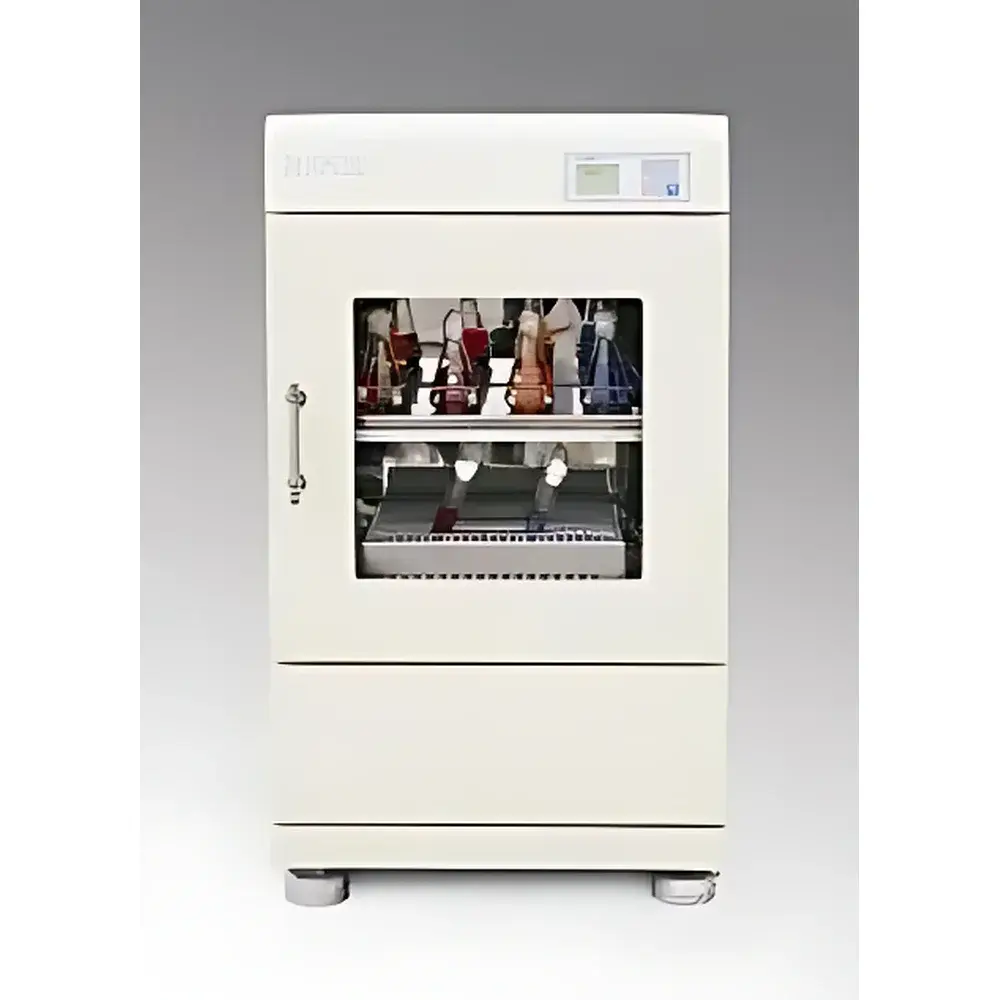
ZWY-2102C Dual-Layer Compact Temperature-Controlled Orbital Shaker
| Origin | Shanghai, China |
|---|---|
| Manufacturer Type | Authorized Distributor |
| Origin Category | Domestic (China) |
| Model | ZWY-2102C |
| Pricing | Available Upon Request |
| Control Method | PID Microprocessor-Based Environmental Scanning Controller |
| Display | Backlit LCD Screen |
| Air Circulation | Forced Convection |
| Oscillation Mode | Orbital (Circular) |
| Drive System | Multi-Dimensional Balanced Drive |
| Door Configuration | Single Front Access Door |
| Ambient Temperature Range | 5–25 °C |
| Temperature Range | 4–60 °C |
| Temperature Resolution | ±0.1 °C |
| Temperature Uniformity | ≤ ±1.0 °C (at 37 °C) |
| Temperature Stability | ≤ ±0.1 °C (at 37 °C) |
| Refrigeration Control | Manual Setpoint |
| Speed Range | 30–300 rpm |
| Speed Accuracy | ±1 rpm |
| Orbit Diameter | Φ26 mm |
| Timer Range | 0–500 h |
| Shelf Dimensions | 496 × 350 mm |
| Number of Shelves | 2 |
| Chamber Volume | 173 L |
| Interior Dimensions | 615 × 440 × 640 mm |
| External Dimensions | 720 × 630 × 1275 mm |
| Net Weight | 165 kg |
| Gross Weight | 190 kg |
| Maximum Capacity | 50 mL × 56 |
| Power Consumption | 950 W |
| Electrical Supply | AC 220 V, 50/60 Hz |
Overview
The ZWY-2102C Dual-Layer Compact Temperature-Controlled Orbital Shaker is an engineered solution for laboratories requiring precise, stable, and scalable incubation with orbital agitation under controlled thermal conditions. Designed around a vertical dual-shelf architecture, this shaker integrates forced-air convection temperature control with microprocessor-driven orbital motion—enabling consistent heat distribution and uniform mixing across two independently supported platforms. Its operational principle relies on PID-regulated thermal feedback combined with brushless AC induction motor drive, ensuring minimal thermal drift (<±0.1 °C at 37 °C), high-speed reproducibility (±1 rpm), and long-term mechanical reliability without carbon brush wear or scheduled maintenance. The unit operates within a biologically relevant temperature range of 4–60 °C—covering standard bacterial culture (30–37 °C), yeast fermentation (28–30 °C), and low-temperature enzyme assays (4–10 °C)—and is validated for use in GLP-compliant environments where traceable environmental parameters and audit-ready operation logs are essential.
Key Features
- Dual-layer vertical configuration maximizes sample throughput while minimizing floor footprint (720 × 630 mm base area), ideal for space-constrained academic, clinical, and QC laboratories.
- Microprocessor-based PID controller with real-time environmental scanning continuously monitors chamber temperature, motor load, and power integrity—triggering multi-stage safety protocols upon deviation.
- Backlit LCD interface displays setpoints and real-time values for temperature, speed, and remaining timer duration; all parameters are password-locked to prevent unauthorized modification during ongoing experiments.
- Gradual acceleration circuitry ensures smooth ramp-up to target speed, eliminating sample splashing or tube displacement during startup—critical for fragile cultures, suspension cells, or low-volume reagent mixing.
- Robust steel-reinforced electrostatically coated chassis with tempered glass front window enables visual monitoring without compromising thermal or vibrational isolation.
- Integrated safety systems include over-temperature cutoff, motor overheating protection, power-failure recovery mode, and audible/visual end-of-timer alerts compliant with ISO 13485 risk management principles.
Sample Compatibility & Compliance
The ZWY-2102C accommodates standard microbiological and molecular biology vessels—including Erlenmeyer flasks (50–750 mL), test tubes, deep-well plates, and culture bottles—on two independent 496 × 350 mm stainless-steel shelves. Each shelf supports up to 56 × 50 mL flasks or 18 × 750 mL vessels, with Φ26 mm orbital amplitude optimized for oxygen transfer in aerobic cultures. The unit meets IEC 61010-1 safety standards for laboratory equipment and is compatible with ISO/IEC 17025 documentation workflows. While not inherently 21 CFR Part 11–compliant, its parameter-locking, timer logging, and non-volatile memory functions support alignment with FDA-regulated validation protocols when integrated into validated laboratory information management systems (LIMS).
Software & Data Management
The embedded controller stores up to 10 user-defined programs with recall functionality, eliminating repetitive setup for routine assays such as OD600 growth curves or recombinant protein expression time courses. All runtime events—including temperature excursions, speed deviations, power interruptions, and alarm activations—are timestamped and retained in non-volatile memory for post-run review. Though no proprietary PC software is bundled, RS-232 or optional USB data export modules (available via OEM integration) allow seamless transfer of operational logs to Excel or electronic lab notebooks (ELNs) for audit trail generation and trend analysis per GxP requirements.
Applications
This shaker serves critical roles across life science research and industrial bioprocessing: microbial growth kinetics studies (E. coli, Bacillus spp.), mammalian cell suspension culture pre-expansion, plasmid amplification in LB medium, antibody production in CHO bioreactor seed trains, enzymatic hydrolysis optimization, and environmental microbiology enrichment protocols. In pharmaceutical quality control, it supports media fill simulations, sterility test incubation with agitation, and stability-indicating dissolution method development. Its 4–60 °C range and ±0.1 °C stability also make it suitable for cold-chain validation studies and low-temperature biocatalyst screening.
FAQ
What is the maximum flask size supported on each shelf?
Each shelf accommodates up to eighteen 750 mL Erlenmeyer flasks or twenty-eight 250 mL flasks, depending on neck geometry and required headspace.
Does the unit support refrigerated operation below ambient temperature?
No—the ZWY-2102C is a heating-only system with active cooling disabled; it maintains temperatures ≥4 °C above ambient but does not incorporate compressor-based refrigeration.
Is calibration certificate included with shipment?
Factory calibration verification is performed prior to dispatch; NIST-traceable temperature and speed calibration certificates are available upon request at additional cost.
Can the shaker be operated inside a cold room?
Yes—provided ambient conditions remain within 5–25 °C and relative humidity stays below 80% non-condensing; external condensation must be prevented per IEC 61010-1 Clause 7.3.2.
What maintenance is required for long-term reliability?
No scheduled motor maintenance is needed due to brushless AC induction design; periodic inspection of door gasket integrity and cleaning of air intake filters every six months is recommended.