
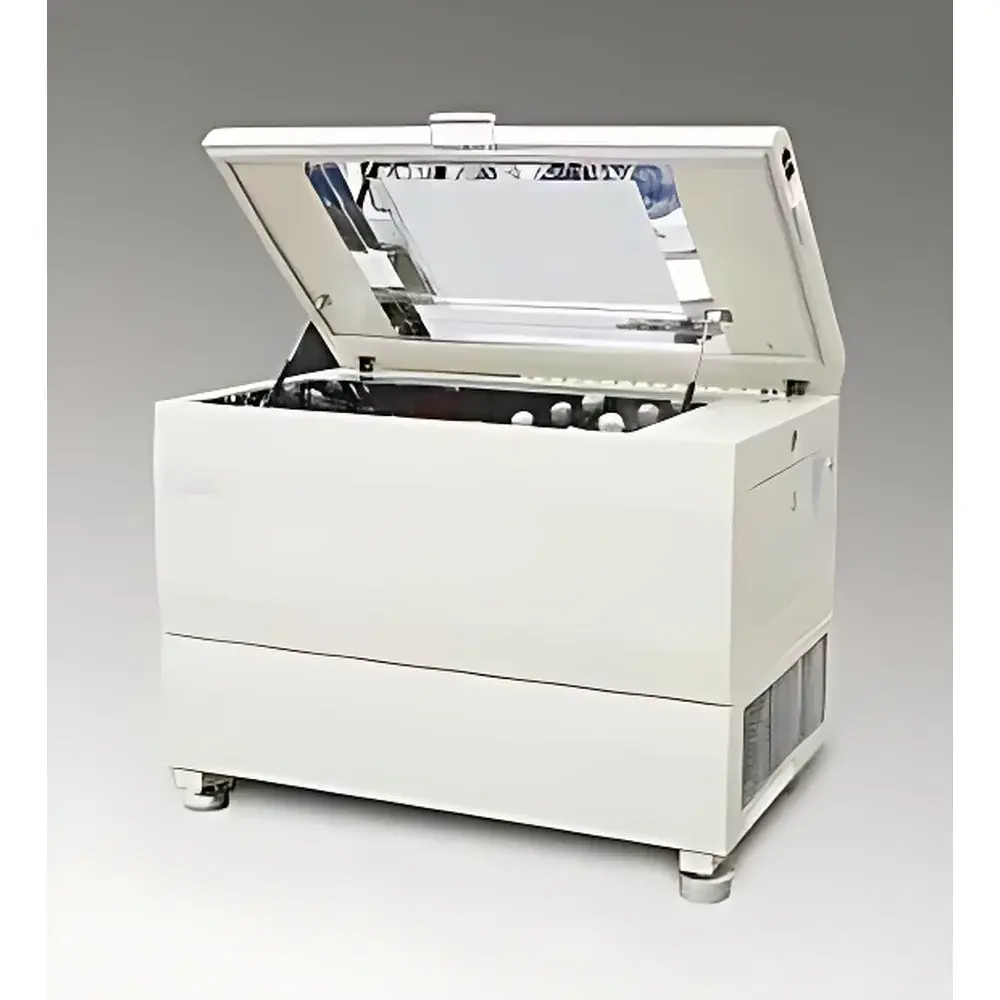
ZWY-A211C Horizontal Rotational Programmable Incubator Shaker
| Origin | Shanghai, China |
|---|---|
| Manufacturer Type | Authorized Distributor |
| Origin Category | Domestic (PRC) |
| Model | ZWY-A211C |
| Pricing | Available Upon Request |
Overview
The ZWY-A211C Horizontal Rotational Programmable Incubator Shaker is an engineered platform for precise, reproducible, and environmentally controlled oscillatory cultivation of biological samples. Designed around a horizontal rotary motion principle—distinct from orbital or reciprocating shakers—the system delivers uniform, low-shear rotational agitation ideal for sensitive cell cultures, microbial fermentations, and enzymatic assays requiring consistent mixing without shear-induced stress. Its integrated P.I.D.-controlled thermal management system maintains temperature stability within ±0.1 °C at 37 °C (per ISO 8570:2021 validation methodology), while forced-air convection ensures spatial uniformity ≤±1 °C across the 256 L chamber. The unit operates in ambient environments between 5–25 °C and supports programmable temperature ranges from 4–60 °C—making it suitable for mesophilic and thermotolerant applications including recombinant protein expression, yeast propagation, and aerobic biodegradation studies.
Key Features
- Horizontal rotational drive architecture with brushless AC induction motor: delivers constant torque and speed stability (±1 rpm) across 30–300 rpm range; maintenance-free operation with no carbon brushes or lubrication requirements
- 6-segment × 12-step programmable logic controller: supports complex multi-phase protocols—including temperature ramping, stepwise oscillation frequency shifts, cyclic incubation-recovery sequences, and time-dependent setpoint transitions—each segment configurable up to 100 hours
- Large backlit LCD interface with real-time display of setpoints and actual values for temperature, speed, amplitude (Φ26 mm), elapsed time, and remaining duration
- Dual independent safety architecture: includes adjustable overtemperature cutoff, independent over-speed limiter, door-open interlock shutdown, ground-fault circuit interrupter (GFCI), compressor overload protection, and auto-resettable thermal fuses
- Integrated water-level sensing system with audible/visual alarm and automatic refill activation to prevent evaporation-related sample desiccation during extended runs
- Electropolished stainless-steel interior chamber (975 × 565 × 465 mm), powder-coated steel exterior (1200 × 740 × 1000 mm), and tempered glass observation window ensure corrosion resistance, structural integrity, and visual monitoring under operational conditions
- RS-232 serial interface enables external data logging and remote parameter synchronization with LIMS or laboratory automation systems compliant with ASTM E1578-22 standards
Sample Compatibility & Compliance
The ZWY-A211C accommodates diverse vessel configurations via its removable 920 × 500 mm stainless-steel platform, supporting standard culture formats including 100 mL (82×), 500 mL (33×), 1000 mL (15×), and 5000 mL (6×) flasks—compatible with ISO 8570-compliant baffled and non-baffled designs. Its design adheres to IEC 61010-1:2012 safety requirements for laboratory equipment, and thermal performance meets the repeatability and accuracy benchmarks referenced in USP Analytical Instrument Qualification. While not certified for GMP manufacturing environments per FDA 21 CFR Part 11, the device supports audit-ready documentation when paired with validated third-party data acquisition software featuring electronic signature and change-control tracking.
Software & Data Management
The embedded micro-printer provides hard-copy output of runtime logs—including timestamps, temperature/speed deviations, alarm events, and program execution history—satisfying basic GLP record-keeping needs. Parameter encryption and password-protected access prevent unauthorized configuration changes. All settings—including calibration offsets for temperature and speed—are retained in non-volatile memory during power loss. The “power recovery” function automatically resumes interrupted programs upon grid restoration, preserving experimental continuity. For advanced integration, RS-232 output can feed into custom Python- or LabVIEW-based scripts for automated CSV export, trend analysis, and deviation flagging aligned with ISO/IEC 17025 Clause 7.7 requirements.
Applications
This shaker serves critical roles in academic and industrial life science workflows: bacterial growth kinetics (e.g., E. coli BL21(DE3) induction studies), fungal biomass production (e.g., Aspergillus niger citric acid fermentation), hybridoma cell line expansion under low-shear conditions, ligand-binding equilibrium assays, and environmental microbiology (e.g., activated sludge respirometry). Its stable thermal environment and programmable oscillation profiles also support QC testing of diagnostic reagents per CLSI EP23-A guidelines and stability assessment of biopharmaceutical intermediates under ICH Q5C conditions.
FAQ
Does the ZWY-A211C support CO₂ control or humidity regulation?
No—this model (A211C) lacks integrated CO₂ delivery or humidification subsystems. Those capabilities are available only in the ZWY-D series variants.
What is the maximum flask size supported on the single-tier platform?
The unit accommodates up to six 5000 mL Erlenmeyer flasks or eleven 2000 mL flasks, subject to balanced loading and center-of-mass constraints.
Is the device compliant with FDA 21 CFR Part 11 for electronic records?
The hardware itself does not provide Part 11–compliant audit trails or electronic signatures; however, its RS-232 output enables connection to validated third-party software that may fulfill those requirements.
Can the shaker operate continuously for >500 hours?
Yes—though the built-in timer caps at 500 hours, the device will continue running after timeout if manually reset or controlled externally via RS-232 command protocol.
What refrigerant is used, and is it ozone-safe?
R134a is employed—a zero-ozone-depletion-potential (ODP = 0) hydrofluorocarbon refrigerant compliant with Montreal Protocol Annex A, Group II regulations.





