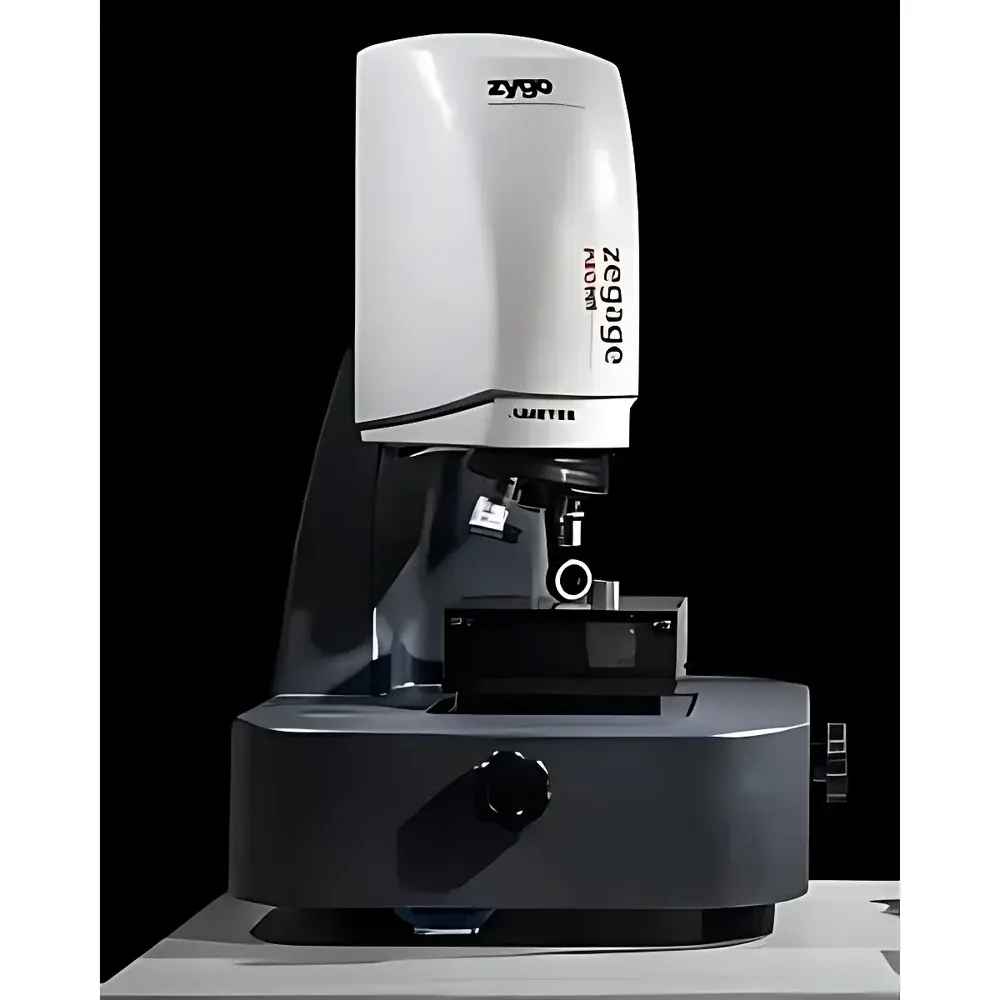
ZYGO ZeGage Pro Non-Contact 3D Optical Profilometer
| Brand | ZYGO |
|---|---|
| Origin | USA |
| Model | ZeGage Pro |
| Type | Non-Contact Profilometer / Surface Roughness Analyzer |
| Measurement Principle | Coherence Scanning Interferometry (CSI) |
| Compliance | ASTM E2947, ISO 25178-2, ISO 4287, ISO 10360-5 |
Overview
The ZYGO ZeGage Pro is a high-precision, non-contact 3D optical profilometer engineered for quantitative surface topography characterization at micro- and sub-micrometer scales. It employs coherence scanning interferometry (CSI), a white-light interferometric technique that delivers nanometer-level vertical resolution and exceptional lateral repeatability across diverse material types—including reflective, semi-transparent, and moderately scattering surfaces. Unlike stylus-based profilers, the ZeGage Pro eliminates mechanical contact, eliminating tip wear, sample deformation, or risk of contamination—critical for delicate optics, MEMS devices, and coated wafers. Its modular design integrates with motorized XY stages and automated focus control, enabling rapid, repeatable measurement of large-area surfaces, step heights, curvature deviations, and areal roughness parameters in accordance with international standards.
Key Features
- Coherence scanning interferometry (CSI) engine delivering ≤0.1 nm vertical resolution and <0.5 nm RMS repeatability under controlled environmental conditions
- Large field-of-view imaging with configurable objectives (2.5× to 100×), supporting lateral resolution from 0.5 µm to 10 µm
- Automated multi-focus stitching for seamless metrology over areas up to 100 mm × 100 mm without manual repositioning
- Real-time fringe analysis and phase-shifting algorithms optimized for high-slope surfaces (up to ±70°) and low-reflectivity materials
- Rugged, vibration-insensitive optical bench architecture with integrated air-bearing stage option for high-stability metrology
- Comprehensive parameter library compliant with ISO 25178-2 (areal surface texture), ISO 4287 (profile-based roughness), and ASTM E2947 (optical interferometric profiling)
Sample Compatibility & Compliance
The ZeGage Pro accommodates a broad spectrum of sample geometries and material classes: polished silicon wafers, fused silica optics, sapphire substrates, metallic alloys, polymer films, ceramic coatings, and patterned photomasks. Its non-destructive nature supports in-line process monitoring of fragile structures such as AR/HR coatings, thin-film stacks, and MEMS cantilevers. All measurements adhere to traceable calibration protocols aligned with NIST-traceable reference artifacts. System validation reports include uncertainty budgets per ISO/IEC 17025 requirements. For regulated environments—including semiconductor fabs and medical device manufacturing—the platform supports audit-ready data logging with optional 21 CFR Part 11-compliant user access controls and electronic signature workflows.
Software & Data Management
ZYGO’s MetroPro software provides an intuitive, scriptable interface for acquisition, analysis, and reporting. It includes built-in modules for step height, film thickness (via multi-layer modeling), curvature radius, volume estimation (e.g., wear volume, coating porosity), and statistical process control (SPC) charting. Raw interferograms and processed height maps are stored in vendor-neutral formats (e.g., .xyz, .csv, .tif) with embedded metadata (wavelength, objective ID, calibration date, operator ID). Batch processing enables unattended measurement of wafer maps or multi-site part inspection. Integration with LabVIEW, MATLAB, and Python APIs allows custom algorithm development and factory automation via SECS/GEM or OPC UA protocols.
Applications
- Semiconductor & MEMS: Quantitative assessment of CMP uniformity, lithographic resist profile fidelity, TSV sidewall angle, and MEMS actuator displacement hysteresis
- Precision Optics: Full-aperture surface form error mapping (PV, RMS, Zernike decomposition), microroughness (Sa, Sq, Sz), and coating uniformity verification on lenses, mirrors, and beam splitters
- Advanced Manufacturing: Tool wear analysis (edge radius, flank wear volume), machined surface texture classification (lay direction, Rsk/Rku), and mold cavity replication fidelity
- Aerospace & Automotive: Thermal barrier coating (TBC) roughness and pore distribution, cylinder bore cross-hatch geometry (angle, depth, bearing ratio), and tribological surface degradation quantification
- Materials Science: In-situ corrosion pit depth evolution, grain boundary topography in polycrystalline metals, fracture surface morphology, and polymer phase separation characterization
- Display & Touch Technologies: Spacer height uniformity on LCD/OLED panels, ITO line width and edge roughness, and micro-structured anti-glare surface metrology
FAQ
What vertical resolution can be achieved with the ZeGage Pro under standard lab conditions?
Typical vertical repeatability is <0.5 nm RMS over repeated measurements on calibrated step standards; resolution is instrument-limited by photon noise and mechanical stability, not digitization.
Does the system support measurement of transparent or multilayer thin films?
Yes—MetroPro includes thin-film analysis tools that model interference fringes from layered dielectrics and extract film thickness, index of refraction, and interfacial roughness using least-squares fitting to spectral reflectance models.
Can ZeGage Pro data be exported for statistical process control (SPC) integration?
All measured parameters export directly to CSV or XML with timestamps, operator IDs, and measurement conditions; SPC dashboards can be generated natively or via third-party MES platforms.
Is environmental vibration isolation required for routine operation?
While the system incorporates passive damping, optimal performance for sub-nanometer metrology requires either active vibration isolation or placement on a granite slab with >1 m thickness in typical industrial labs.
How does CSI differ from confocal microscopy or focus variation for surface metrology?
CSI provides superior vertical linearity and absolute height accuracy over large ranges (>100 µm), whereas confocal methods suffer from chromatic aberration-induced scaling errors and focus-variation systems exhibit slope-dependent height bias on steep features.