
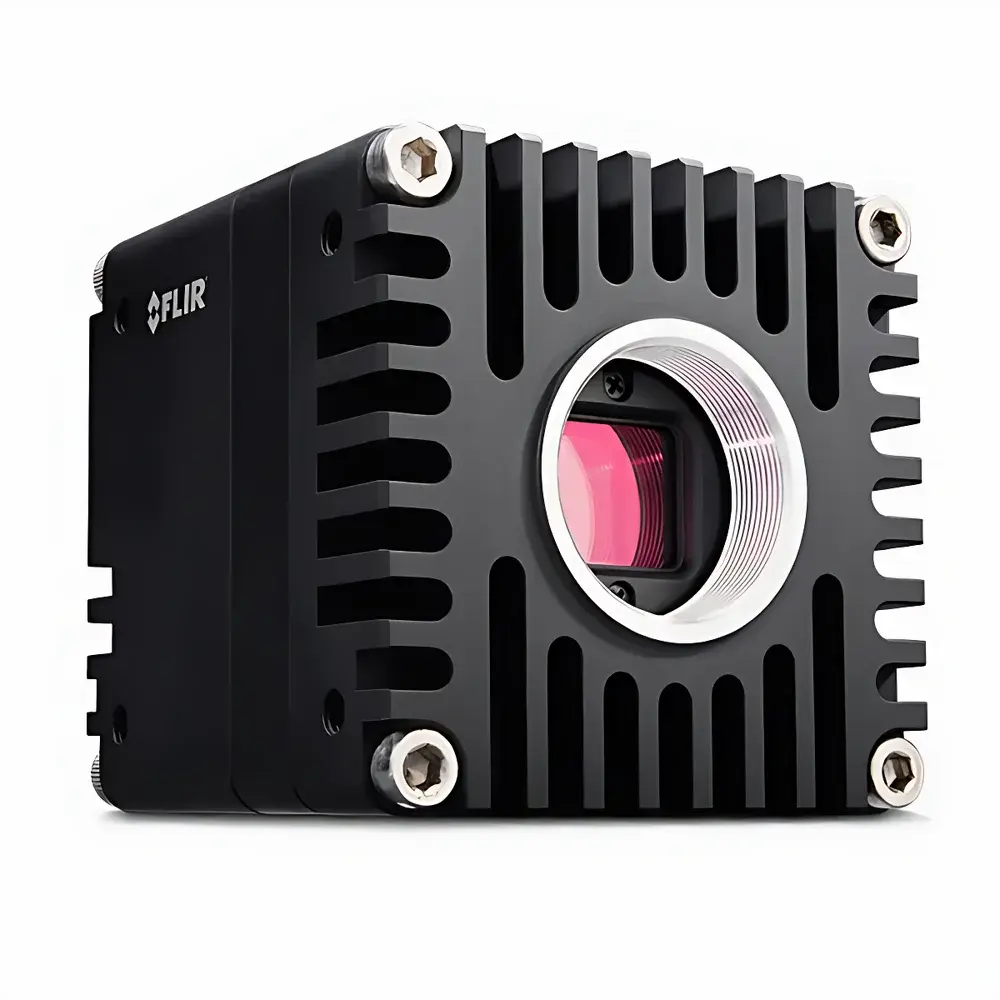
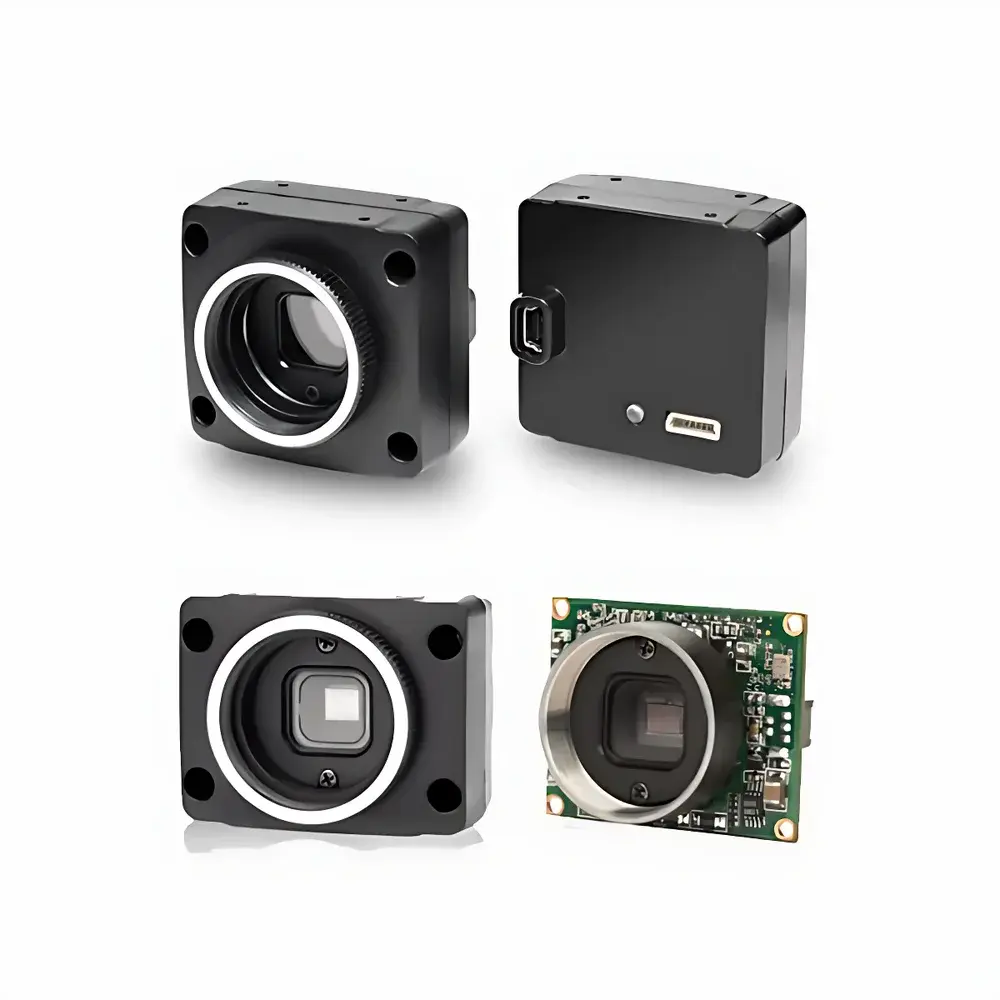
FLIR USB2 Industrial CMOS Camera
| Brand | FLIR |
|---|---|
| Origin | Canada |
| Manufacturer Type | Original Equipment Manufacturer (OEM) |
| Import Status | Imported |
| Model | USB2 Cameras |
| Image Resolution | 1296 × 964 |
| Pixel Size | 3.75 µm |
| Sensor Format | 1/2.5" (approx. 5.76 mm × 4.29 mm active area |
| note | chassis dimensions 25.5 mm × 44 mm × 41 mm refer to housing, not sensor) |
| Onboard Memory | ≥2 GB RAM |
| Interface Voltage/Current | 3.3 V, max. 150 mA |
| Dynamic Range | 57.85 dB |
| Quantum Efficiency | 46% @ 470 nm |
| Interface Standard | USB 2.0 (480 Mbps theoretical, ~40 MB/s sustained) |
Overview
The FLIR USB2 Industrial CMOS Camera is a compact, OEM-optimized machine vision imaging solution engineered for integration into automated inspection systems, laboratory instrumentation, and embedded optical measurement platforms. Based on a high-sensitivity global-shutter or rolling-shutter CMOS image sensor (model-specific configuration), it operates via the standardized USB 2.0 interface—providing deterministic latency, plug-and-play compatibility with Windows, Linux, and macOS, and robust synchronization capabilities through hardware-triggered acquisition. Its optical architecture supports C-mount lens interfacing, enabling interchangeability with standard industrial optics while maintaining mechanical stability under vibration and thermal cycling. Designed for continuous-duty operation in controlled environments, the camera delivers consistent photon-to-digital conversion performance across its specified spectral response range (typically 380–1000 nm), with peak quantum efficiency at 470 nm—making it particularly suitable for fluorescence, spectral reflectance, and monochromatic illumination applications.
Key Features
- Compact form factor (25.5 mm × 44 mm × 41 mm) optimized for space-constrained integrations including endoscopic modules, portable spectrometers, and inline quality control stations.
- C-mount lens interface with removable IR-cut/glass filter assembly, allowing flexible spectral band selection without external filter wheels.
- General-purpose input/output (GPIO) connector supporting TTL-level trigger in/out, exposure control, and status signaling—enabling precise synchronization with motion stages, lasers, or lighting controllers.
- Onboard status LED indicators for power, USB enumeration, and frame capture activity—facilitating rapid system diagnostics during commissioning and maintenance.
- Integrated tripod mounting thread (¼”-20 UNC) for quick mechanical alignment and repeatable positioning in metrology-grade setups.
- Fully compatible with FLIR’s FlyCapture SDK (v2.x and later), providing cross-platform access to low-level register control, custom ROI definition, pixel binning, and real-time histogram analysis.
Sample Compatibility & Compliance
The camera is designed for use with static or dynamically moving samples requiring visible-light imaging at moderate frame rates (up to ~30 fps at full resolution, dependent on host bandwidth and exposure settings). It complies with USB Implementers Forum (USB-IF) certification requirements for device enumeration and power delivery. While not intrinsically rated for hazardous locations or medical device classification, its electrical design adheres to IEC 61000-6-3 (EMI emission) and IEC 61000-6-2 (immunity) standards when installed per manufacturer guidelines. The absence of internal cooling fans ensures silent operation—critical for acoustic-sensitive environments such as acoustic microscopy or laser interferometry labs. For regulated industries (e.g., pharmaceutical visual inspection per USP <1118> or ISO 13485 manufacturing), validation documentation—including factory calibration reports and SDK traceability logs—can be provided upon request.
Software & Data Management
FlyCapture SDK provides native support for C++, C#, Python (via PySpin wrapper), and MATLAB interfaces. All acquired frames are timestamped with microsecond precision using the host system clock, supporting time-correlated multi-sensor experiments. The SDK implements configurable metadata embedding (e.g., exposure time, gain, trigger source), enabling audit-ready data provenance required under GLP and GMP frameworks. Raw image buffers are delivered in uncompressed Bayer or RGB8 formats; optional on-the-fly debayering and gamma correction reduce post-processing overhead. Data streaming is managed via ring-buffer memory allocation, minimizing dropped frames under sustained acquisition—even when writing directly to NVMe storage arrays. Audit trail functionality (including user session logging and parameter change history) is available when deployed with FLIR’s optional Vision Software Suite.
Applications
- Automated optical inspection (AOI) of PCB solder joints, semiconductor wafers, and surface defects in coated substrates.
- Fluorescence imaging in life science research, including GFP-tagged cell tracking and microplate reader integration.
- Dimensional metrology in conjunction with structured light projectors or telecentric lenses for sub-pixel edge detection.
- Real-time particle counting and sizing in fluidic channels using backlight illumination and binary threshold segmentation.
- Embedded vision in portable Raman spectrometers and hyperspectral line-scan systems where size, power, and interface simplicity are prioritized over ultra-high throughput.
FAQ
Is this camera supported under Linux operating systems?
Yes—the FlyCapture SDK includes native Linux drivers (x86_64 and ARM64) with kernel module signing support for Ubuntu 18.04+, CentOS/RHEL 7+, and Debian 10+.
Can I use third-party software like HALCON or OpenCV directly?
Yes—FlyCapture exposes standard V4L2 and DirectShow interfaces, enabling seamless integration with HALCON, OpenCV (cv2.VideoCapture), and LabVIEW IMAQdx.
What is the maximum cable length supported for USB 2.0 operation?
Standard passive cables are limited to 5 meters; active extension solutions (e.g., powered hubs or fiber-optic USB extenders) can achieve up to 50 meters while maintaining full bandwidth and timing integrity.
Does the camera support hardware triggering with exposure control?
Yes—via the GPIO header, users can configure rising/falling-edge trigger inputs with programmable exposure delay (0–100 ms) and pulse width modulation for strobed illumination synchronization.
Is firmware upgradable in the field?
Yes—firmware updates are performed via FlyCapture GUI or command-line utility, preserving all user-configured parameters and calibration offsets across versions.




