
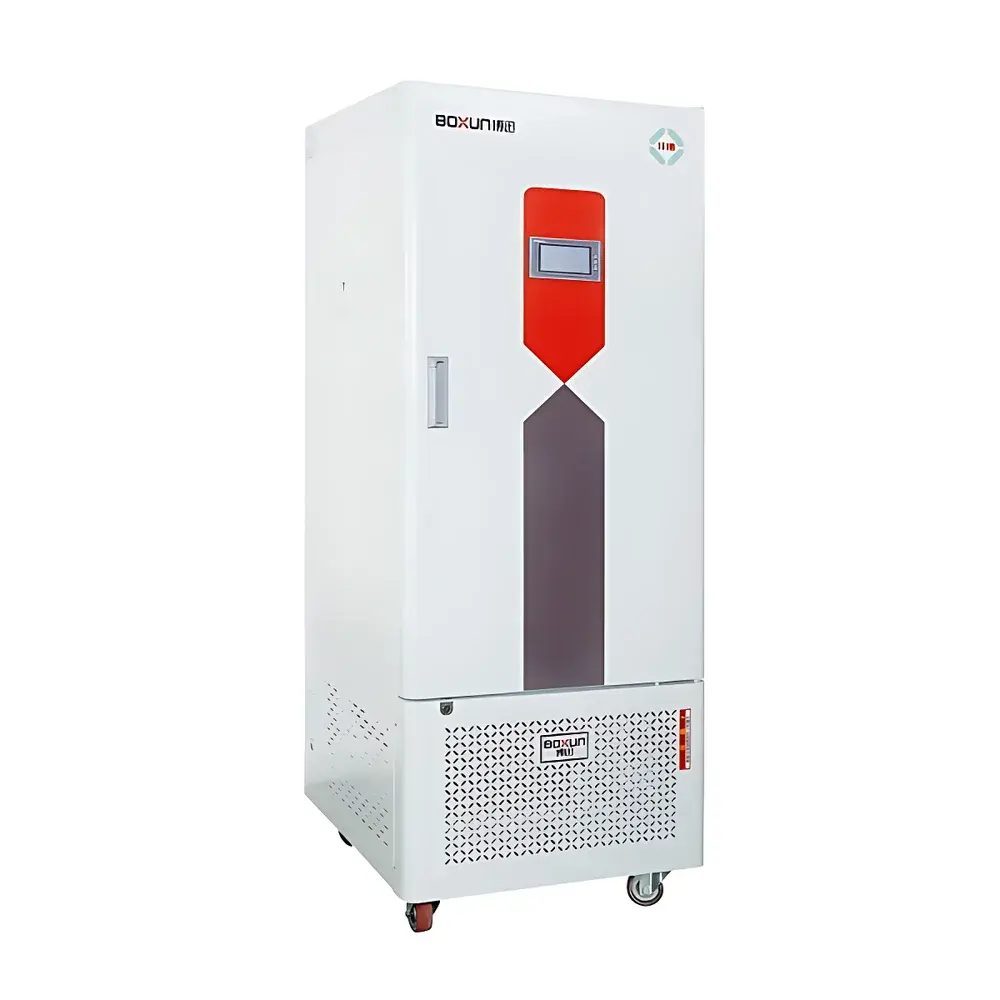
Boxun BGA-400 Plant Growth Chamber
| Brand | Boxun |
|---|---|
| Origin | Shanghai, China |
| Manufacturer Type | Direct Manufacturer |
| Region of Origin | Domestic (China) |
| Model | BGA-400 |
| Pricing | Upon Request |
| Illumination Method | Shelf-Mounted LED Lighting |
| Light Source | Full-Spectrum LED Array (Far-Red, Red, Blue, White) |
| Spectral Range | Visible Spectrum (400–700 nm PAR) |
| Temperature Control Range | 0–70 °C |
| Temp. Fluctuation | ±0.5 °C (at 25 °C) |
| Temp. Uniformity | ±1 °C (at 25 °C) |
| Humidity Range | 50–95 % RH |
| Humidity Fluctuation | ±3–7 % RH |
| Illuminance Range | 0–40,000 lux (stepless dimming) |
| Chamber Capacity | 400 L |
| Internal Dimensions (W×D×H) | 600 × 640 × 1050 mm |
| External Dimensions (W×D×H) | 745 × 1070 × 1695 mm |
| Max. Growth Height | 450 mm |
| Total Growth Area | 0.77 m² |
| Standard Shelves | 2 (max. 4) |
| Standard Light Layers | 2 (max. 4) |
| Power Input | 2350 W |
| Display | 4.3″ LCD Touchscreen |
| Data Storage | >100,000 records with USB export |
| Communication | RS485 + USB |
| Cooling System | Inverter-Driven Refrigeration |
| Humidification | Ultrasonic Mist Generation |
| Sensor | Imported High-Accuracy Capacitive RH Sensor |
| Door Design | Dual-Glass Door with Magnetic Seal & Inner Condensate Recovery |
| Validation Ports | Two Ø30 mm side ports |
| Interior Finish | Seamless Arc-Corner Stainless Steel |
| Security | Multi-Level Password Protection |
Overview
The Boxun BGA-400 Plant Growth Chamber is an engineered environmental simulation platform designed for reproducible, long-term plant phenotyping, seed germination studies, photobiology research, and controlled-environment agriculture (CEA) applications. It operates on a dual-control principle: precise thermohygrometric regulation combined with spectrally optimized, spatially uniform photosynthetic photon flux density (PPFD)-equivalent illumination. The chamber integrates a microprocessor-based BRIGHT I control system that dynamically compensates for ambient thermal load shifts—such as door openings or external temperature drift—by continuously recalibrating compressor output, heater duty cycle, and humidifier pulse width. This ensures stable setpoint adherence across all operational conditions without manual intervention. Its 400 L working volume accommodates multi-tier cultivation under fully programmable diurnal cycles (24-hr time profiles), enabling simulation of seasonal light–temperature–humidity regimes critical for circadian rhythm studies and stress-response assays.
Key Features
- Inverter-driven refrigeration system enables frost-free operation across the full 0–70 °C range while reducing energy consumption by up to 35% compared to fixed-speed compressors.
- Shelf-integrated full-spectrum LED lighting array (far-red: 730 nm, red: 660 nm, blue: 450 nm, white: 5000 K) delivers uniform irradiance across each growth plane; individual shelf-level intensity control allows independent optimization per plant species or developmental stage.
- Ultrasonic mist humidification generates low-enthalpy water vapor (< 30 °C), minimizing leaf surface thermal shock and eliminating condensation-related pathogen risk—critical for sensitive tissue culture or high-humidity monocot protocols.
- Dual-glass observation door with magnetic sealing and inner condensate recovery prevents internal parameter disturbance during visual monitoring and eliminates manual defrosting or drip pan maintenance.
- Seamless stainless-steel interior with radius-corner construction supports ISO 14644-1 Class 7 cleanroom-compatible cleaning protocols and resists biofilm accumulation in extended-use scenarios.
- Built-in validation infrastructure includes two Ø30 mm side ports compliant with ASTM E2500-13 for probe insertion during IQ/OQ/PQ qualification, plus RS485 Modbus RTU support for integration into centralized facility monitoring systems.
Sample Compatibility & Compliance
The BGA-400 accommodates standard growth vessels—including Petri dishes, Magenta boxes, hydroponic rafts, and 10-cm pots—across up to four independently adjustable shelves. Its 450 mm vertical clearance and 0.77 m² total growth area support both rosette-forming Arabidopsis and tall-stemmed maize seedlings. All materials contacting the growth environment comply with USP Class VI biocompatibility standards. Humidity and temperature sensors are calibrated traceable to NIST standards, and data logging meets GLP requirements per 21 CFR Part 11 when paired with validated USB export workflows. The chamber satisfies ISO 17025 clause 5.9.1 for environmental monitoring equipment used in accredited testing laboratories.
Software & Data Management
The BRIGHT I operating system provides real-time graphical visualization of temperature, relative humidity, and illuminance via dual-axis trend curves synchronized to user-defined time stamps. Historical datasets—including alarm logs with timestamps, severity codes, and root-cause annotations—are stored locally for ≥12 months (≥100,000 entries). Data export occurs via encrypted USB flash drive in CSV format compatible with MATLAB, JMP, and LabArchives. Audit trails record all parameter modifications, user logins, and calibration events with immutable timestamps—enabling full compliance with FDA 21 CFR Part 11 electronic record requirements when deployed in regulated GxP environments.
Applications
- Photomorphogenesis studies requiring spectral tuning of phytochrome and cryptochrome activation pathways.
- Abiotic stress screening (drought, heat, cold) under tightly controlled VPD (vapor pressure deficit) gradients.
- Seed dormancy release assays using precisely timed far-red/red light pulses.
- Controlled-environment pre-acclimatization of tissue-cultured plantlets prior to greenhouse transfer.
- Long-duration biomass accumulation trials for C3/C4 crop models under elevated CO₂–coordinated climate scenarios (when integrated with optional gas modulation modules).
FAQ
Does the BGA-400 support third-party protocol integration via Modbus or Ethernet?
Yes—the RS485 interface supports Modbus RTU communication for bidirectional control and telemetry within SCADA or building management systems.
Can humidity be maintained below 50% RH for xerophytic species studies?
No—the system’s humidification design targets 50–95% RH; sub-50% operation requires external desiccant drying or ventilation coupling, not supported out-of-the-box.
Is the LED spectrum customizable beyond the factory-configured four-channel array?
Hardware-level spectral reconfiguration is not supported; however, intensity ratios across the four channels can be programmed per shelf to emulate natural canopy light gradients.
What validation documentation is supplied with the unit?
Each shipment includes a Factory Acceptance Test (FAT) report, sensor calibration certificates (NIST-traceable), and IQ/OQ template packages aligned with ISO/IEC 17025 Annex A.3.
How frequently must the ultrasonic humidifier tank be cleaned to prevent mineral scaling?
With deionized water use, cleaning is recommended every 14 days; tap water usage requires weekly descaling with 5% citric acid solution.





