
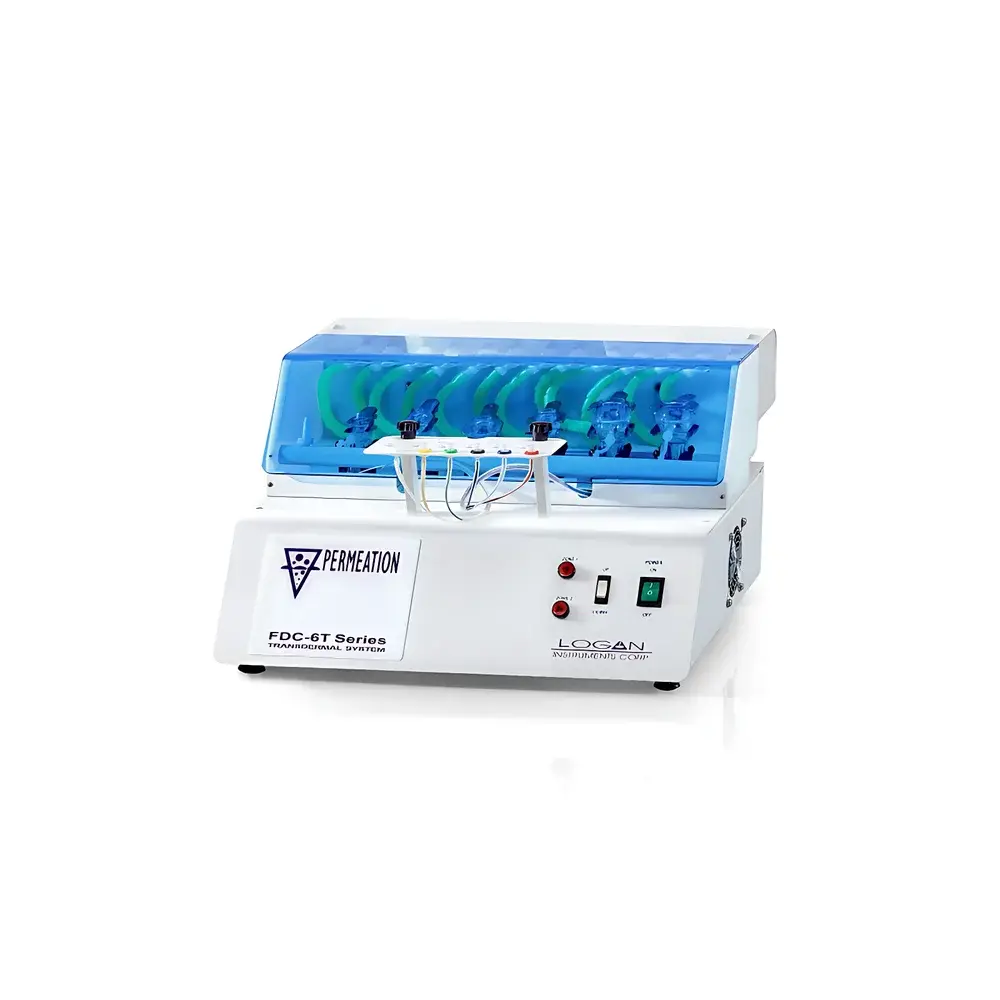
LOGAN FDC-6TA Vertical Transdermal Diffusion System
| Brand | LOGAN |
|---|---|
| Origin | USA |
| Model | FDC-6TA |
| Heating Method | Water-Jacketed Temperature Control |
| Sample Orientation | Vertical (Upright) |
| Bubble-Elimination Function | Integrated Air-Release Mechanism |
| Dual-Zone Independent Temperature Control | Yes (2 zones × 3 stations each) |
| Light-Blocking & Insulated Lid | Standard |
| Dose Volume Adjustment | Via Interchangeable Silicone Gasket Sets (Multiple Aperture Sizes) |
| Application Scope | In vitro Permeation Testing (IVPT) and In vitro Release Testing (IVRT) of Semi-Solids, Topical Dosage Forms, and Cosmetic Formulations |
Overview
The LOGAN FDC-6TA Vertical Transdermal Diffusion System is an engineered platform for standardized in vitro permeation testing (IVPT) and in vitro release testing (IVRT) of topical and transdermal pharmaceutical and cosmetic formulations. Designed in accordance with regulatory expectations outlined in FDA Guidance for Industry on “Extended-Release Dosage Forms: Development, Evaluation, and Application of In Vitro/In Vivo Correlations” and aligned with principles referenced in USP “Semisolid Dosage Forms – Performance Tests” and “Drug Release”, the FDC-6TA employs a vertical diffusion cell configuration that replicates physiological orientation and minimizes hydrostatic pressure artifacts common in horizontal setups. Its core measurement principle relies on passive diffusion across a synthetic or biological membrane (e.g., Strat-M®, porcine ear skin, or human epidermis) under controlled thermodynamic conditions—specifically, constant temperature maintenance via water-jacketed heating and precise donor compartment geometry. This architecture ensures high reproducibility in flux determination, cumulative permeation profiling, and release kinetics quantification over time.
Key Features
- Vertical cell orientation to emulate anatomical positioning and reduce membrane distortion or donor-phase convection effects.
- Integrated air-release mechanism enabling systematic degassing of donor and receptor phases prior to seal closure—critical for eliminating interfacial bubbles that compromise membrane contact and mass transfer accuracy.
- Water-jacketed heating system delivering ±0.2 °C thermal stability across all six diffusion stations, minimizing temperature gradients that affect diffusion coefficients and partitioning behavior.
- Dual-zone independent temperature control allows concurrent operation of two distinct experimental conditions—one zone at 32 °C (skin-surface simulation) and another at 37 °C (core-body temperature)—each managing three diffusion cells.
- Light-blocking, insulated lid maintains thermal homogeneity and prevents photodegradation of light-sensitive actives (e.g., retinoids, avobenzone), supporting ICH Q5C stability considerations.
- Modular silicone gasket set system enables precise donor dose volume definition (e.g., 10 µL–500 µL) without modifying cell geometry—essential for method robustness across diverse rheological formulations including hydrogels, ointments, and emulsions.
Sample Compatibility & Compliance
The FDC-6TA accommodates a broad spectrum of semi-solid dosage forms: creams, gels, ointments, lotions, patches, masks, sunscreens, and cleansers. It supports both synthetic membranes (e.g., polymeric diffusion barriers compliant with ASTM E1498) and excised biological membranes under GLP-compliant workflows. The system meets mechanical and operational criteria referenced in ISO 29681:2011 (“Cosmetics — Determination of percutaneous absorption in vitro using flow-through diffusion cells”) and aligns with FDA’s recommended practices for IVRT method validation—including assessment of sink condition maintenance, membrane integrity verification, and sampling interval justification. All hardware components are constructed from 316 stainless steel and borosilicate glass to ensure chemical resistance and cleanability per GMP Annex 15 requirements.
Software & Data Management
While the FDC-6TA operates as a benchtop hardware platform without embedded digital control, it is fully compatible with third-party data acquisition systems (e.g., Gilson FC204 fraction collectors, HPLC autosamplers, or UV-Vis spectrophotometers) via standardized ¼″-20 threaded mounting interfaces and modular sample port configurations. Experimental metadata—including temperature logs, sampling timestamps, and gasket ID tracking—is structured to support ALCOA+ principles when integrated into validated LIMS or ELN environments. For regulated environments, the system supports audit-trail-ready documentation when paired with 21 CFR Part 11–compliant software for instrument control and data capture.
Applications
- Comparative IVRT for generic topical product development per FDA Draft Guidance on “Topical Dermatological Products: In Vivo Bioequivalence Recommendations”.
- Formulation screening of penetration enhancers, nanocarriers, or pH-modulated gels using Franz-type kinetic modeling (e.g., zero-order, Higuchi, Korsmeyer-Peppas).
- Stability-indicating permeation studies assessing active degradation impact on flux profiles over accelerated storage conditions.
- Cosmetic efficacy evaluation—including substantivity of moisturizers, antioxidant delivery kinetics, and sunscreen film uniformity assessment via receptor-phase UV absorbance mapping.
- Regulatory submission support for ANDAs, NDAs, and CPVP dossiers requiring full method description, equipment qualification records (IQ/OQ), and system suitability data.
FAQ
Is the FDC-6TA compliant with USP and ?
Yes—the vertical geometry, temperature control fidelity, and membrane interface design conform to apparatus specifications and operational parameters described in these monographs.
Can the system be qualified for GMP use?
Absolutely; IQ/OQ protocols are available from LOGAN, and the stainless-steel/glass construction supports cleaning validation and routine calibration against NIST-traceable thermistors.
What membrane types are validated for use with this system?
Strat-M® membrane is routinely used for IVRT; excised porcine or human skin requires custom mounting fixtures, which LOGAN provides upon request.
Does the dual-zone control allow different temperatures between donor and receptor compartments?
No—each zone controls the entire thermal environment (donor + receptor + jacket) uniformly; independent donor/receptor temperature gradients are not supported.
Are replacement gaskets and maintenance kits available?
Yes—LOGAN supplies certified silicone gasket sets (with dimensional certification), O-rings, glass diffusion cells, and water-jacket service kits with documented shelf life and lot traceability.





