
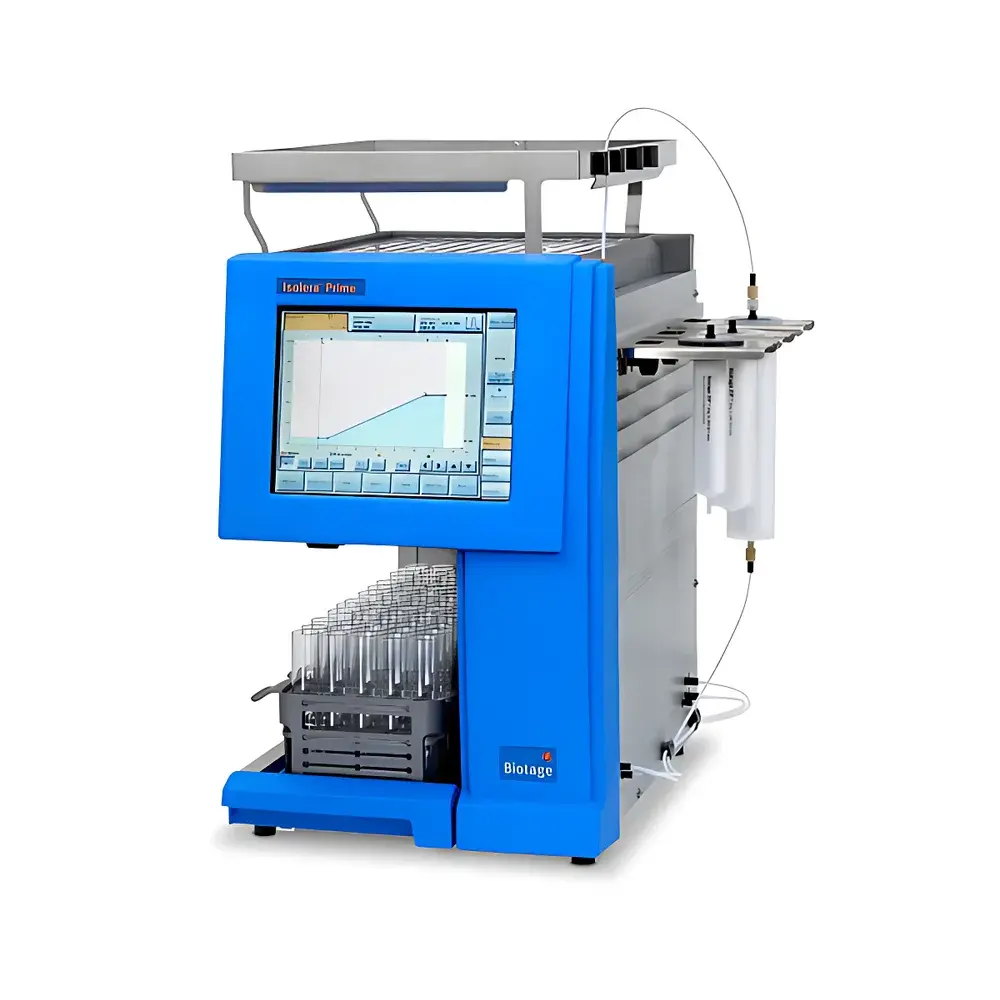
Biotage Isolera Prime Automated Flash Chromatography System
| Brand | Biotage |
|---|---|
| Origin | Sweden |
| Model | Isolera Prime |
| Instrument Type | Automated Flash Chromatography System |
| Flow Rate | 1–100 mL/min |
| Maximum System Pressure | 10 bar (150 psi) |
| UV Detection Range | 200–400 nm (standard), optional 200–800 nm |
| Gradient Capability | Dual-solvent channels with TLC-driven gradient generation |
| Fraction Collection Options | 13 mm, 16 mm, 18 mm, 25 mm test tubes |
| Display | 10.4-inch capacitive touchscreen |
| Operating System | Embedded Linux |
| Connectivity | Ethernet-enabled for remote control, data logging, and network printing |
| Compliance | Compatible with GLP/GMP workflows via audit trail-ready software architecture |
Overview
The Biotage Isolera Prime is an entry-level, fully automated flash chromatography system engineered for reliable, reproducible purification of organic compounds across academic, industrial, and pharmaceutical R&D laboratories. Unlike generic concentrators or evaporators, the Isolera Prime operates on the principle of low-pressure liquid chromatography (LPLC), utilizing controlled solvent gradients to resolve complex mixtures based on differential polarity and affinity toward stationary phases. It is not a sample concentrator in the evaporation sense—rather, it integrates intelligent fraction collection post-separation, enabling targeted isolation of purified compounds directly from crude reaction mixtures. Designed for scalability and method transfer, the system bridges the gap between analytical HPLC and preparative-scale purification, supporting load ranges from 4 mg to >100 g depending on column selection and matrix complexity.
Key Features
- Intelligent gradient generation: Automatically calculates optimal solvent gradients from user-input TLC Rf values using patented Biotage Method Scout™ technology—eliminating empirical trial-and-error.
- Dual-wavelength UV detection: Standard 200–400 nm photodiode array detector with optional 200–800 nm extension supports simultaneous monitoring at two independent wavelengths, critical for co-eluting compounds with distinct chromophores.
- High-throughput fluidics: Capable of flow rates up to 100 mL/min at ≤10 bar pressure, significantly reducing run times without compromising resolution or column integrity.
- Modular column compatibility: Accepts SNAP™ cartridges (silica, C18, amino, diol, NH₂, and custom-packed variants) as well as third-party flash columns meeting standard 10–340 mL volume specifications.
- Integrated safety and diagnostics: Real-time pressure monitoring with audible/visual alerts, automatic leak detection, and solvent/waste level sensors ensure uninterrupted operation and operator safety.
- Touch-first interface: 10.4-inch high-resolution capacitive touchscreen running embedded Linux OS provides direct access to method editing, gradient building (isocratic, linear, or stepwise), and real-time chromatogram visualization.
Sample Compatibility & Compliance
The Isolera Prime accommodates a broad range of sample types—including synthetic intermediates, natural product extracts, peptide fragments, and small-molecule APIs—provided they exhibit sufficient solubility in common flash solvents (e.g., hexane/EtOAc, DCM/MeOH, water/acetonitrile). Its modular design allows seamless integration with external detectors (e.g., ELSD, CAD, or MS-compatible flow cells) via analog/digital I/O ports, extending detection capability beyond UV-absorbing species. From a regulatory standpoint, the system supports GLP- and GMP-aligned workflows: software logs all method parameters, run metadata, detector signals, and fraction triggers with timestamped, non-editable records. Audit trail functionality complies with FDA 21 CFR Part 11 requirements when deployed with appropriate IT infrastructure and user access controls.
Software & Data Management
Controlled by Biotage’s proprietary UNIFLASH™ software (v5.x+), the Isolera Prime enables full method development, execution, and reporting without external PCs. Gradient profiles are constructed via intuitive drag-and-drop or numeric input; methods can be saved, duplicated, version-controlled, and exported as XML files for cross-platform sharing. All chromatographic data—including UV traces, pressure logs, fraction maps, and collection triggers—are stored locally on the onboard SSD and synchronized over Ethernet to network drives or LIMS. Remote monitoring and start/stop commands are supported via standard web browsers or Biotage’s mobile-responsive dashboard. Data export formats include CSV, PDF reports, and AIA-compliant chromatogram files compatible with third-party analysis tools.
Applications
- Routine purification of reaction products in medicinal chemistry and process R&D
- Isolation of bioactive constituents from plant extracts or fermentation broths
- Desalting and buffer exchange of peptides prior to LC-MS analysis
- Removal of catalysts, ligands, or protecting groups during multistep syntheses
- Method scouting and optimization for subsequent scale-up on larger Isolera systems (e.g., Dalton, One, or Four)
- Teaching chromatographic principles in undergraduate organic chemistry laboratories
FAQ
Is the Isolera Prime suitable for volatile or thermally labile compounds?
Yes—the system operates at ambient temperature and atmospheric pressure, eliminating thermal degradation risks associated with rotary evaporation or heated nitrogen blowdown concentrators.
Can I use non-Biotage columns with this instrument?
Yes—any flash column with standard Luer-lock or threaded fittings and compatible dimensions (ID × length) can be mounted using optional adapters; performance validation is recommended per application.
Does the system support method validation per ICH Q2(R2) guidelines?
While the hardware itself does not perform validation, its deterministic gradient delivery, calibrated UV response, and traceable data capture provide foundational elements required for validation protocols when combined with documented SOPs and IQ/OQ/PQ procedures.
How is fraction collection triggered?
Fractions may be collected manually, by time, by volume, or automatically based on UV threshold crossing, peak apex detection, or multi-wavelength ratio algorithms—all configurable within UNIFLASH.
What maintenance is required for long-term reliability?
Routine tasks include flushing lines with appropriate solvents between runs, replacing UV lamp annually (if used >2,000 hours), and verifying pump seal integrity every 6 months under continuous operation; no routine calibration is needed due to factory-trimmed flow and pressure sensors.



