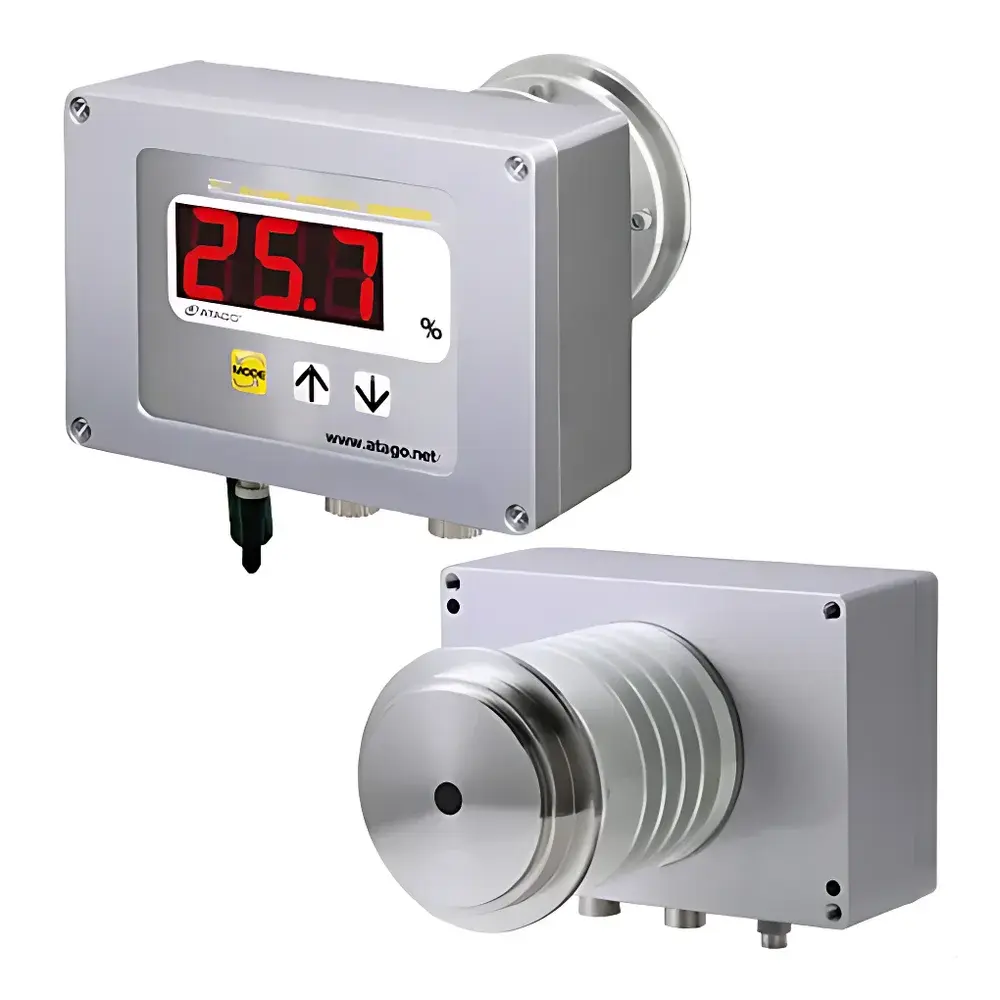
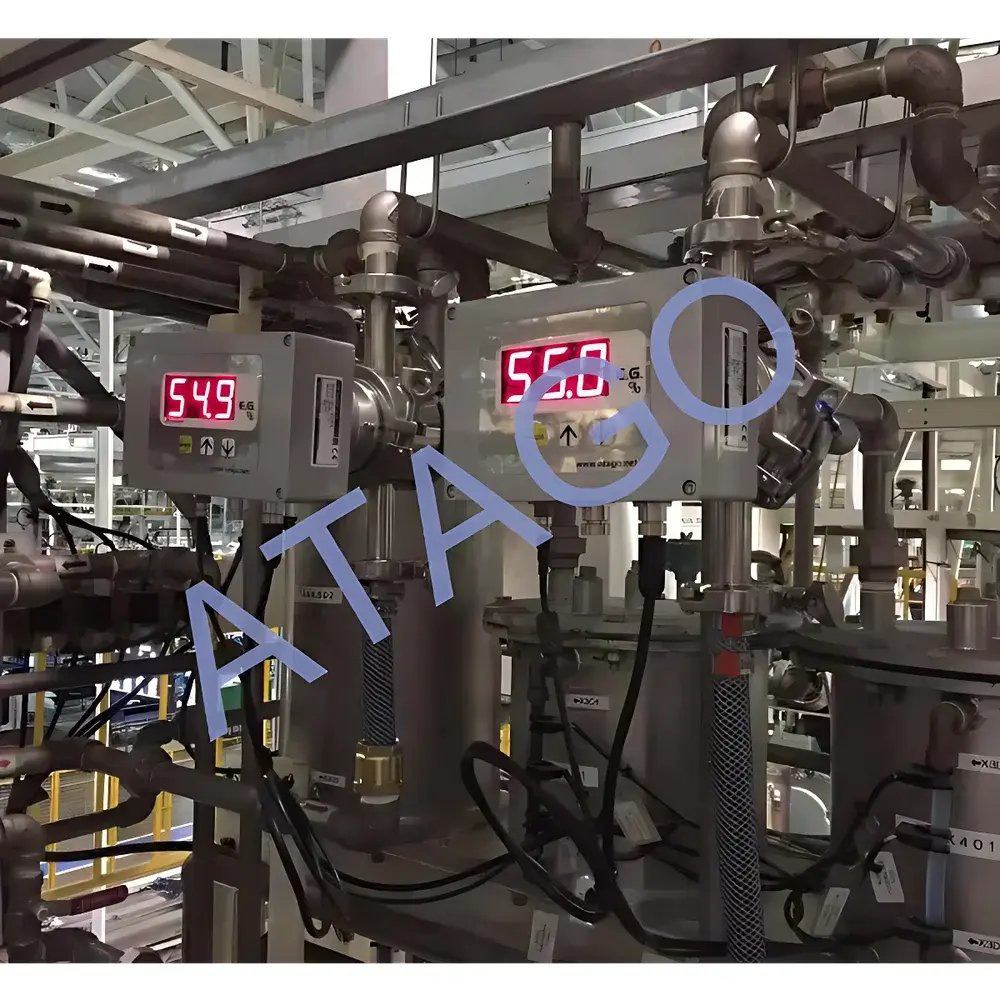
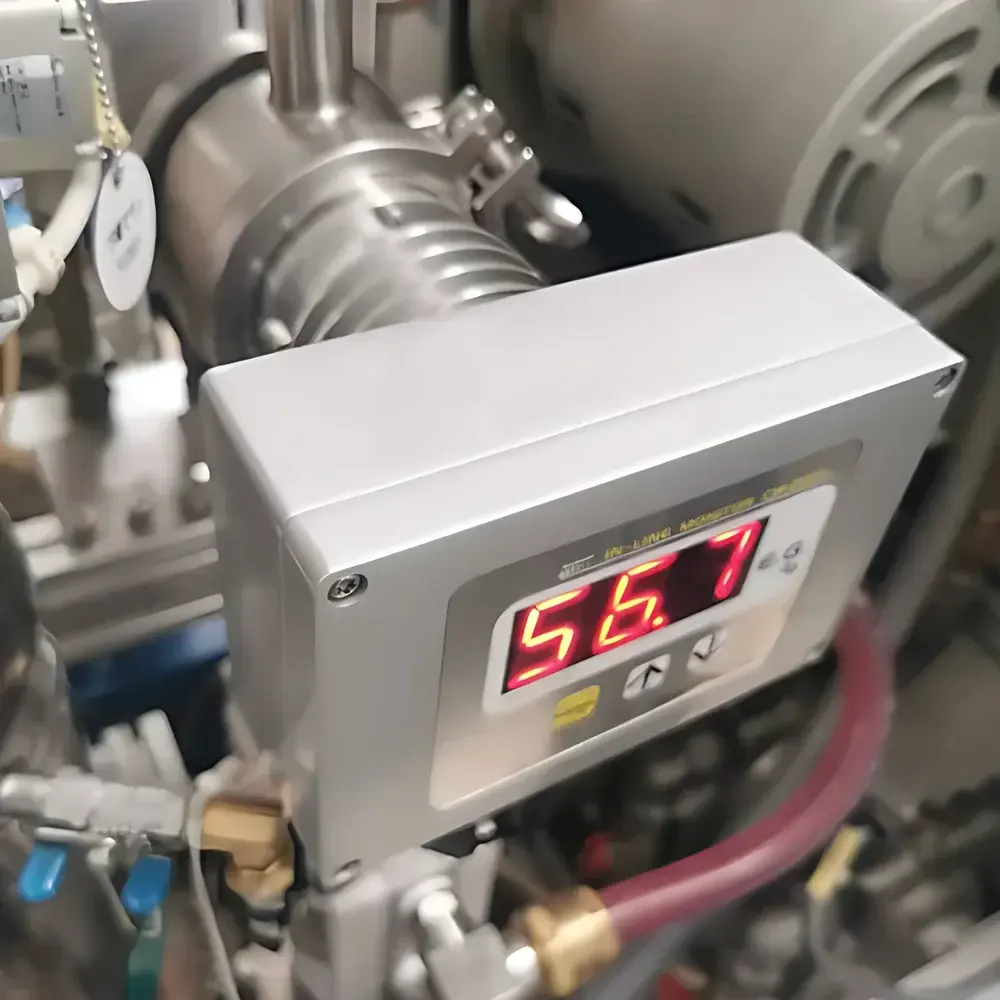
ATAGO CM-800α-DMF Online Refractometer
| Brand | ATAGO |
|---|---|
| Origin | Japan |
| Model | CM-800α-DMF |
| Measurement Range | DMF 0.0–40.0% (w/w), Temperature −15 to 160°C (5 to 320°F) |
| Resolution | DMF 0.1%, Temperature 1°C/1°F |
| Accuracy | DMF ±0.3%, Temperature ±1°C/1°F |
| Wetted Materials | SUS 316L, Synthetic Sapphire Prism |
| IP Rating | IP67 |
| Output | 4–20 mA, RS-232C |
| Light Source | LED (≈589 nm, D-line equivalent) |
| Auto-Temperature Compensation Range | 5–100°C |
| Measurement Interval | ~1 s (configurable up to 5 presets) |
| Power Supply | DC 24 V (AC 100 V optional with AD-32 adapter) |
| Dimensions | 160 × 167 × 110 mm, Weight: 2.4 kg |
Overview
The ATAGO CM-800α-DMF Online Refractometer is an industrial-grade process analytical instrument engineered for continuous, real-time monitoring of dimethylformamide (DMF) concentration in liquid streams across chemical recovery and fiber manufacturing processes. It operates on the principle of critical-angle refractometry: a collimated LED light source (center wavelength ≈589 nm, spectrally aligned with the sodium D-line) is directed onto the interface between a synthetic sapphire prism and the process fluid. The instrument precisely detects the critical angle at which total internal reflection occurs—this angle correlates directly with the solution’s refractive index. Using a pre-calibrated, temperature-compensated algorithm specific to DMF–water binary systems, the device computes mass-based DMF concentration (%) with high reproducibility and minimal drift. Unlike optical absorption or conductivity methods, refractometry is inherently insensitive to sample color, turbidity, suspended solids, micro-bubbles, or non-absorbing contaminants—making it uniquely suited for harsh, opaque, or particulate-laden process streams common in wet-process leather manufacturing, acrylic fiber coagulation baths, and solvent recovery towers.
Key Features
- High-stability sapphire prism coupled with corrosion-resistant SUS 316L wetted housing—rated for continuous exposure to aggressive organic solvents including DMF, NMP, and DMAc.
- Integrated automatic temperature compensation (ATC) across 5–100°C, ensuring measurement integrity under dynamic thermal conditions typical of distillation columns and coagulation tanks.
- IP67-rated enclosure for reliable operation in humid, washdown, or outdoor industrial environments.
- Fast measurement cycle (~1 second default, configurable in five discrete intervals) enables responsive closed-loop control of feed valves, dilution pumps, or reflux ratios.
- Dual analog and digital outputs: isolated 4–20 mA signal (HART-compatible wiring possible) for PLC/DCS integration, plus RS-232C for direct PC logging or configuration via ATAGO’s proprietary software.
- No consumables, no reagents, no moving parts—designed for >10-year service life with routine calibration verification only.
Sample Compatibility & Compliance
The CM-800α-DMF is validated for inline installation in stainless steel or lined piping systems (DN15–DN50 compatible with standard flange or sanitary clamp mounts). It complies with IEC 61000-6-2 (immunity) and IEC 61000-6-4 (emissions) for industrial electromagnetic environments. While not certified for hazardous areas (e.g., ATEX/IECEx), its low-power DC24V architecture minimizes ignition risk in classified zones when installed with appropriate barriers. The instrument supports traceable calibration per ISO/IEC 17025 guidelines when paired with NIST-traceable DMF reference standards. Its measurement methodology aligns with ASTM D1218 (refractive index of hydrocarbons) and USP principles for non-destructive concentration analysis in pharmaceutical and fine chemical applications requiring GLP-compliant data integrity.
Software & Data Management
Data output via RS-232C includes raw refractive index (nD), compensated DMF %, and real-time temperature—all timestamped and formatted for seamless ingestion into SCADA, MES, or LIMS platforms. Optional ATAGO Process Manager software enables remote configuration, trend visualization, alarm threshold setting (high/low limits, rate-of-change), and audit-trail generation compliant with FDA 21 CFR Part 11 requirements—including electronic signatures, user access levels, and immutable event logs. All measurement data retain full traceability to calibration events and environmental conditions, supporting GMP documentation workflows in regulated manufacturing settings.
Applications
- Real-time DMF concentration control in wet-process synthetic leather production—specifically in coagulation baths where precise solvent-water ratio dictates membrane porosity and tensile strength.
- Continuous monitoring of DMF-rich condensate streams in vacuum distillation recovery units, enabling dynamic optimization of energy consumption and solvent purity.
- Quality assurance in acrylic fiber spinning plants, where DMF concentration in coagulation baths must remain within ±0.5% tolerance to prevent filament defects.
- Integration into automated cleaning-in-place (CIP) cycles for solvent-handling lines, using concentration drop-off as an endpoint indicator for rinse completion.
- Supporting PAT (Process Analytical Technology) initiatives in chemical API manufacturing where solvent composition is a Critical Process Parameter (CPP).
FAQ
What is the maximum allowable process pressure for the CM-800α-DMF?
The sensor is rated for continuous operation at ≤1.0 MPa (10 bar) static pressure; higher pressures require custom pressure housings or inline pressure-reduction manifolds.
Can the instrument measure other solvents besides DMF?
It is factory-calibrated exclusively for DMF–water systems; alternate calibrations (e.g., for NMP or DMAc) require factory reprogramming and separate validation.
Is temperature compensation applied to both the refractive index and concentration output?
Yes—ATC is applied mathematically to the raw nD value prior to DMF % calculation, using a multi-point polynomial model derived from empirical DMF–water thermodynamic data.
How often does the unit require calibration verification?
ATAGO recommends quarterly verification using certified DMF reference standards; frequency may be extended to semi-annual under stable process conditions with documented historical performance.
Does the sapphire prism require periodic polishing or replacement?
No—synthetic sapphire (Mohs hardness 9) is chemically inert and abrasion-resistant; routine cleaning with deionized water or ethanol suffices for long-term optical clarity.