
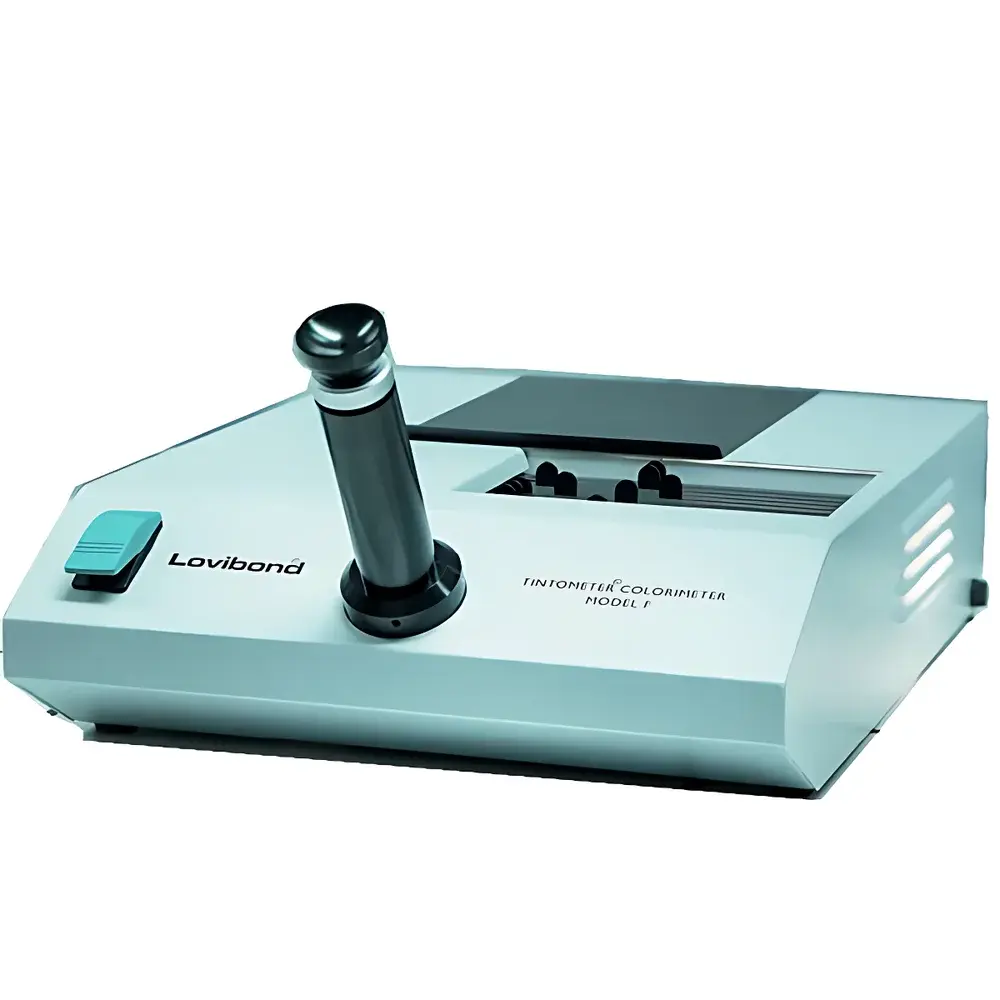
Lovibond MODEL-F Visual Colorimeter
| Brand | Lovibond (Tintometer) |
|---|---|
| Origin | United Kingdom |
| Model | MODEL-F |
| Measurement Principle | Dual-field visual comparison against Lovibond® RYBN glass filter standards |
| Color Scale | Lovibond Red (R): 0.1–79.9, Yellow (Y): 0.1–79.9, Blue (B): 0.1–49.9, Neutral (N): 0.1–3.9 |
| Resolution | 0.1 Lovibond Unit |
| Light Source | Twin 12 V / 10 W tungsten-halogen lamps |
| Illumination | Daylight-mimicking (CIE Standard Illuminant C approx.) with integrated blue filter for spectral consistency |
| Optical System | Precision prism-based dual-view field with standardized viewing geometry |
| Sample Path Length | Adjustable from 0.1 to 153 mm (0.004 to 6 in) |
| Power Supply | 220 V AC / 12 V DC adapter |
| Dimensions & Weight | 330 × 410 × 230 mm |
| Certifications | CE compliant |
| Accessories | Interchangeable R/Y/B/N filter discs (e.g., Part Nos. 180200, 180300–180400), RYBN standard filter sets (184000–187000) |
Overview
The Lovibond MODEL-F Visual Colorimeter is a precision-engineered, dual-field comparator designed exclusively for quantitative color assessment using the internationally recognized Lovibond® RYBN color scale system. Operating on the principle of visual color matching under controlled illumination, the MODEL-F enables objective evaluation of color intensity in transparent liquids, translucent suspensions, semi-solids, and reflective solids—without reliance on electronic sensors or software algorithms. Its optical architecture employs a calibrated twin-tungsten halogen light source filtered to approximate CIE Standard Illuminant C, ensuring spectral stability across repeated measurements. The instrument’s core function is based on the classical method of juxtaposing a sample’s transmitted or reflected light against a series of certified glass interference filters arranged in discrete R (Red), Y (Yellow), B (Blue), and N (Neutral) scales. Each Lovibond unit corresponds to a defined optical density increment, traceable to primary standards maintained by Tintometer Ltd., the originator and custodian of the Lovibond color system since 1870.
Key Features
- Dual-field observation system with side-by-side sample and reference viewing zones, enabling direct visual comparison under identical illumination conditions.
- Modular, interchangeable filter discs (R, Y, B, N) with three decades per scale (e.g., 0.1–0.9, 1.0–9.0, 10.0–70.0 for Red), facilitating precise interpolation and extended dynamic range.
- Integrated blue correction filter ensures consistent spectral output, minimizing metamerism and enhancing inter-instrument agreement.
- Adjustable sample path length (0.1–153 mm) accommodates diverse sample formats—including low-volume liquids, viscous pastes, and solid specimens—when used with optional solid-sample accessories.
- Removable polymeric sample cell liner prevents staining and simplifies decontamination; designed for periodic replacement to maintain optical neutrality of the measurement chamber.
- Individual glass filter elements are serviceable and replaceable without disc replacement, supporting long-term calibration integrity and reducing lifecycle cost.
- Robust mechanical construction with CE-marked power supply (220 V AC / 12 V DC) ensures stable operation in laboratory, QC, and production environments.
Sample Compatibility & Compliance
The MODEL-F supports analysis of both transparent and opaque materials. For transparent liquids (e.g., edible oils, solvents, pharmaceutical solutions), measurements follow ASTM D1209 (APHA/Pt-Co), ASTM D1500 (petroleum products), and ISO 4630 (used lubricants). For semi-solids and powders—including foodstuffs, cosmetics, and industrial pigments—the optional Solid Sample Kit enables reflectance-based grading per BS 684-2.12 and AOAC 952.02 methodologies. All Lovibond® RYBN filters are manufactured and certified by Tintometer Ltd. in accordance with ISO/IEC 17025-accredited processes. While the MODEL-F itself does not generate digital audit trails, its manual operation aligns with GLP-compliant workflows when paired with documented SOPs, operator training records, and periodic verification using certified reference standards (e.g., Lovibond Filter Set 184000).
Software & Data Management
The MODEL-F is a purely optical, analog instrument with no embedded electronics, firmware, or data logging capability. As such, it requires no software installation, network connectivity, or cybersecurity protocols. Results are recorded manually in laboratory notebooks or LIMS-compatible spreadsheets. This design eliminates risks associated with firmware obsolescence, software validation burdens, or FDA 21 CFR Part 11 compliance requirements for electronic records—making it suitable for regulated environments where simplicity, traceability, and deterministic repeatability are prioritized over automation. Calibration verification is performed visually using master reference filters supplied with each set (e.g., 185000, 186000), with documentation retained per internal QA procedures.
Applications
- Quality control of vegetable oils, biodiesel, and fatty acids per AOCS Cd 13b-92 and ISO 660.
- Color grading of honey, syrups, and fruit juices in accordance with Codex Alimentarius and national food standards.
- Assessment of oxidation stability in lubricants and transformer oils (ASTM D1500, DIN 51395).
- Pharmaceutical excipient qualification per USP and EP 2.2.42.
- Paint and coating formulation verification where RYBN correlates with yellowness index (YI) and b* values in CIELAB space.
- Educational use in chemistry and food science laboratories for teaching fundamental principles of colorimetry and human visual perception.
FAQ
Is the MODEL-F compliant with ISO/IEC 17025?
The instrument itself is not accredited, but its use within an ISO/IEC 17025-certified laboratory is fully supported when operated per validated SOPs and verified with traceable Lovibond reference filters.
Can it measure APHA/Pt-Co color?
Yes—via correlation using Lovibond Yellow scale and published conversion tables (e.g., ASTM D1209 Annex A1); however, dedicated APHA instruments are recommended for regulatory submissions requiring strict conformance.
What maintenance is required?
Routine cleaning of the prism surfaces and sample chamber liner; annual verification with master filters; replacement of tungsten-halogen lamps every ~2,000 hours of operation.
Are replacement filters supplied with NIST-traceable certificates?
Yes—each Lovibond filter set (e.g., 184000, 180200) includes a manufacturer’s certificate of conformity referencing Tintometer’s ISO/IEC 17025 scope, though not direct NIST traceability.
Does it support GMP documentation requirements?
It supports GMP through procedural controls: operator qualification, equipment logbooks, filter certification records, and documented verification protocols—not through automated data capture.






