
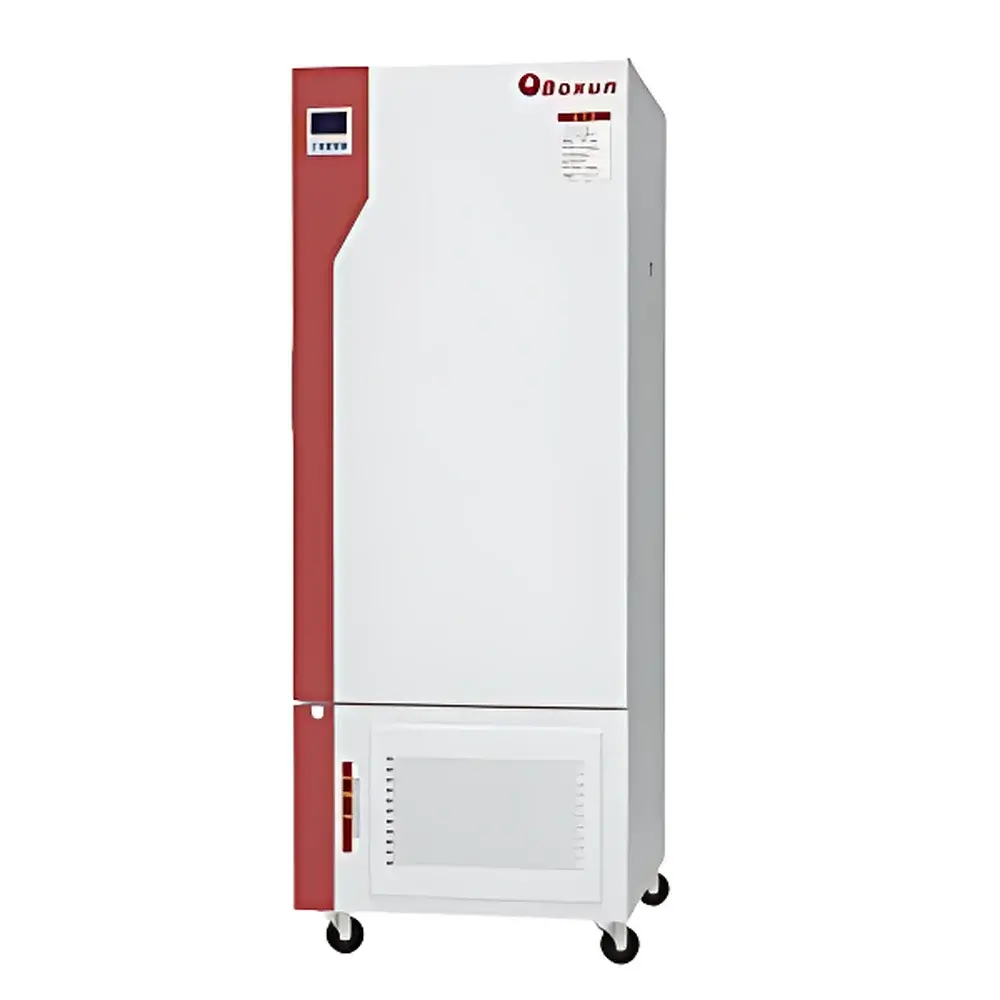
Boxun BSD-400 Orbital Shaking Incubator
| Brand | Boxun |
|---|---|
| Origin | Shanghai, China |
| Manufacturer Type | Direct Manufacturer |
| Product Origin | Domestic (China) |
| Model | BSD-400 |
| Price Range | USD 1,400 – 2,800 |
| Temperature Range | 0°C to 60°C |
| Temperature Uniformity | ±1°C (at 37°C) |
| Temperature Fluctuation | ±0.5°C |
| Temperature Resolution | 0.1°C |
| Capacity | 400 L |
| Shaking Mode | Orbital |
| Speed Range | 0–220 rpm (adjustable) |
| Orbit Diameter | 20 mm |
| Reciprocating Mode | 0–300 cycles/min (adjustable) |
| Stroke Amplitude | 30 mm |
| Shelf Dimensions (W×D×H) | 500 × 500 × 200 mm |
| Inner Chamber Dimensions (W×D×H) | 600 × 640 × 1050 mm |
| Overall Dimensions (W×D×H) | 745 × 930 × 1695 mm |
| Power Input | 1400 W |
| Timer Range | 0–9999 min |
| Standard Features | Microprocessor-based PID control, LCD display, over-temperature alarm, independent fresh-air inlet, tempered glass observation door, RS-485 interface, power-failure data retention & auto-restart, programmable 10-segment/99-cycle schedule, mechanical door lock, integrated refrigeration system with auto-defrost (non-energy-consuming), eco-friendly R134a refrigerant, centrifugal blower with proprietary air duct design |
| Optional Accessories | Thermal printer (curve printing), GPRS remote alarm module, PC monitoring software |
Overview
The Boxun BSD-400 Orbital Shaking Incubator is an engineered platform for controlled environmental cultivation of microbial, cellular, and botanical samples under simultaneous temperature regulation and mechanical agitation. Designed for laboratories requiring reproducible aerobic culture conditions—particularly in BOD analysis, microbiological assay validation, fermentation optimization, and seed germination studies—the unit integrates precision thermoregulation with variable-speed orbital shaking. Its core architecture employs a dual-function refrigeration system using R134a (CFC-free), compliant with international environmental directives including the Montreal Protocol and EU F-Gas Regulation. The incubator operates via PID-controlled microprocessor logic, delivering stable thermal performance across its full 0–60°C range, with verified uniformity of ±1°C at 37°C—a critical benchmark for ISO/IEC 17025-accredited microbiology labs. Unlike static incubators, the BSD-400’s motor-driven shaker platform ensures homogeneous oxygen transfer and suspension stability for liquid-phase cultures, directly supporting CLSI M07-A10 and USP growth kinetics requirements.
Key Features
- Microprocessor-based PID temperature control with 0.1°C resolution and ±0.5°C fluctuation tolerance
- Orbital shaking mechanism with continuously adjustable speed (0–220 rpm) and 20 mm orbit diameter; reciprocating mode available (0–300 cpm, 30 mm stroke)
- Integrated refrigeration system featuring patented non-energy-consuming auto-defrost cycle—eliminates thermal interruption during prolonged operation
- Proprietary air circulation design with centrifugal blower and multi-directional ducting, achieving ±1°C uniformity without forced convection artifacts
- Independent fresh-air inlet valve enabling dynamic atmospheric exchange while maintaining chamber integrity—critical for long-term anaerobic/aerobic transition experiments
- LCD interface with real-time display of setpoint, actual temperature, elapsed time, and alarm status; supports 10-segment, 99-cycle programmable schedules
- RS-485 serial interface compliant with Modbus RTU protocol for integration into LabVantage, STARLIMS, or custom SCADA systems
- Mechanical door lock and tempered double-glazed observation window minimize thermal leakage and support GLP-compliant access logging
Sample Compatibility & Compliance
The BSD-400 accommodates standard Erlenmeyer flasks (up to 2 L), culture tubes, petri dishes, and multi-well plates on its 500 × 500 mm stainless steel shaking platform. Its 400 L working volume and 600 × 640 × 1050 mm interior allow stacking of up to three independently regulated shelves (optional). The unit meets IEC 61010-1:2010 safety standards for laboratory equipment and conforms to ISO 14644-1 Class 8 cleanroom-compatible operation when used with HEPA-filtered air supply (add-on). It supports regulatory workflows aligned with FDA 21 CFR Part 11 (via optional audit-trail-enabled PC software), EU Annex 11, and WHO TRS 961 Annex 6 for environmental monitoring in pharmaceutical QC labs. No humidity control is provided—making it suitable for applications where moisture-sensitive media or desiccation-prone strains require dry-air environments.
Software & Data Management
Data integrity is ensured through built-in non-volatile memory that retains all setpoints, runtime logs, and alarm events during power loss. Upon restoration, the system resumes operation from the last valid state with timestamp-synchronized recovery. The RS-485 port enables bidirectional communication with third-party data acquisition systems, supporting CSV export of temperature/shake profiles at user-defined intervals (1 s to 60 min). Optional PC monitoring software provides real-time graphing, trend analysis, and PDF report generation—including deviation alerts against preloaded SOP thresholds. When paired with the thermal printer accessory, the system outputs time-stamped calibration verification curves traceable to NIST-certified references—fulfilling ALCOA+ data governance principles.
Applications
- Biochemical Oxygen Demand (BOD5) testing per ASTM D5210 and ISO 5815-1
- Microbial enumeration (total viable count, coliforms, Pseudomonas spp.) per ISO 4833-1 and APHA 9221
- Antibiotic susceptibility testing (AST) culture preparation under CLSI guidelines
- Yeast and filamentous fungal propagation for bioprocess development
- Plant tissue culture initiation and callus induction under controlled agitation
- Enzyme production kinetics in submerged fermentation systems
- Environmental isolate enrichment from water, soil, and food matrices
FAQ
Does the BSD-400 support humidity control?
No. This model is a dry-air orbital incubator; relative humidity is not regulated. For humidified applications, consider the Boxun BSD-400H variant.
What is the maximum flask size compatible with the standard platform?
Erlenmeyer flasks up to 2 L volume are supported using optional universal clamps; standard configuration holds six 1 L flasks.
Is the RS-485 interface compatible with LabVIEW and Python-based control scripts?
Yes—Modbus RTU implementation allows native integration via NI-VISA or PyModbus libraries without proprietary drivers.
How does the auto-defrost system avoid temperature drift during cycling?
It utilizes phase-change heat sink technology that absorbs latent cold energy during shutdown, eliminating compressor restart surges and maintaining chamber stability within ±0.3°C.
Can the unit operate continuously for 30 days without maintenance?
Yes—validated for unattended 720-hour runs under ISO 13485 production-grade stress testing; recommended quarterly cleaning of air filters and condenser coils.



