
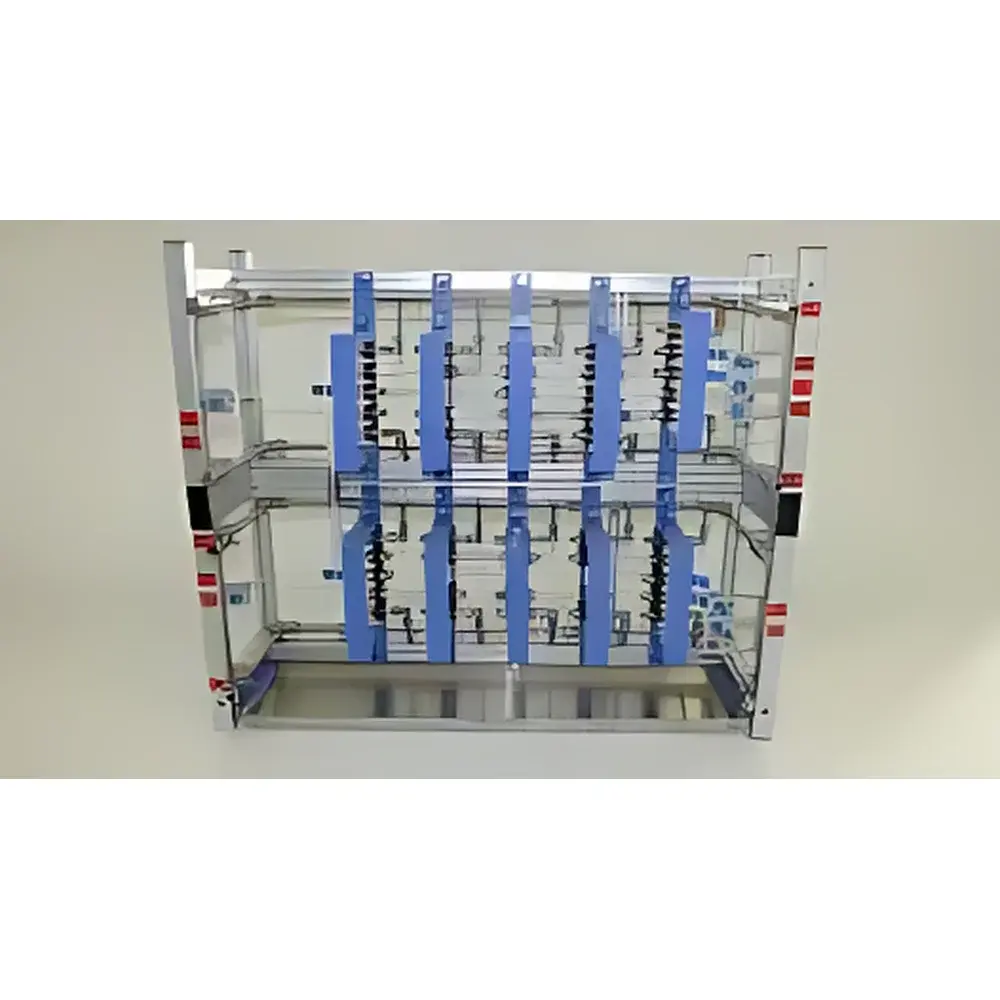
Corning G1 Glass Microchannel Reactor
| Origin | France |
|---|---|
| Manufacturer Type | Distributor |
| Origin Category | Imported |
| Model | G1 |
| Pricing | Upon Request |
Overview
The Corning G1 Glass Microchannel Reactor is an engineered platform for precise, scalable, and thermally controlled continuous-flow chemistry. Built on Corning’s proprietary fused-silica glass microstructure technology, the G1 leverages laminar flow hydrodynamics and high surface-area-to-volume ratios to deliver exceptional heat and mass transfer performance. Its core measurement and control principle is based on residence time distribution (RTD)–governed reaction kinetics under steady-state laminar flow, enabling reproducible process intensification from lab-scale screening to pilot production. With an annual liquid throughput capacity of up to 80 metric tons, the G1 bridges the gap between discovery-phase reaction scouting and small-batch GMP-compliant manufacturing of fine chemicals, pharmaceutical intermediates, and specialty materials.
Key Features
- Fused-silica glass construction ensures full optical transparency, chemical inertness toward strong acids/bases (e.g., HF-resistant up to 40% v/v at ≤60 °C), and compatibility with high-pH and halogenated reagents.
- Modular design supports rapid configuration of reaction zones—including homogeneous, heterogeneous, and multiphase modules—via standardized fluidic interfaces and thermal coupling plates.
- G1 SHH (Solid–Liquid Heterogeneous Handling) module enables robust suspension handling of catalysts (e.g., Pd/C, Raney Ni) or solid reagents without clogging, validated for particle sizes up to 50 µm at sustained flow rates.
- Integrated dual-sided thermal exchange plates provide symmetric temperature control across the entire microchannel stack, minimizing axial thermal gradients (<±0.5 °C over 10 cm channel length at 100 mL/min).
- Pressure drop characteristics are optimized for low-energy operation: ≤0.8 bar at 100 mL/min with water-like fluids (ρ = 1000 kg/m³, η = 1 cP); <0.15 bar at 10 mL/min under identical conditions.
- Residence time is precisely tunable from 5.0 seconds (at 100 mL/min) down to sub-second ranges via flow rate modulation or optional flow-splitting manifolds.
Sample Compatibility & Compliance
The G1 reactor accommodates a broad range of chemistries—including nitration, sulfonation, lithiation, hydrogenation, and photochemical transformations—across liquid, liquid–liquid, and solid–liquid systems. It is compatible with organic solvents (THF, MeCN, DCM, DMF), aqueous media, and biphasic mixtures. All wetted components comply with USP Class VI biocompatibility standards and meet ISO 10993-5 cytotoxicity requirements. The system architecture supports integration into GLP- and GMP-aligned workflows: electronic logbooks, audit-trail-enabled controllers (optional), and documentation packages aligned with ASTM E2500-13 (Good Automated Manufacturing Practice) and ICH Q7 Annex 11 principles. No internal elastomers or metallic wetted surfaces ensure trace-metal-free output—critical for catalyst-sensitive syntheses and electronic-grade chemical production.
Software & Data Management
While the G1 operates as a stand-alone hardware platform, it is designed for seamless integration with third-party process analytical technology (PAT) ecosystems. Flow controllers, temperature units, and inline UV/Vis or FTIR sensors can be synchronized via analog (4–20 mA) or digital (Modbus RTU/TCP) protocols. Corning provides comprehensive technical documentation—including FMEA reports, material certifications (RoHS, REACH), and pressure vessel compliance statements per PED 2014/68/EU—for regulatory submission support. Data acquisition and batch record generation are typically managed through customer-selected SCADA or MES platforms compliant with FDA 21 CFR Part 11 when electronic signatures and audit trails are required.
Applications
- Rapid kinetic profiling of exothermic reactions (e.g., Grignard additions, diazotizations) with real-time thermal runaway mitigation.
- Scale-down modeling for API manufacturing processes, supporting Quality-by-Design (QbD) development per ICH Q5, Q8, and Q9 guidelines.
- On-demand synthesis of unstable intermediates (e.g., diazonium salts, acyl nitriles) with millisecond-level residence time control.
- Heterogeneous catalytic hydrogenations using immobilized Pd or Pt on carbon—validated for >500 h continuous operation without activity decay.
- Photochemical cyclizations under uniform LED irradiation (365 nm), leveraging full reactor transparency and narrow RTD for quantum yield optimization.
FAQ
Is the G1 reactor suitable for handling slurries containing heterogeneous catalysts?
Yes—the G1 SHH module is specifically engineered for solid-containing streams, supporting stable operation with catalyst loadings up to 20 wt% and particles ≤50 µm at flow rates ≥10 mL/min.
What is the maximum operating pressure and temperature range?
The standard G1 glass stack is rated for continuous operation up to 20 bar and 120 °C; custom high-pressure configurations (up to 50 bar) are available upon engineering review.
Can the G1 be integrated into an automated reaction screening platform?
Absolutely—it features standardized 1/4″-UNF and M6 fluidic ports, DIN rail mounting options, and protocol-ready control signals for integration with robotic liquid handlers and automated sampling systems.
Does Corning provide validation support for GMP environments?
Corning supplies IQ/OQ documentation templates, material traceability dossiers, and factory acceptance test (FAT) protocols; site-specific PQ execution remains the responsibility of the end user’s qualified personnel.



