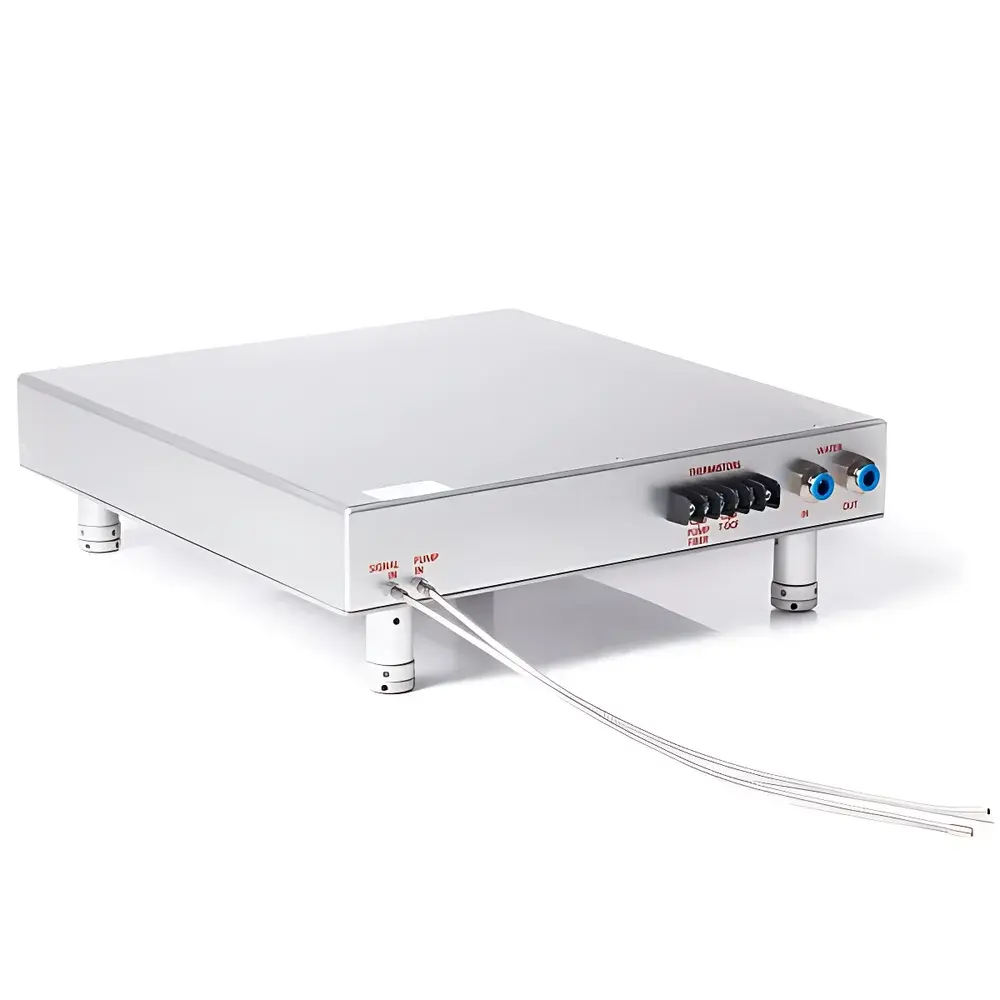
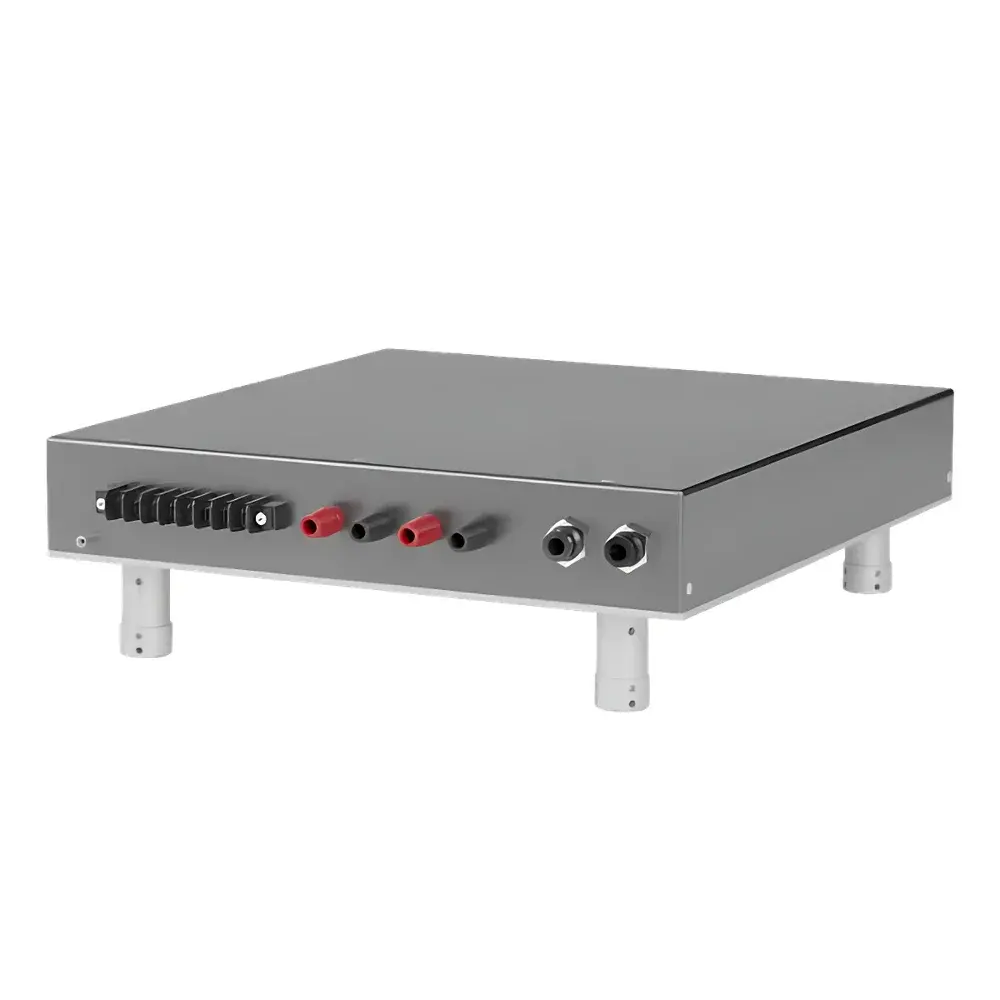
AmpliConyx TGMC-PM / TGMD-PM Benchtop Polarization-Maintaining Tapered Double-Clad Fiber Amplifier Modules
| Brand | AmpliConyx |
|---|---|
| Origin | Finland |
| Model | TGMC-PM / TGMD-PM |
| Output Power (Max) | 100 W |
| Pump Wavelength | 976 nm |
| Signal Input | PM 10/125 Fiber |
| PER (Input-Dependent) | ≥13 dB |
| Cooling | Water-Cooled |
| Dimensions (TGMC-PM) | 342 × 330 × 38 mm |
| Dimensions (TGMD-PM) | 342 × 330 × 58 mm |
| Flow Rate | 4–10 L/min |
Overview
The AmpliConyx TGMC-PM and TGMD-PM are benchtop polarization-maintaining (PM) fiber amplifier modules engineered for high-fidelity amplification of ultrafast and narrow-linewidth seed sources in demanding scientific and industrial laser systems. Both modules leverage AmpliConyx’s proprietary tapered double-clad fiber (T-DCF) technology — a monolithic, all-fiber architecture that combines large-mode-area (LMA) guidance with robust polarization extinction and minimized nonlinear phase accumulation. Unlike conventional step-index or photonic crystal fibers, the T-DCF geometry enables single-transverse-mode operation (M² < 1.3) at output powers up to 100 W while maintaining low nonlinearity, high beam quality, and excellent thermal stability. The TGMC-PM serves as a modular, externally pumped gain stage with user-accessible pump and signal ports; the TGMD-PM integrates a high-brightness 150 W pump diode, eliminating external pump coupling complexity and optimizing optical alignment repeatability. Both units employ hermetically sealed aluminum housings with precision-machined thermal interfaces, enabling direct integration with laboratory chillers or custom heat sinks.
Key Features
- Patented polarization-maintaining tapered double-clad fiber (T-DCF) core technology — delivers diffraction-limited beam quality (M² 13 dB at 1040 nm input) without active polarization control
- Full metal enclosure with CNC-machined thermal interface — optimized for conductive and water-based thermal management; baseplate compatible with standard cold plates and recirculating chillers
- Integrated temperature monitoring system — thermistors embedded at critical nodes: pump diode junction, gain fiber section, and pump combiner — providing real-time thermal feedback for stability-critical applications
- TGMD-PM includes fully integrated 150 W 976 nm pump diode with collimated free-space output — eliminates fiber-to-fiber pump coupling losses and reduces alignment sensitivity
- Standard PM 10/125 μm input fiber interface — supports common ultrafast oscillators and CW seed lasers; custom fiber types available upon request
- Factory-tested and delivered with full performance validation report — including spectral output, power stability (<±1.5% over 8 h), PER mapping, and thermal transient response data
Sample Compatibility & Compliance
The TGMC-PM and TGMD-PM modules are designed for compatibility with commercially available ultrafast fiber oscillators (e.g., Yb-doped mode-locked sources operating at 1030–1065 nm, pulse durations from 100 fs to 1 ns, repetition rates from 1 MHz to 100 MHz) and narrow-linewidth CW sources (≤10 kHz linewidth). Input signal requirements include minimum 5 mW average power and ≤30 dBm peak power to avoid nonlinear damage at the input splice. Both modules meet IEC 61000-6-3 (EMC emission) and IEC 61000-6-2 (immunity) standards. Mechanical design adheres to ISO 10110-7 surface quality specifications for internal optics, and fiber handling complies with Telcordia GR-1209-CORE for reliability under thermal cycling. All units undergo 100% burn-in testing at rated load and are certified for continuous-duty operation under GLP-compliant environmental conditions (20–25 °C ambient, 40–60% RH).
Software & Data Management
While the modules operate autonomously without firmware or embedded controllers, AmpliConyx provides a comprehensive LabVIEW-compatible DAQ interface package for third-party integration. This includes calibrated analog voltage outputs corresponding to thermistor readings (0–5 V = 0–80 °C), digital status flags (pump enable, interlock OK, thermal fault), and optional RS-485 Modbus RTU support for centralized rack monitoring. All thermal sensor channels are traceably calibrated against NIST-traceable reference thermometers (uncertainty ±0.2 °C). Raw test reports — including full spectral characterization (OSA trace), power-vs-pump curves, and PER vs. wavelength sweeps — are delivered in PDF and CSV formats, supporting audit-ready documentation per ISO/IEC 17025 and FDA 21 CFR Part 11 requirements when used in regulated environments.
Applications
- Ultrafast amplifier front-ends for OPCPA pump stages requiring >50 W average power and <1.2 M² beam parameter product
- High-power CW fiber laser seeding in materials processing systems (e.g., precision cutting of transparent ceramics)
- Polarization-sensitive interferometric metrology where PER degradation must remain below 0.5 dB over 24-hour operation
- Scientific instrumentation requiring stable, low-noise, single-spatial-mode amplification — e.g., frequency comb amplification, cavity-enhanced absorption spectroscopy
- Defense-grade directed-energy prototypes requiring MIL-STD-810G compliant thermal shock resilience and minimal modal instability onset threshold
FAQ
What is the maximum permissible seed input power for safe operation?
The modules accept up to 30 mW average input power under standard configuration. Higher inputs require custom splice optimization and are subject to nonlinear threshold evaluation.
Can the TGMD-PM be operated in CW mode without modulation?
Yes — the integrated pump diode supports both CW and modulated operation; thermal management remains effective across 0–100% duty cycle.
Is the free-space output collimated or focused?
The output is uncollimated free-space beam with near-Gaussian profile and divergence consistent with M² < 1.3; collimation optics are user-supplied per application requirements.
Are these modules qualified for use in Class 1 laser enclosures?
Yes — when installed with appropriate interlocks and beam containment, both models comply with IEC 60825-1:2014 for Class 1 system integration.
Does AmpliConyx provide OEM customization for spectral bandwidth or polarization extinction ratio?
Yes — custom T-DCF draw towers allow tailored dispersion profiles and PER enhancement beyond standard 13 dB; lead time and MOQ apply.