
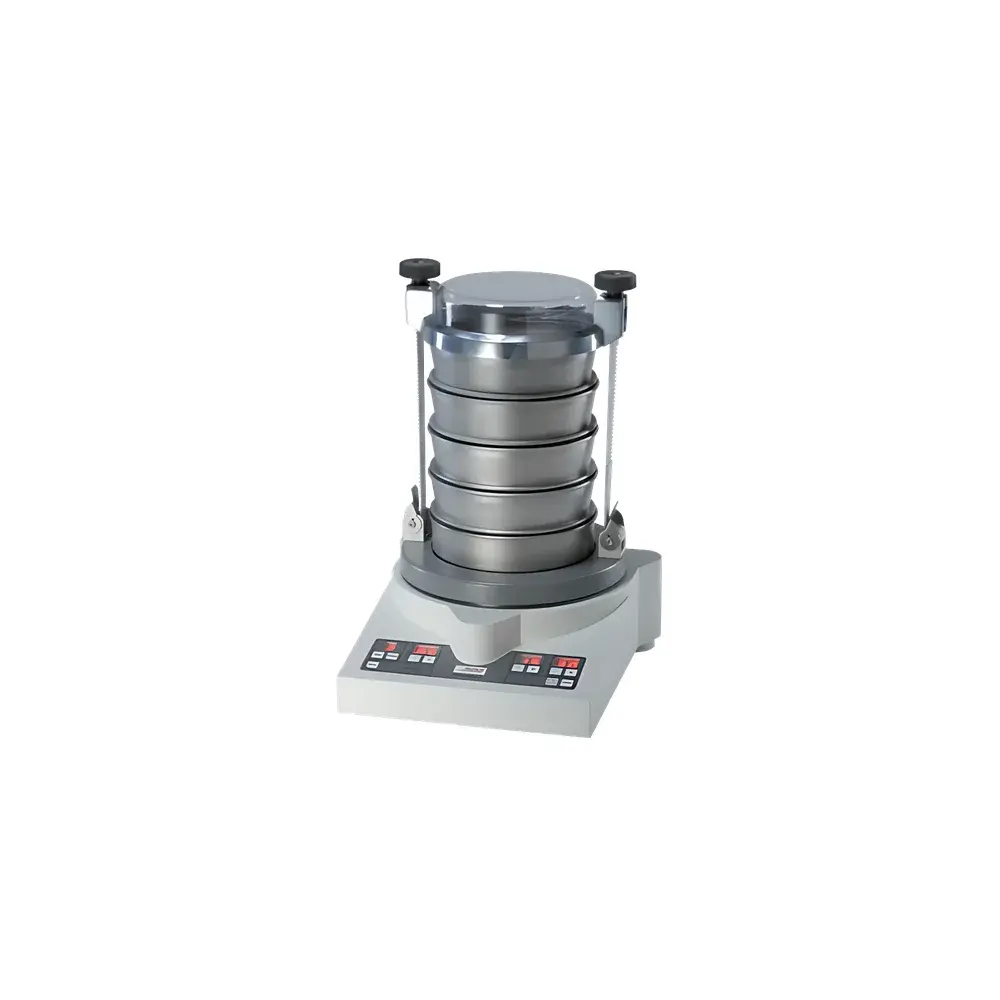
FRITSCH ANALYSETTE 3 PRO Vibratory Sieve Shaker
| Brand | FRITSCH |
|---|---|
| Origin | Germany |
| Model | ANALYSETTE 3 PRO |
| Dry Sieving Range | 32 µm – 63 mm |
| Wet Sieving Range | 20 µm – 10 mm |
| Micro Sieving Range | 5 µm – 100 µm |
| Sample Capacity (Dry) | <100 g (for <100 µm), <1 kg (for <25 mm) |
| Sample Capacity (Wet) | 20–100 g |
| Sample Capacity (Micro) | 0.2–0.5 g |
| Sieving Time (Dry) | 3–20 min |
| Sieving Time (Wet) | 3–10 min |
| Sieving Time (Micro) | 30–60 min |
| Max. Stackable Sieve Trays | 10 × 50 mm trays or 16 × 25 mm trays |
| Compliance | ISO 3310-1/-2, ASTM E11, DIN 66165, EN 10204 3.1B |
| Software Interface | AUTOSIEVE (PC-connected, GLP-compliant data logging) |
Overview
The FRITSCH ANALYSETTE 3 PRO Vibratory Sieve Shaker is a precision-engineered laboratory instrument designed for standardized dry, wet, and micro-sieving of granular and powdered materials in accordance with internationally recognized particle size analysis protocols. Based on the principle of horizontal circular vibration (gyratory motion) combined with controlled amplitude and frequency modulation, the device induces efficient particle stratification and separation across stacked sieve trays—enabling reproducible classification of particles according to their geometric dimensions. Its mechanical architecture adheres to DIN 66165 requirements for repeatability in sieve analysis, making it suitable for routine quality control (QC), raw material verification, and R&D applications in pharmaceuticals, ceramics, construction aggregates, metallurgy, and food processing industries.
Key Features
- Triple-mode operation: configurable for dry sieving (32 µm – 63 mm), wet sieving (20 µm – 10 mm), and high-resolution micro-sieving (5 µm – 100 µm) using dedicated accessories and fluid handling modules.
- Modular tray system supporting up to 10 standard 50 mm-height sieves or 16 compact 25 mm-height sieves per run—optimized for throughput without compromising mechanical stability or amplitude consistency.
- Integrated torque-based clamping mechanism automatically compensates for minor planar misalignment between sieve trays and the shaker deck, ensuring uniform energy transfer and minimizing edge effects during prolonged operation.
- Microprocessor-controlled interface with backlit LCD display provides real-time monitoring of elapsed time, remaining duration, vibration intensity, and active program ID—supporting full parameter recall and manual override.
- Onboard memory stores up to nine user-defined sieving programs—including preset amplitude/frequency profiles, timer settings, and cascade logic for multi-stage sequential runs.
- Compliance-certified sieve frames available in multiple diameters (200/50 mm, 200/25 mm, 100/40 mm, 8″/2″)—all manufactured to ISO 3310-1 (metal wire mesh) and ISO 3310-2 (perforated plate), with traceable EN 10204 3.1B inspection certificates supplied with each set.
Sample Compatibility & Compliance
The ANALYSETTE 3 PRO accommodates a broad range of sample types—including brittle solids, friable granules, cohesive powders, and suspensions—provided they meet physical compatibility criteria for vibrational separation (e.g., absence of excessive moisture-induced agglomeration in dry mode; appropriate density contrast in wet mode). All sieve meshes are validated against ISO 3310 and ASTM E11 specifications for mesh count tolerance, wire diameter, and aperture uniformity. The instrument’s operational repeatability satisfies DIN 66165 Class A performance criteria for cumulative undersize distribution deviation (<±2% RSD for repeated measurements under identical conditions). For regulated environments, the system supports audit-ready documentation when paired with AUTOSIEVE software, meeting foundational requirements for GLP and GMP-aligned workflows.
Software & Data Management
AUTOSIEVE is a Windows-based application provided free of charge by FRITSCH for direct USB or RS-232 communication with the ANALYSETTE 3 PRO. It enables remote initiation, real-time status feedback, and automated result compilation—including mass-on-each-sieve, cumulative passing/retained fractions, and D10/D50/D90 calculations. Data export formats include CSV, Excel, and PDF reports compliant with internal QA templates. Crucially, AUTOSIEVE supports cross-platform integration: sieve data can be directly overlaid with laser diffraction results from FRITSCH’s ANALYSETTE 22 or 28 series instruments, enabling hybrid particle size distribution modeling and method correlation studies. All session logs include timestamped operator ID, environmental metadata (if connected to optional temperature/humidity sensors), and electronic signatures—facilitating partial compliance with FDA 21 CFR Part 11 when deployed within validated IT infrastructure.
Applications
- Pharmaceutical excipient grading and blend uniformity assessment prior to tableting or capsule filling.
- Quality assurance of ceramic raw materials (e.g., alumina, zirconia) where particle packing density directly influences sintering behavior.
- Aggregate classification in concrete and asphalt formulation, aligned with ASTM C136 and EN 933-1 test methods.
- Food powder flowability evaluation (e.g., milk powder, flour, cocoa) via sieve cut-point analysis correlated with Hausner ratio or Carr index.
- Recycled metal powder characterization for additive manufacturing feedstock qualification (per ASTM F3049).
- Educational laboratories conducting comparative sieve analysis experiments under ISO 565 and ISO 2591-1 frameworks.
FAQ
What standards does the ANALYSETTE 3 PRO comply with for sieve calibration and validation?
It conforms to ISO 3310-1/-2 for sieve mesh specifications, DIN 66165 for repeatability, and EN 10204 3.1B for certified material test reports accompanying each sieve set.
Can wet sieving be performed without external water recirculation equipment?
Yes—the unit integrates a sealed wet sieving chamber with integrated drain port and optional spray nozzle kit; however, continuous recirculation requires external pump and filtration setup.
Is AUTOSIEVE compatible with LIMS or ERP systems?
Native LIMS integration is not embedded, but CSV/Excel exports support manual or scripted ingestion into most laboratory information management platforms.
How frequently should mechanical calibration be performed?
Annual verification of vibration amplitude and frequency accuracy is recommended using certified metrology tools; FRITSCH offers factory recalibration services with NIST-traceable documentation.
Does the system support IQ/OQ/PQ documentation packages?
Standard delivery includes basic OQ templates; full IQ/OQ/PQ kits—including risk assessments, URS alignment, and protocol execution records—are available upon request for regulated facility deployments.



