
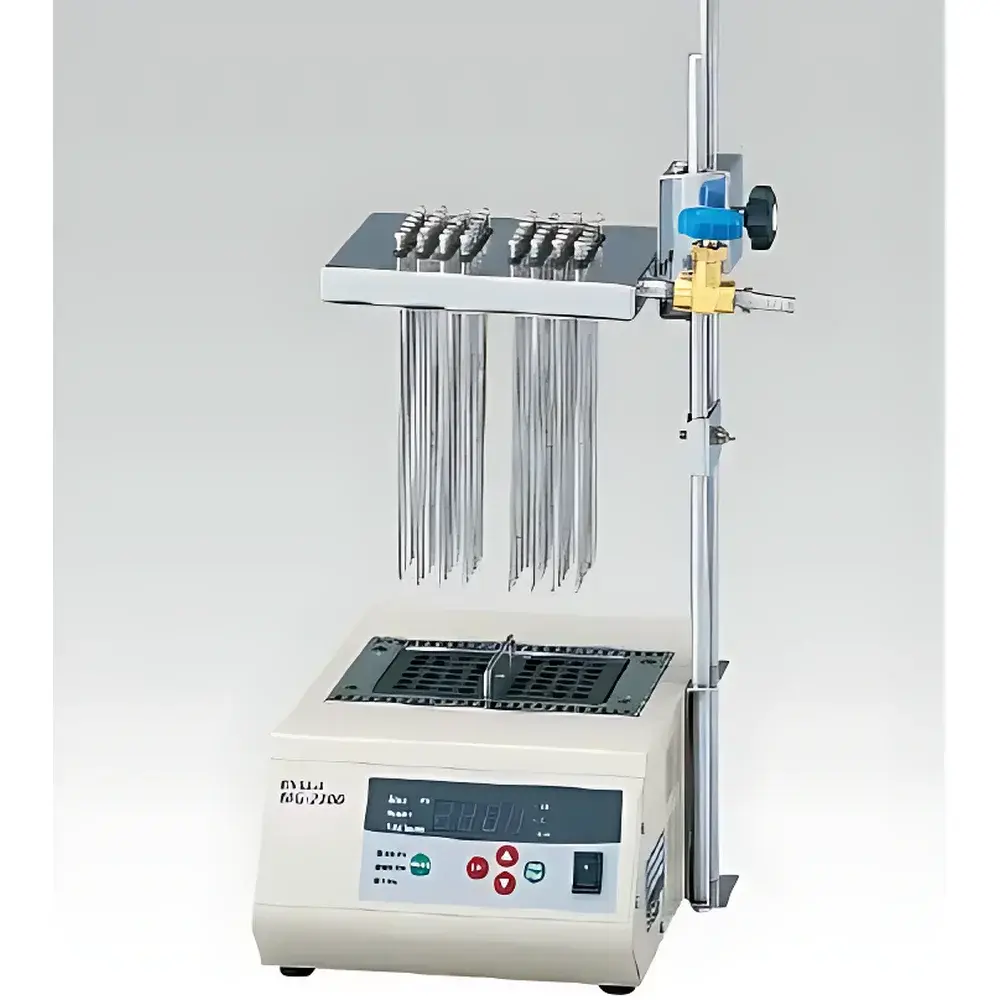
EYELA MGS Series Nitrogen Evaporator
| Brand | EYELA (Tokyo Rikakikai Co., Ltd.) |
|---|---|
| Origin | Japan |
| Model | MGS |
| Temperature Range | Ambient +5°C to 200°C |
| Temperature Accuracy | ±0.1–0.2°C |
| Control System | Microcomputer-based P.I.D. temperature control |
| Display Resolution | 0.1°C (digital LED) |
| Heating Block | Single aluminum block (90W × 125D × 70H mm), SUS304 stainless steel sample tubes (1.6 mm ID × 180 mm length) |
| Gas Filtration | Integrated 0.2 µm hydrophobic filter |
| Gas Flow Regulation | Adjustable needle valve (9 mm OD inlet connection) |
| Safety Features | Dual-limit temperature alarm, power failure detection, heater runaway protection, independent over-temperature cutoff, Pt100Ω sensor monitoring, fuse protection |
| Programmability | Two-stage program control, auto-start/stop, auto-tuning, temperature display calibration |
| Operating Ambient | 5–35°C |
| Dimensions & Weight | 240W × 310D × 600H mm, 7.5 kg |
Overview
The EYELA MGS Series Nitrogen Evaporator is an engineered solution for gentle, reproducible solvent removal from heat-sensitive and oxidation-prone samples in analytical and preparative laboratories. Designed around the principle of controlled inert gas (typically nitrogen) flow across the surface of liquid samples held in heated aluminum blocks, the system enables rapid yet precise concentration without thermal degradation or oxidative artifact formation. Unlike open-vessel evaporation or rotary evaporation, the MGS employs directed laminar gas flow—delivered via individually adjustable nozzles—to accelerate surface vaporization while minimizing splashing, cross-contamination, and analyte loss. Its microprocessor-controlled heating architecture ensures stable thermal environments across the entire block, supporting method transfer and compliance with GLP/GMP-aligned workflows in regulated environments.
Key Features
- Independent nozzle control per sample position—enabling selective activation (PAT mode) to reduce nitrogen consumption by up to 60% compared to fixed-flow systems.
- High-precision P.I.D. temperature regulation with ±0.1–0.2°C accuracy and 0.1°C digital resolution, supported by real-time Pt100Ω sensing and automatic tuning.
- Single aluminum heating block (90W × 125D × 70H mm) with uniform thermal distribution and rapid response; compatible with standard 1.6 mm ID × 180 mm SUS304 sample tubes.
- Integrated 0.2 µm hydrophobic filter on the main gas inlet line to prevent particulate ingress and protect downstream instrumentation and sample integrity.
- Two-stage programmable operation: users may define sequential temperature ramps and dwell times, enabling unattended overnight concentration of multi-step protocols.
- Dual-layer safety architecture—including independent mechanical over-temperature cutoff, electronic runaway detection, fused power supply, and comprehensive alarm logging for temperature deviation, power interruption, and sensor fault conditions.
- Modular gas delivery interface: 9 mm OD inlet with fine-thread needle valve allows precise flow adjustment (typical range: 0–15 L/min); optional heated gas module available for pre-warming nitrogen to reduce condensation and improve evaporation kinetics.
Sample Compatibility & Compliance
The MGS accommodates a broad range of sample containers—including standard test tubes, culture tubes, and microcentrifuge formats—via interchangeable nozzle assemblies. Optional accessories support direct integration with Pasteur pipettes and volumetric transfer devices, eliminating need for repeated needle cleaning and reducing carryover risk. The system complies with general laboratory safety standards (IEC 61010-1) and supports audit-ready documentation when used in conjunction with validated SOPs. While not inherently 21 CFR Part 11 compliant, its programmable parameters, alarm event logging, and temperature traceability facilitate alignment with FDA-regulated workflows when paired with secure networked data capture systems and electronic lab notebooks (ELNs). It is routinely deployed in laboratories adhering to ISO/IEC 17025, AOAC, and AOCS methodologies for residue analysis, lipid extraction, and pesticide screening.
Software & Data Management
The MGS operates as a standalone instrument with embedded firmware; no external PC or proprietary software is required for basic operation. All setpoints, alarms, and program steps are configured via front-panel membrane keys and displayed on a high-contrast LED screen. Temperature calibration offset values can be stored and recalled per unit. For traceability, users may manually record start/stop times, final temperatures, and alarm events in logbooks. When integrated into automated labs, the device’s analog temperature output (0–5 V) and dry-contact alarm signals allow connection to SCADA systems or centralized monitoring platforms. Full digital data export requires third-party DAQ hardware and compliant software—commonly implemented using LabVIEW, MATLAB, or custom Python scripts under validated conditions.
Applications
- Food safety testing: concentration of pesticide residues (e.g., organophosphates, pyrethroids) prior to GC-MS or LC-MS/MS analysis per AOAC 2007.01 and EN 15662.
- Environmental analysis: cleanup and concentration of PAHs, PCBs, and phthalates from soil extracts and water samples (EPA Method 8270, 8082).
- Clinical and forensic toxicology: preparation of urine and blood extracts for drug metabolite quantification.
- Nutraceutical and natural product research: solvent removal following solid-phase extraction (SPE) or liquid–liquid partitioning of polyphenols, carotenoids, and essential oils.
- Pharmaceutical QC: residual solvent reduction in API intermediates and stability-indicating assays where oxidation must be avoided.
FAQ
Can the MGS be used with gases other than nitrogen?
Yes—argon and helium are compatible, provided gas purity meets ≥99.995% and pressure is regulated to 0.1–0.3 MPa. Oxygen or reactive gases are strictly prohibited.
Is the heating block interchangeable between MGS models?
No—the MGS uses a proprietary single-block design; blocks are not cross-compatible with other EYELA evaporator series (e.g., N-1000, N-EVAP).
Does the MGS support remote monitoring or Ethernet connectivity?
No native network interface is included; however, analog voltage output and relay contacts enable integration with building management or lab automation systems.
What maintenance is required for long-term reliability?
Monthly inspection of the 0.2 µm filter, annual verification of Pt100Ω sensor calibration, and periodic cleaning of nozzle orifices with ethanol and compressed air are recommended.
Can the MGS operate continuously for 24 hours?
Yes—designed for unattended operation within ambient conditions of 5–35°C and relative humidity ≤70% non-condensing, provided ventilation clearance (≥10 cm rear/side) is maintained.



