
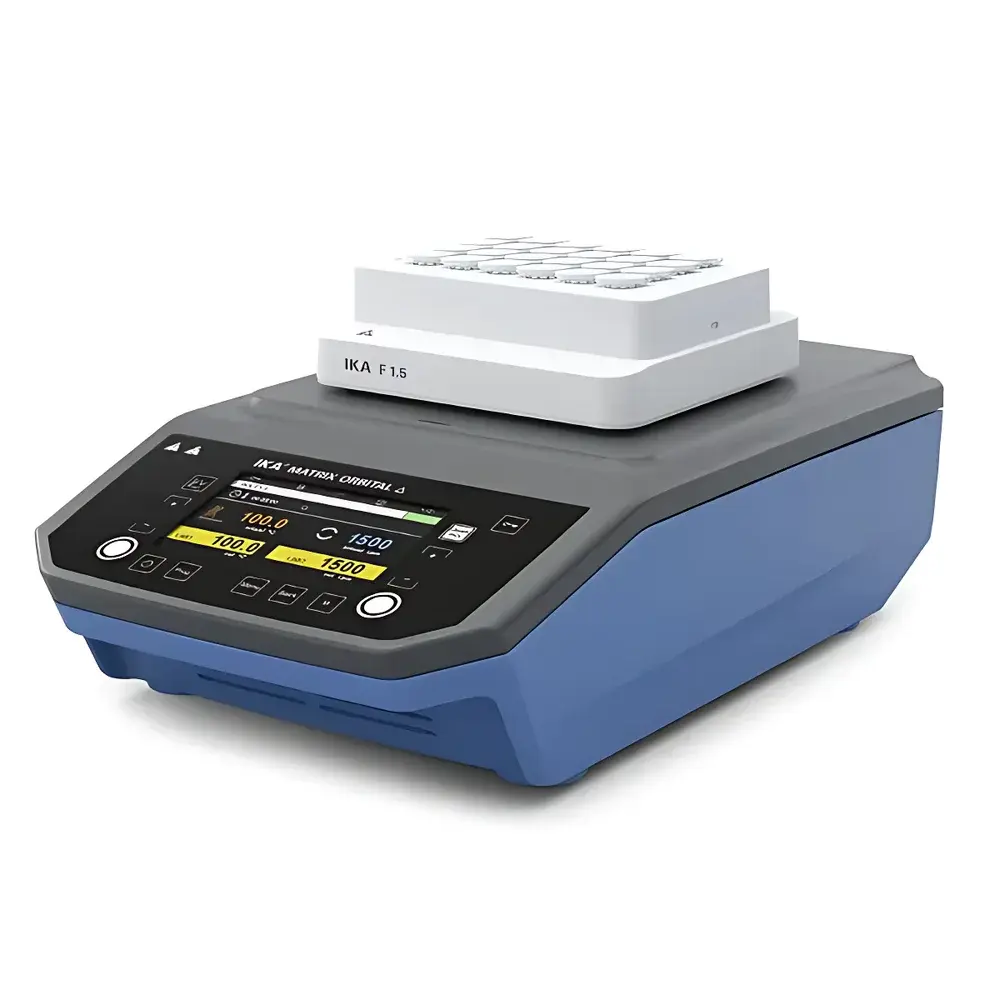
IKA MATRIX Orbital Delta F1.5 Thermostatic Orbital Shaker
| Brand | IKA |
|---|---|
| Origin | Germany |
| Model | MATRIX Orbital Delta F1.5 |
| Orbit Diameter | 3 mm |
| Max Load | 0.3 kg |
| Speed Range | 0–1500 rpm |
| Min Adjustable Speed | 300 rpm |
| Speed Accuracy | ±30 rpm |
| Speed Resolution | 10 rpm steps |
| Timer Range | 1 s – 6000 min |
| Heating Range | RT +4 °C to 100 °C |
| Heating Power | 100 W |
| Temp. Control Accuracy | ±0.5 °C |
| Temp. Stability | ±0.5 °C |
| Temp. Uniformity | ±0.5 °C (@20–45 °C), ±1.5 °C (@other ranges) |
| Heating Rate | 11 °C/min |
| Display | TFT (speed & temp.) |
| Sample Capacity | 24 × 1.5 mL tubes |
| Dimensions (W×D×H) | 216 × 158 × 351 mm |
| Weight | 9.2 kg |
| Ambient Operating Conditions | 5–40 °C, ≤80% RH |
| Protection Class | IP21 (DIN EN 60529) |
| Interfaces | RS232, USB |
| Voltage | 100–240 V AC, 50/60 Hz |
| Max Input Power | 240 W |
| Fuse | 2× T4A 250V |
Overview
The IKA MATRIX Orbital Delta F1.5 Thermostatic Orbital Shaker is an engineered solution for precise, reproducible sample homogenization and temperature-controlled incubation in life science laboratories. Designed around orbital shaking mechanics—where platform motion follows a circular path with a fixed 3 mm orbit diameter—the instrument delivers consistent kinetic energy transfer to samples while maintaining thermal uniformity across the entire 24-position aluminum block. Its dual-function architecture integrates high-fidelity temperature regulation (±0.5 °C stability at 37 °C) with digitally controlled rotational agitation (0–1500 rpm, 10 rpm resolution), enabling simultaneous mixing and heating of low-volume biological specimens—including blood derivatives, nucleic acid preparations, immunoassay plates, and small-molecule formulations. The system operates under continuous, timed, or multi-step programmable protocols, supporting standardized workflows compliant with GLP and ISO 17025 laboratory quality requirements.
Key Features
- Orbital shaking with precisely defined 3 mm orbit diameter ensures laminar, non-turbulent fluid motion—minimizing shear stress on sensitive biomolecules such as plasmid DNA and antibody conjugates.
- Integrated Peltier-based heating system (100 W output) achieves rapid thermal ramping (up to 11 °C/min) and maintains setpoint accuracy within ±0.5 °C across the operational range (RT+4 °C to 100 °C).
- TFT display with intuitive menu navigation provides real-time visualization of speed, temperature, elapsed time, and remaining duration—supporting both operator verification and audit-ready documentation.
- Programmable operation modes include continuous run, countdown timer (1 s to 100 h), and multi-segment ramp profiles—enabling automated execution of complex protocols such as enzyme reaction kinetics or thermal denaturation studies.
- Aluminum die-cast housing offers mechanical rigidity and thermal mass buffering, reducing vibration transmission and enhancing positional stability during high-speed operation (up to 1500 rpm).
- Dual communication interfaces (RS232 and USB) support integration into LIMS environments and facilitate remote parameter configuration, data logging, and firmware updates via IKA Labworld software.
Sample Compatibility & Compliance
The MATRIX Orbital Delta F1.5 accommodates standard 24 × 1.5 mL microcentrifuge tubes in a fixed-position aluminum block, eliminating tube displacement during high-RPM operation. Its design complies with DIN EN 60529 (IP21 ingress protection), ensuring safe operation in general laboratory environments with ambient humidity ≤80% RH and temperatures between 5–40 °C. Electrical safety conforms to IEC 61010-1 standards for laboratory equipment. While not certified for sterile applications, its smooth, non-porous surfaces support routine decontamination using ethanol or 70% isopropanol—making it suitable for pre-PCR setup, ELISA plate preparation, and reagent equilibration in QC/QA labs operating under ISO 9001 or FDA 21 CFR Part 11–aligned data integrity frameworks.
Software & Data Management
IKA Labworld software (v3.0+) enables full remote control, protocol storage, and timestamped event logging—including start/stop triggers, temperature ramps, and speed transitions. All logged parameters are exportable in CSV format for traceability and regulatory review. Audit trail functionality records user ID, timestamp, and parameter changes—supporting compliance with ALCOA+ principles (Attributable, Legible, Contemporaneous, Original, Accurate). USB connectivity permits direct firmware updates without external hardware; RS232 supports legacy integration with SCADA systems or centralized lab automation controllers.
Applications
- Pre-analytical processing of whole blood, serum, and plasma samples prior to centrifugation or downstream immunoassays.
- Thermal activation and mixing of restriction enzyme digests, ligase reactions, and RT-PCR master mixes.
- Equilibration of antibody-coated ELISA plates and antigen-binding buffers at physiological or elevated temperatures.
- Accelerated solubility testing of pharmaceutical excipients in early-stage formulation development.
- Cell lysis optimization using detergent-based or enzymatic methods under controlled thermal-agitation conditions.
- Standardized reagent resuspension and homogenization in clinical microbiology and molecular diagnostics workflows.
FAQ
Can the MATRIX Orbital Delta F1.5 accommodate tubes larger than 1.5 mL?
No—the device is mechanically optimized for 24 × 1.5 mL microcentrifuge tubes only. Use of alternative tube formats may compromise thermal uniformity and mechanical stability.
Is the heating system capable of cooling below ambient temperature?
No. This model features resistive/Peltier heating only and does not provide active cooling functionality.
Does the instrument support password-protected user access levels?
Yes—via IKA Labworld software, administrators can assign role-based permissions for parameter editing, protocol execution, and data export functions.
What is the maximum allowable load when operating at 1500 rpm?
The rated maximum load remains 0.3 kg regardless of speed setting; exceeding this limit risks imbalance-induced vibration and premature bearing wear.
How frequently should calibration verification be performed?
We recommend quarterly verification of temperature accuracy using NIST-traceable thermistors and annual speed calibration per ISO/IEC 17025 guidelines for accredited laboratories.




