
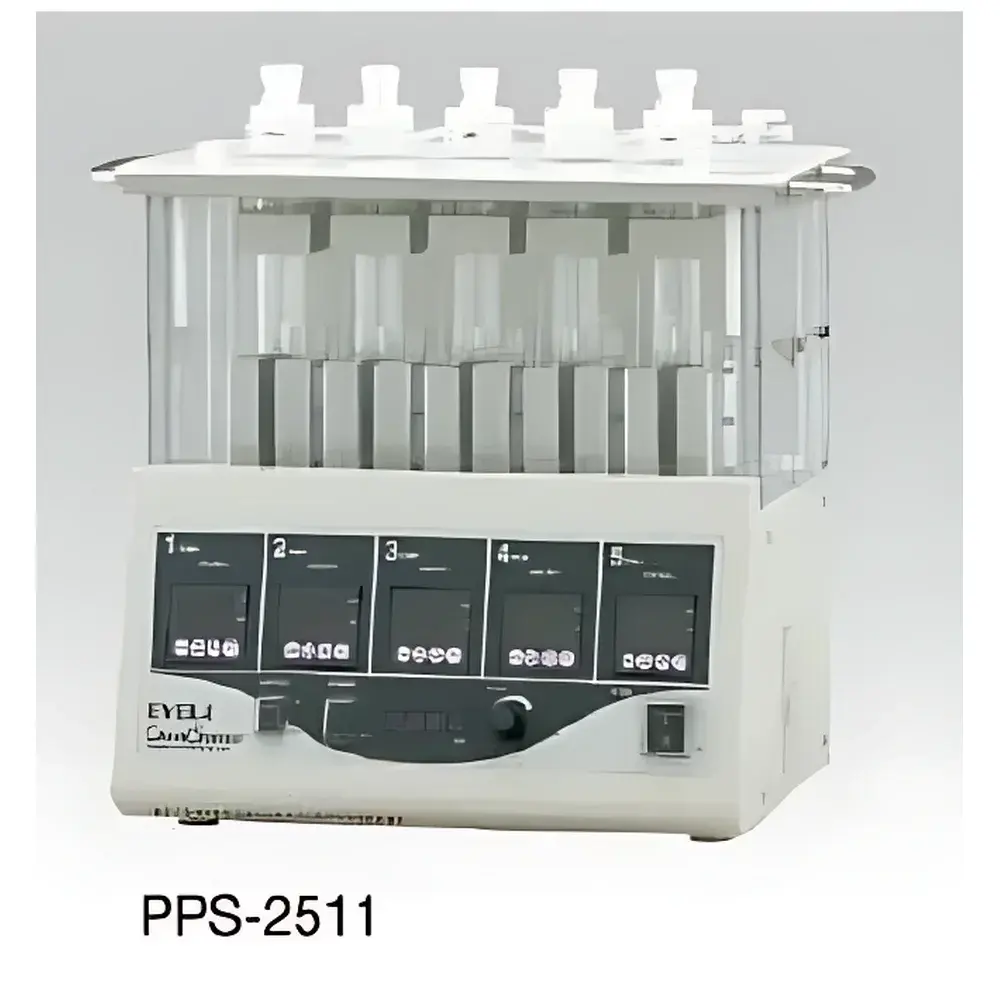
EYELA PPS Series Parallel Organic Synthesis System
| Brand | EYELA (Tokyo Rikakikai Co., Ltd.) |
|---|---|
| Origin | Japan |
| Model | PPS-1511 / PPS-2511 / PPS-3511 |
| Reaction Vessels | 1–5 units (independently controlled) |
| Synthesis Volume | 1–4 mL (PPS-1511), 10–30 mL (PPS-2511), 50–60 mL (PPS-3511) |
| Temperature Range | −23 to 160 °C (PPS-1511), −27 to 160 °C (PPS-2511), −28 to 130 °C (PPS-3511) — each zone independently adjustable |
| Temp. Control Accuracy | ±0.5 °C |
| Stirring Speed | 100–1600 rpm (4 mL water, PPS-1511), 100–1300 rpm (30 mL water, PPS-2511), 100–1100 rpm (60 mL water, PPS-3511) |
| Stirring Input | Rotary knob with digital RPM display (20–2000 rpm) |
| Temp. Input & Display | Membrane keypad with digital display (−40.0 to 160.0 °C) |
| Gas Handling | Vacuum evacuation and inert gas purging (requires optional sealed reaction vessels) |
| Reflux Capability | Integrated high-efficiency reflux condenser |
| Reagent Addition | Syringe, pipette, or standard-taper dropping funnel — all under inert atmosphere |
| Visual Monitoring | Front-access observation slot with integrated LED illumination |
| Safety Systems | Leakage current breaker, thermal fuse, self-diagnostic firmware (including sensor fault detection and user-configurable upper temperature limit), dual-layer protective housing, drip tray, aluminum block presence detection, motor overheat protection |
| Vessel Dimensions (mm) | Φ15×150H (flanged, PPS-1511), Φ30×200H (flanged, PPS-2511), Φ35×200H (flanged, PPS-3511) |
| Stir Bar Sizes (mm) | Φ10×5H (cross-type), Φ20×7H (cross-type), Φ25×8H (cross-type) |
| External Dimensions (W×D×H, mm) / Weight | 465×335×390 / 25 kg (PPS-1511), 465×335×440 / 27 kg (PPS-2511), 465×335×450 / 28 kg (PPS-3511) |
Overview
The EYELA PPS Series Parallel Organic Synthesis System is an engineered platform for precise, reproducible, and scalable laboratory-scale organic synthesis under controlled thermal, mechanical, and atmospheric conditions. Designed around the principle of independent multi-zone thermal regulation combined with robust magnetic stirring, the PPS system enables true parallel experimentation across up to five reaction vessels—each with fully decoupled temperature setpoints, stirring rates, and gas environment control. Its architecture integrates Peltier-based heating/cooling modules with high-resolution PID feedback loops, allowing linear ramping profiles (both ascending and descending), gradient-controlled crystallization protocols, and stable isothermal operation across a wide dynamic range (−28 °C to +160 °C). The system’s modular aluminum heating blocks—compatible with standard ground-glass joints and interchangeable across PPS models—support rapid method transfer between small-scale screening (1–4 mL) and intermediate batch synthesis (50–60 mL). As a core tool in modern process chemistry labs, the PPS system adheres to foundational principles of reaction optimization: statistical experimental design (DoE), kinetic profiling, catalyst evaluation, and impurity pathway mapping—all executed without cross-contamination or thermal crosstalk.
Key Features
- Five independently controlled reaction zones with individual temperature and stirring parameter assignment—enabling simultaneous comparison of reaction conditions (e.g., temperature gradients, catalyst screening, solvent effects).
- High-precision thermal regulation: ±0.5 °C stability across full operating range; programmable linear ramps and stepwise profiles support controlled nucleation, polymorph screening, and exotherm management.
- Integrated inert atmosphere capability via vacuum/inert gas cycling—compatible with Schlenk-line workflows and moisture-/oxygen-sensitive chemistries (e.g., organometallic catalysis, lithiation, hydride reductions).
- Dual-mode reagent addition: syringe, pipette, or standard-taper dropping funnel—performed through septum-sealed vessels without breaking inert conditions.
- Front-mounted observation window with adjustable LED illumination allows real-time visual assessment of color change, precipitate formation, phase separation, and stir bar dynamics—critical for endpoint determination and troubleshooting.
- Comprehensive safety architecture: dual thermal fuses, motor overheat cutoff, electronic leakage protection, automatic sensor fault detection, and physical containment via double-layer housing and spill-resistant drip tray.
- Modular hardware design: aluminum blocks, Teflon insulation plates, and stir bars are model-interchangeable; legacy EYELA blocks remain compatible with new PPS temperature/stirring modules.
Sample Compatibility & Compliance
The PPS system accommodates standard borosilicate glass reaction tubes with flanged O-ring seals (Φ15–Φ35 mm OD), ensuring compatibility with common labware and enabling pressure-rated operation when used with optional sealed vessels. All wetted surfaces—including stir bars, sealing gaskets, and gas inlet fittings—are chemically resistant to organic solvents, strong acids/bases, and halogenated reagents. The system supports GLP-compliant documentation workflows: temperature and stirring logs are timestamped and exportable via RS-232 or USB interface. While not certified for IEC 61000-4 EMC immunity or ATEX environments, its electrical architecture meets JIS C 61010-1 and UL 61010-1 safety standards for laboratory equipment. For regulated pharmaceutical development, the PPS can be validated per ASTM E2500 and aligned with USP analytical instrument qualification (AIQ) frameworks—particularly for Stage 1 (Design Qualification) and Stage 2 (Installation Qualification) assessments.
Software & Data Management
The PPS operates via embedded firmware with no external PC dependency—temperature and stirring parameters are configured directly via membrane keypad and rotary encoder interfaces. Real-time values (actual vs. setpoint) are continuously displayed on dual digital readouts. Data logging is performed internally at user-selectable intervals (1–60 sec); logged files (CSV format) store time-stamped records of temperature, RPM, and diagnostic flags (e.g., “sensor open”, “overtemp warning”). Export occurs via USB flash drive—no proprietary software required. Audit trail functionality includes operator ID input (via numeric code), session start/end timestamps, and automatic error-code generation upon fault detection—satisfying basic FDA 21 CFR Part 11 requirements for electronic records when paired with institutional procedural controls (e.g., password-protected access, defined roles, and manual logbook correlation).
Applications
- Pharmaceutical process research: parallel optimization of coupling reactions (Suzuki, Heck, Buchwald–Hartwig), hydrogenations, and asymmetric epoxidations under varied thermal profiles.
- Catalyst discovery and screening: evaluation of ligand-metal combinations across temperature gradients to identify activity/selectivity trade-offs.
- Functional materials synthesis: controlled polymerization initiation, MOF crystallization, and nanoparticle nucleation kinetics studies.
- Green chemistry development: solvent-free or low-solvent reactions, microwave-assisted protocol translation, and energy-efficient thermal cycling.
- Academic teaching laboratories: safe, repeatable demonstration of multi-variable reaction design, Arrhenius analysis, and thermodynamic vs. kinetic product control.
FAQ
Can the PPS system operate under positive pressure?
No—the base configuration supports only ambient-pressure or slight vacuum/inert gas blanket operation. Positive pressure requires custom vessel adaptation and is not covered under standard warranty.
Is remote monitoring or control possible?
The system does not include Ethernet/Wi-Fi connectivity. Remote access is limited to post-hoc data retrieval via USB; real-time telemetry requires third-party DAQ integration.
What maintenance is required for long-term reliability?
Annual calibration of temperature sensors using NIST-traceable reference baths is recommended. Stir bar integrity and O-ring elasticity should be inspected before each high-temperature run.
Are there GMP-compliant validation packages available?
EYELA provides IQ/OQ documentation templates; however, final URS alignment, risk assessment (ICH Q9), and PQ execution must be conducted by the end-user’s qualified personnel in accordance with internal SOPs.
Can cryogenic temperatures below −28 °C be achieved?
Not with standard Peltier modules. Sub-ambient operation beyond the specified lower limit requires external chiller integration via auxiliary coolant ports—performance depends on chiller capacity and thermal interface quality.



