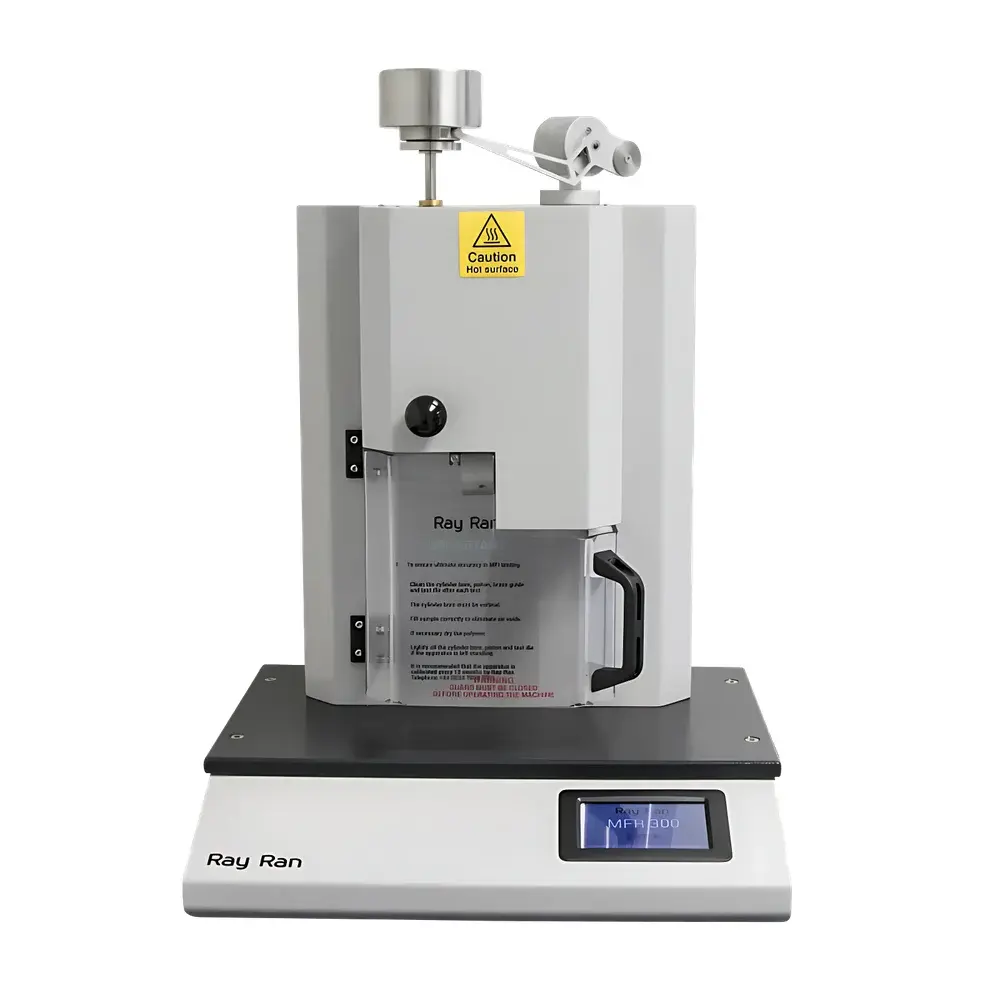
Ray-Ran MFR300 Melt Flow Indexer
| Brand | Ray-Ran |
|---|---|
| Origin | Netherlands |
| Model | MFR300 |
| Temperature Range | 0–450 °C (500 °C optional) |
| Temperature Accuracy | ±0.10 °C |
| Temperature Resolution | 0.10 °C |
| Piston Displacement Resolution | ±0.02 mm |
| Heating Zones | Dual-zone |
| Power Supply | 110 V/60 Hz or 220 V/50 Hz, 10 A fuse |
| Connectivity | Wi-Fi, USB, Ethernet |
| Compliance | ISO 1133, ASTM D1238, GB/T 3682 |
Overview
The Ray-Ran MFR300 Melt Flow Indexer is a precision-engineered instrument designed for the quantitative assessment of thermoplastic polymer melt rheology under standardized load and temperature conditions. Operating on the fundamental principle of extrusion plastometry, it measures the mass or volume of polymer melt extruded through a calibrated die under defined gravitational or applied load over a fixed time interval—directly yielding Melt Flow Rate (MFR) and Melt Volume Rate (MVR) values per ISO 1133-1 and ASTM D1238. Its dual-zone heating architecture ensures axial thermal uniformity across the barrel, minimizing radial temperature gradients that compromise test reproducibility. The system integrates optical rotary encoding for sub-millimeter piston displacement resolution, enabling traceable, high-fidelity data acquisition required for method B (MVR) and method C (melt density) determinations. Designed for routine QC laboratories and R&D environments in polymer compounding, injection molding, and extrusion facilities, the MFR300 delivers metrologically sound results aligned with international regulatory expectations.
Key Features
- Dual-zone independent heating control maintains ±0.10 °C temperature stability across the entire 0–450 °C operating range (500 °C optional), satisfying stringent thermal homogeneity requirements of ISO 1133 Annex A.
- 4.3-inch capacitive touchscreen interface with icon-driven workflow navigation reduces operator dependency and minimizes procedural deviations during method selection (A, B, C) and density testing.
- Optical linear encoder with ±0.02 mm displacement resolution enables accurate real-time tracking of piston travel—essential for MVR calculation, shear rate derivation, and viscosity profiling.
- Automated programmable cutter mechanism performs timed extrudate cutting for Method A (MFR), optional Method B (MVR), and in-situ melt density determination without manual intervention.
- Multi-slice acquisition mode captures user-defined discrete data points (up to 99 slices) at pre-specified piston travel intervals, generating full flow curves without physical sample segmentation—enhancing throughput, repeatability, and operator safety.
- Intelligent energy management system (“Eco Mode”) dynamically reduces standby power consumption to a user-configurable percentage, supporting laboratory sustainability goals without compromising thermal readiness.
Sample Compatibility & Compliance
The MFR300 accommodates standard ISO/ASTM-compliant dies (2.095 mm diameter × 8.000 mm length) and pistons (9.474 mm diameter) for universal applicability across polyolefins, engineering thermoplastics (e.g., PA, PC, POM), fluoropolymers, and biodegradable resins. It supports all three ISO 1133 test methods: Method A (gravimetric MFR), Method B (volumetric MVR), and Method C (melt density determination). Instrument firmware and calibration protocols are fully traceable to NIST-traceable reference standards. Full compliance with ISO/IEC 17025 documentation requirements is facilitated through audit-ready calibration logs, temperature validation reports, and hardware revision tracking. The system meets essential requirements for GLP and GMP-aligned polymer characterization workflows, including secure user access levels and electronic record integrity.
Software & Data Management
The MFR300 operates exclusively with Ray-Ran’s Techni-Test v5.x software platform—a validated, Windows-based application supporting Wi-Fi, USB, and Ethernet connectivity. Techni-Test provides real-time graphical visualization of piston displacement vs. time, automatic calculation of MFR/MVR, shear stress (τ), shear rate (γ̇), apparent viscosity (η), and intrinsic viscosity (IV) where applicable. All raw and processed data are stored in encrypted local databases with timestamped metadata, including operator ID, environmental conditions, and calibration status. Reports export natively to PDF and CSV formats compatible with Microsoft Excel for statistical process control (SPC) integration. Audit trail functionality records all user actions—including method edits, result overrides, and calibration events—in accordance with FDA 21 CFR Part 11 principles. Data backups and remote diagnostics are supported via networked deployment.
Applications
- Quality control of incoming polymer pellets and regrind in automotive, packaging, and medical device manufacturing.
- Process optimization of extrusion and injection molding parameters through correlation of MFR/MVR shifts with molecular weight distribution (MWD) trends.
- Batch-to-batch consistency verification in masterbatch production and compound formulation development.
- Regulatory submission support for ISO 10993-compliant polymer characterization dossiers.
- Evaluation of thermal degradation effects via sequential MFR measurements at elevated temperatures or extended dwell times.
- Research into structure–property relationships in branched polyethylenes and long-chain branched polymers using multi-slice flow curve analysis.
FAQ
Does the MFR300 comply with ISO 1133 and ASTM D1238?
Yes—the instrument’s thermal control, mechanical geometry, and measurement algorithms are rigorously aligned with both standards, including Annex A (temperature uniformity) and Annex B (die calibration requirements).
Can the MFR300 determine melt density in situ?
Yes—Method C implementation uses synchronized piston displacement and extrudate mass data to compute melt density at test temperature without requiring separate density gradient column measurements.
Is Techni-Test software validated for regulated environments?
Techni-Test v5.x includes configurable audit trails, electronic signatures, and data integrity safeguards consistent with ALCOA+ principles and suitable for 21 CFR Part 11 environments when deployed with appropriate IT governance controls.
What is the purpose of the “multi-slice” function?
It acquires multiple MFR/MVR data points along a single extrusion stroke, enabling construction of flow curves that reveal non-Newtonian behavior—critical for predicting processing stability and die swell characteristics.
How does the dual-zone heating improve test accuracy?
Independent top- and bottom-zone control eliminates axial thermal drift and ensures ≤0.5 °C temperature deviation across the 100 mm barrel length, directly improving inter-laboratory reproducibility per ISO 1133 repeatability criteria.
Related Products