
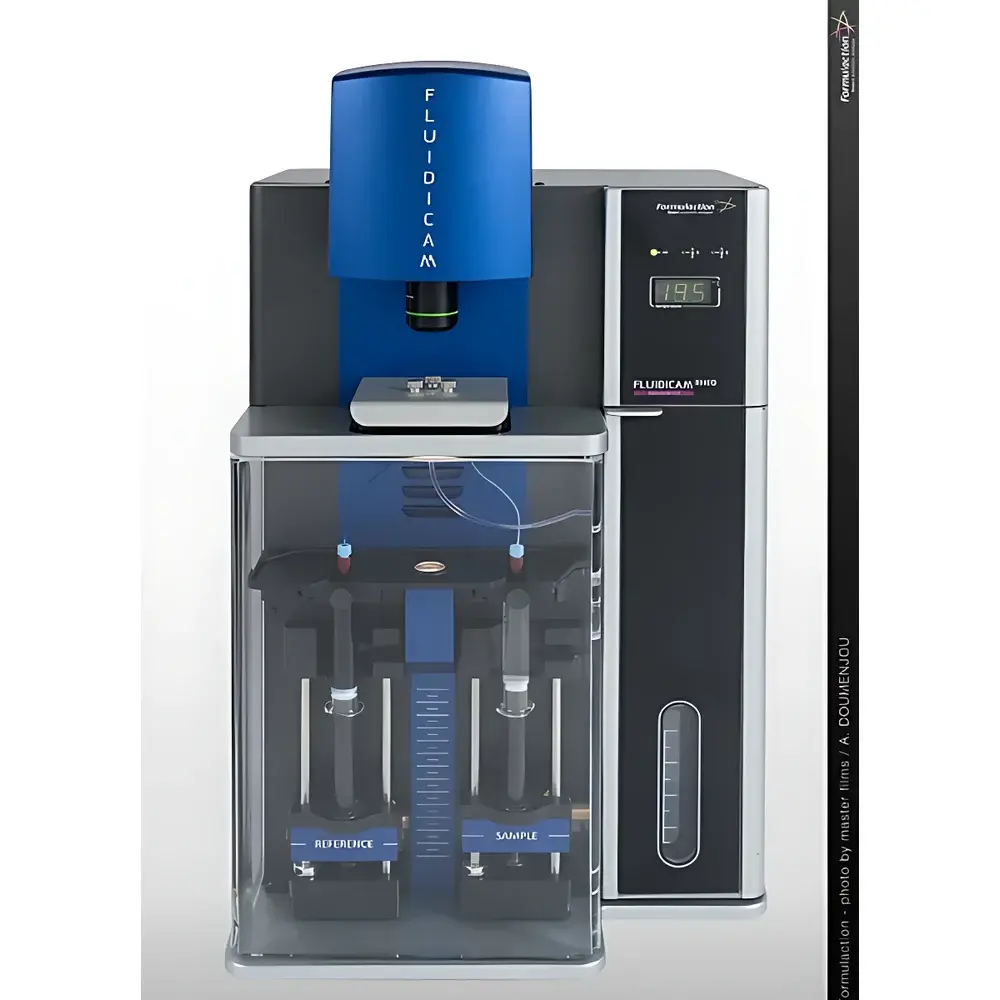
Formulaction FLUIDICAM Microfluidic Visual Rheometer
| Brand | Formulaction (Microtrac) |
|---|---|
| Origin | France |
| Model | FLUIDICAM |
| Viscosity Range | 0.1–200,000 cP |
| Shear Rate Range | 100–1.8×10⁵ s⁻¹ |
| Temperature Control Range | 4–80 °C |
| Compliance | Designed for GLP/GMP-relevant workflows with audit-trail-capable software logging |
Overview
The Formulaction FLUIDICAM Microfluidic Visual Rheometer is an advanced, chip-based rotational rheometry platform engineered for high-precision viscosity and shear-dependent rheological characterization of complex fluids under dynamic flow conditions. Unlike conventional rotational or capillary rheometers, FLUIDICAM employs a microfluidic co-flow principle rooted in laminar interfacial hydrodynamics. In its Y-shaped microchannel, the unknown sample and a calibrated reference fluid are simultaneously injected at precisely controlled volumetric flow rates. Due to immiscibility and laminar flow dominance at low Reynolds numbers, the two streams form a stable, optically resolvable interface. The lateral displacement of this interface—captured in real time by an integrated high-resolution optical imaging system—is directly governed by the relative viscosities and flow rate ratio of the two fluids. Leveraging first-principles fluid mechanics and proprietary inversion algorithms, FLUIDICAM computes absolute viscosity as a function of local shear rate (γ̇ = 6Q/wh², where Q is total flow rate, w is channel width, h is channel height), enabling construction of full flow curves (η vs. γ̇) without mechanical torque sensing or moving parts. This approach eliminates wall-slip artifacts common in conventional geometries and provides intrinsic sensitivity across an exceptionally broad shear rate spectrum—from 100 s⁻¹ up to 1.8×10⁵ s⁻¹—making it uniquely suited for applications demanding high-fidelity data at industrially relevant deformation rates.
Key Features
- Microfluidic chip-based measurement architecture with disposable, single-use polymeric flow cells—ensuring zero cross-contamination and eliminating cleaning validation requirements.
- Real-time optical interface tracking using CMOS-based high-speed imaging (≥100 fps) and sub-pixel edge-detection algorithms for nanometer-level positional resolution.
- Automated, closed-loop flow control via dual syringe pumps with pressure feedback—enabling precise, repeatable shear rate ramping and step profiling.
- Integrated Peltier-controlled thermal module delivering rapid, uniform temperature stabilization from 4 °C to 80 °C (±0.1 °C accuracy) within the microchannel.
- No calibration required for viscosity determination: absolute measurement traceable to SI-derived units via geometric and flow parameters.
- One-click acquisition of full flow curves, temperature sweeps, or time-resolved viscosity kinetics—fully automated from initialization to report export.
Sample Compatibility & Compliance
FLUIDICAM accommodates a wide range of material classes—including Newtonian and non-Newtonian liquids, gels, pastes, emulsions, suspensions, and semi-solids—with minimal sample volume (typically 50–200 µL per test). Its non-contact, optically based methodology avoids mechanical stress-induced structural breakdown in fragile systems (e.g., protein therapeutics, shear-thinning hydrogels, or fragile colloidal dispersions). The instrument is routinely deployed in regulated environments supporting GLP and GMP workflows. Data acquisition software includes user access control, electronic signatures, and FDA 21 CFR Part 11-compliant audit trails—including timestamped parameter logs, raw image archives, and versioned analysis scripts. All measurement protocols align with ISO 16520-1 (rheology of dispersions) and ASTM D2196 (apparent viscosity of non-Newtonian materials), with documented uncertainty budgets available upon request.
Software & Data Management
The FLUIDICAM Control & Analysis Suite is a Windows-native application built on a modular architecture supporting both routine QC and advanced research use cases. It features intuitive workflow-guided experiment setup, live visualization of interface dynamics, and real-time viscosity calculation. Raw image sequences, processed interface coordinates, and derived rheological parameters (η, n, K, τ₁/₂, etc.) are stored in a structured SQLite database with metadata tagging (operator, date, sample ID, protocol version). Export options include CSV, Excel, and PDF reports compliant with internal SOPs. Advanced users may access Python API bindings for custom script integration, batch processing, or correlation with complementary techniques (e.g., DLS, FTIR, or rheo-SALS). Software updates are delivered via secure HTTPS with cryptographic signature verification.
Applications
- Pharmaceuticals: Quantifying injection-force-related viscosity of parenteral formulations (e.g., monoclonal antibodies, mRNA-LNPs) at shear rates >10⁴ s⁻¹—critical for needle gauge selection, patient comfort assessment, and stability monitoring of shear-induced aggregation.
- Coatings & Inks: Mapping high-shear viscosity behavior during atomization and spray deposition—directly informing nozzle design, air-assist optimization, and film formation kinetics.
- Food Science: Correlating mouthfeel perception with transient viscosity decay during mastication (shear rates 10³–10⁵ s⁻¹), enabling rational reformulation of dairy alternatives, sauces, and textured plant proteins.
- Oilfield Chemistry: Characterizing yield stress and shear-thinning profiles of drilling muds under downhole-relevant shear regimes—supporting rheological modeling for hydraulic fracture design and cuttings transport efficiency.
- Personal Care: Evaluating sensory attributes of creams and gels through high-shear extensional response, bridging formulation chemistry with consumer-perceived spreadability and absorption rate.
FAQ
How does FLUIDICAM differ from traditional rotational rheometers?
FLUIDICAM uses microfluidic co-flow and optical interface detection instead of mechanical torque transduction, eliminating wall slip, inertia effects, and geometry-dependent edge artifacts—particularly critical for low-viscosity, particulate-laden, or shear-sensitive samples.
Is sample preparation required before measurement?
Minimal preparation is needed: samples must be filtered (≤5 µm) to prevent microchannel clogging; no degassing or pre-shearing is necessary due to the instrument’s self-conditioning flow initiation protocol.
Can FLUIDICAM measure yield stress?
While not a direct yield stress instrument, FLUIDICAM enables robust estimation of apparent yield points via extrapolation of Herschel-Bulkley fits to high-shear-rate data, validated against vane or creep measurements for comparative studies.
What maintenance is required?
No routine mechanical calibration or alignment is needed. Maintenance consists solely of periodic replacement of disposable chips and syringe pump tubing—documented in the included maintenance log template.
Is technical support available globally?
Yes—Formulaction provides regional application engineering support, remote diagnostics, and on-site training through authorized Microtrac distribution partners in EMEA, North America, and APAC regions.



