
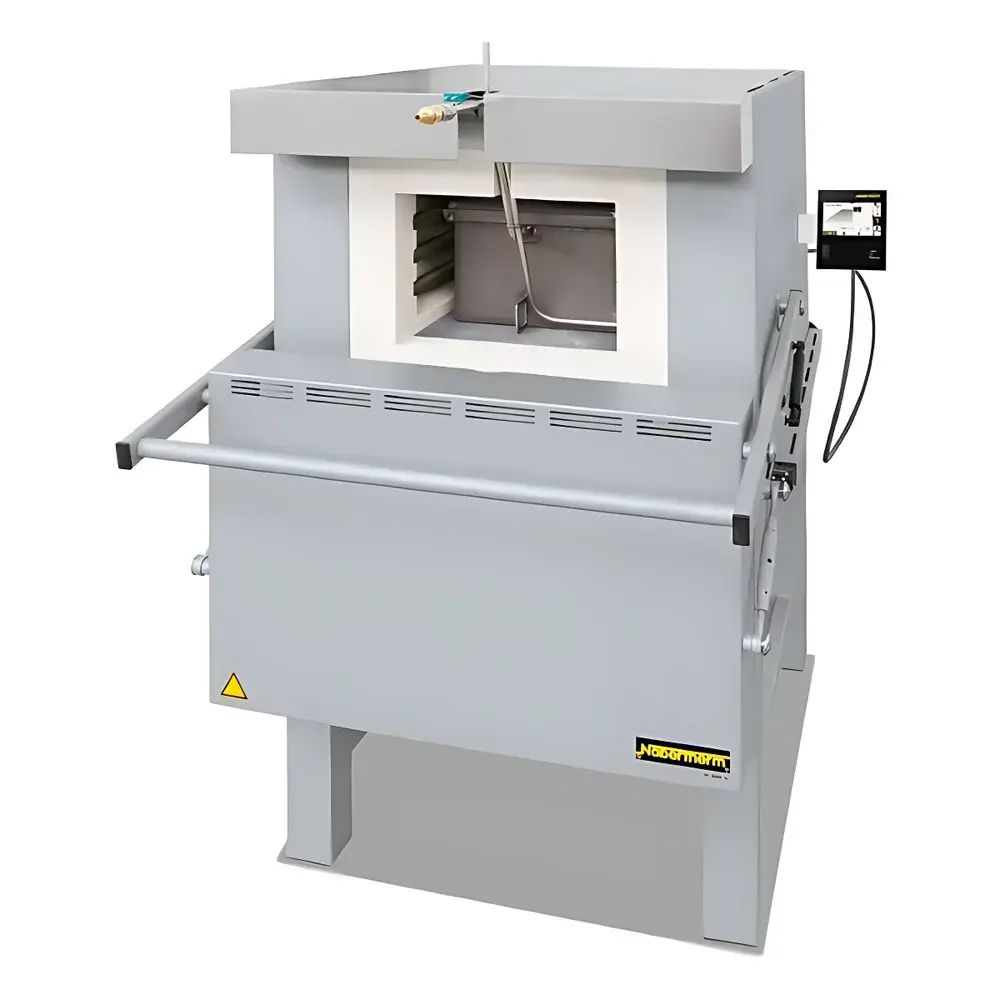
Nabertherm N-Series Box-Type Muffle Furnace
| Brand | Nabertherm |
|---|---|
| Origin | Germany |
| Model | N-Series |
| Maximum Temperature | 1280 °C |
| Heating Configuration | Triple-Sided (Left, Right, Bottom) |
| Insulation | Multi-Layer Refractory Brick Structure |
| Power Supply | 1-Phase (3.0–5.5 kW) or 3-Phase (6.4–25.0 kW) |
| Weight | 60–480 kg |
| Compliance | CE, EN 61000-6-3, EN 61000-6-4, IEC 61000-4-2/4/5/6 |
Overview
The Nabertherm N-Series Box-Type Muffle Furnace is a precision-engineered laboratory furnace designed for reproducible high-temperature thermal processing in research, quality control, and industrial R&D environments. Operating on the principle of radiant heat transfer via embedded silicon carbide (SiC) heating elements mounted on support tubes, the furnace delivers uniform temperature distribution across its insulated chamber. Its triple-sided heating architecture—active heating from both lateral walls and the base—ensures minimal thermal gradients and superior temperature homogeneity (±3 °C at 1200 °C, per internal validation protocols). The muffle design isolates the process chamber from combustion byproducts and external contaminants, making it suitable for oxidation-sensitive treatments, ashing, sintering, calcination, and controlled-atmosphere annealing when integrated with optional gas manifolds or sealed retorts.
Key Features
- Robust multi-layer insulation composed of lightweight, low-conductivity refractory bricks and ceramic fiber modules—engineered to minimize standby heat loss and reduce energy consumption by up to 25% compared to conventional single-layer designs.
- Triple-sided heating system: SiC heating elements mounted on corrosion-resistant support tubes provide long service life (>10,000 h at 1200 °C) and stable thermal output without sagging or hot-spot formation.
- Bottom-mounted SiC heating plate protects against mechanical impact and thermal shock during sample loading/unloading, extending structural integrity over extended operational cycles.
- Front-loading door with parallel-guided downward opening mechanism—designed to eliminate upward radiation exposure to operators and improve workspace ergonomics.
- Integrated pneumatic damping system with gas springs ensures smooth, controlled door actuation and reduces operator fatigue during repetitive use.
- Standard rear-wall exhaust port (introduced from model N 31/H onward) enables continuous off-gas removal and integration with fume extraction systems compliant with ISO 14644-1 Class 8 cleanroom ventilation standards.
- Stainless steel base frame included as standard equipment for N 7/H through N 17/HR models; larger units (N 31/H and above) ship with reinforced floor-standing chassis rated for static loads up to 500 kg.
Sample Compatibility & Compliance
The N-Series accommodates diverse sample geometries—from crucibles and ceramic boats to custom retorts and protective atmosphere containers—within its precisely dimensioned working chambers (internal volumes ranging from 9 to 87 L). All models comply with European safety directives (2014/35/EU Low Voltage Directive, 2014/30/EU EMC Directive) and bear CE marking. Thermal performance adheres to DIN 17007 Part 2 for industrial furnaces and meets material testing requirements under ASTM E1112 (standard practice for calibration of laboratory furnaces). When configured with optional inert gas purging kits (e.g., argon or nitrogen), the furnace supports USP and ISO 13485-compliant sterilization validation protocols for medical device manufacturing. Optional data logging interfaces satisfy FDA 21 CFR Part 11 audit trail requirements when paired with NTLog-enabled controllers.
Software & Data Management
Equipped with Nabertherm’s NTLog-capable controller (standard on all N-Series units), the furnace supports time-stamped process recording directly to USB flash drives—capturing setpoint, actual temperature, power output, and alarm events at user-defined intervals (1–60 s resolution). Raw CSV-formatted logs are compatible with MATLAB, Python pandas, and industry-standard LIMS platforms. Optional PC connectivity via RS485 or Ethernet enables remote monitoring and integration into centralized lab automation systems. Firmware updates maintain compatibility with evolving GLP/GMP documentation workflows, including electronic signature support and configurable user access levels (operator, technician, administrator).
Applications
- Thermal analysis of metallic alloys (e.g., titanium partial annealing per ASTM F136)
- Ash content determination in pharmaceutical excipients (USP )
- Ceramic sintering and binder burnout in additive manufacturing pre-processing
- Calibration of thermocouples and RTDs per ISO/IEC 17025 accredited procedures
- Heat treatment of dental prosthetics and orthopedic implants under controlled atmospheres
- Residue quantification in environmental soil and wastewater testing (EPA Method 3010A)
- Pre-conditioning of reference materials for inter-laboratory comparison studies
FAQ
What is the maximum continuous operating temperature for the N-Series?
The N-Series is rated for continuous operation up to 1280 °C, validated per DIN 51742 and supported by thermal stability testing over 500 consecutive cycles.
Can the furnace be used under inert or reducing atmospheres?
Yes—when fitted with optional gas-tight muffle inserts, purge ports, and pressure-regulated flow controllers, the N-Series supports N₂, Ar, H₂/N₂ mixtures, and vacuum-assisted processing down to 10⁻² mbar.
Is third-party calibration documentation available?
Nabertherm provides factory calibration certificates traceable to PTB (Physikalisch-Technische Bundesanstalt); accredited on-site calibration services are available through authorized partners in North America and EMEA.
How is temperature uniformity verified across the working zone?
Uniformity is characterized using a 9-point thermocouple mapping procedure per IEC 60584-1, with results documented in the delivery report for each unit.
What maintenance intervals are recommended for heating elements and insulation?
SiC elements require no scheduled replacement under normal usage; refractory brick integrity should be inspected annually using visual and thermal imaging methods per Nabertherm Maintenance Bulletin MB-N-2023-04.



