
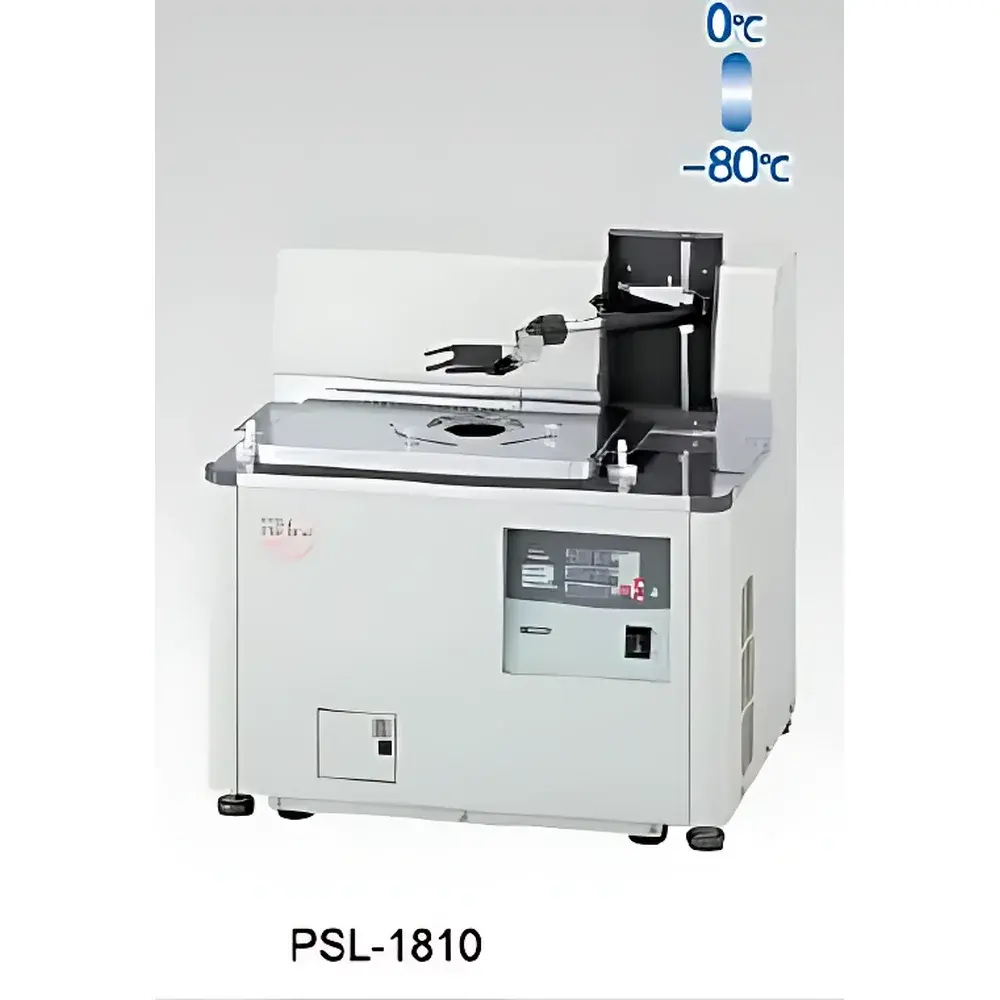
EYELA PSL-1810 Low-Temperature Circulating Bath
| Brand | EYELA (Tokyo Rikakikai Co., Ltd.) |
|---|---|
| Origin | Japan |
| Model | PSL-1810 |
| Temperature Range | −80 °C to 0 °C |
| Temperature Stability | ±1 °C |
| Stirring Speed | 100–800 rpm |
| Heating Power | 450 W |
| Cooling System | Dual-compressor, air-cooled |
| Refrigerants | R507A (primary stage), R23 (secondary stage) |
| Bath Capacity | 3.5 L |
| Bath Chamber Dimensions | Φ180 × 140 H mm (SUS304 stainless steel) |
| Max. Vessel Size | Φ95 mm × 300 mL |
| External Dimensions | 530 W × 450 D × 520 H mm |
| Weight | ~70 kg |
| Control Method | PID temperature control |
| Display & Setting | Digital LED display with manual keypad input |
| Safety Functions | Leakage current protection, overcurrent cutoff, heater over-power prevention, compressor high-pressure cutoff, relay overload protection, self-diagnostic system (heater fault, sensor failure, high/low temperature alarm), compressor time-delay startup |
| Auxiliary Function | Auto power-on/off scheduling |
| Stirrer Output | 25 W |
Overview
The EYELA PSL-1810 Low-Temperature Circulating Bath is an engineered precision thermal management system designed for demanding laboratory applications requiring stable, reproducible sub-zero temperature control. Unlike conventional water baths limited to ambient or mildly refrigerated operation, the PSL-1810 employs a cascaded dual-compressor refrigeration architecture—comprising independent primary (R507A) and secondary (R23) cooling stages—to achieve and maintain temperatures from −80 °C to 0 °C within ±1 °C stability. This performance envelope meets critical requirements in cryogenic sample conditioning, low-temperature reaction monitoring, viscosity benchmarking of high-molecular-weight polymers, and calibration of cold-stage instrumentation. The bath chamber is constructed entirely from electropolished SUS304 stainless steel, ensuring long-term corrosion resistance against aqueous and mildly aggressive coolants (e.g., ethanol/water or ethylene glycol/water mixtures). Its compact footprint (530 × 450 × 520 mm) and integrated circulation pump support both internal bath use and external jacketed reactor cooling via flexible inlet/outlet ports.
Key Features
- Dual-stage refrigeration system enabling reliable operation down to −80 °C without liquid nitrogen dependency
- PID-based digital temperature controller with LED display and intuitive keypad interface for precise setpoint entry and real-time monitoring
- Integrated variable-speed stirrer (100–800 rpm, 25 W output) ensuring uniform thermal distribution and minimizing radial temperature gradients across the 3.5 L bath volume
- Comprehensive safety architecture including compressor high-pressure cutoff, heater over-power limiter, leakage current detection, relay overload protection, and automated self-diagnostic routines for heater integrity, sensor functionality, and thermal excursion events
- Programmable auto power-on/off function supporting unattended overnight operation and energy-efficient scheduling aligned with lab workflow cycles
- Air-cooled condenser design eliminating need for external chilled water supply or dedicated ventilation ducting
Sample Compatibility & Compliance
The PSL-1810 accommodates standard laboratory vessels up to Φ95 mm diameter and 300 mL volume, making it compatible with common jacketed flasks, reaction kettles, and analytical cell holders. Its SUS304 bath interior complies with ISO 8573-1 (compressed air purity) and ASTM G128 (corrosion resistance of stainless steels in chloride environments) for sustained chemical compatibility. While not certified for medical device manufacturing, the unit supports GLP-aligned workflows through traceable temperature logging (when paired with optional analog/digital output modules) and adheres to IEC 61010-1:2010 safety standards for electrical equipment used in laboratory environments. Its thermal stability profile satisfies method requirements outlined in USP for low-temperature sterile compounding environment validation and ASTM D7042 for kinematic viscosity measurements under controlled thermal conditions.
Software & Data Management
The PSL-1810 operates as a standalone instrument with embedded firmware; no proprietary software installation is required for basic operation. However, optional analog voltage (0–5 V or 0–10 V) and RS-232/RS-485 interfaces enable integration into centralized lab automation systems (e.g., LabVIEW, DeltaV, or custom SCADA platforms) for remote setpoint adjustment, real-time temperature streaming, and alarm event logging. When configured with external data loggers compliant with FDA 21 CFR Part 11, the system supports audit-trail generation—including operator ID, timestamped parameter changes, and deviation alerts—for regulated QC/QA environments. All temperature readings derive from a calibrated Pt100 sensor mounted directly in the bath fluid path, ensuring measurement traceability to NIST standards via factory documentation.
Applications
- Cryogenic stabilization of biological samples prior to cryo-EM grid preparation
- Controlled-rate cooling of polymer melts during DSC pre-conditioning protocols
- Thermal equilibration of reference standards for viscometer calibration at sub-zero temperatures
- Low-temperature reaction quenching in synthetic organic chemistry workflows
- Environmental stress testing of electronic components under accelerated cold-cycle conditions
- Calibration of infrared thermography systems using blackbody sources immersed in stabilized coolant
FAQ
What coolant solutions are recommended for operation below −40 °C?
Ethanol/water (30/70 v/v) or ethylene glycol/water (40/60 v/v) mixtures are validated for continuous use down to −80 °C. Pure water is restricted to ≥0 °C operation.
Is external circulation flow rate adjustable?
Yes—the built-in centrifugal pump offers fixed-flow operation (~12 L/min at 0.5 bar), but external flow can be modulated using in-line needle valves or pressure-regulated manifolds connected to the dual 1/4″ BSP outlet/inlet ports.
Does the unit support external temperature probe feedback control?
No—the PSL-1810 regulates exclusively based on its internal Pt100 sensor. For process-critical applications requiring junction-point control, an external controller with cascade capability must be employed.
What maintenance intervals are specified for the dual-compressor system?
Compressor oil inspection is recommended every 2,000 operating hours; full refrigerant charge verification and filter-drier replacement are advised every 5 years or after any refrigerant circuit breach, per EYELA Technical Bulletin TB-PSL-003.
Can the stirrer operate independently of temperature control?
Yes—stirring speed may be adjusted manually at any time, regardless of whether heating, cooling, or standby mode is active.



