
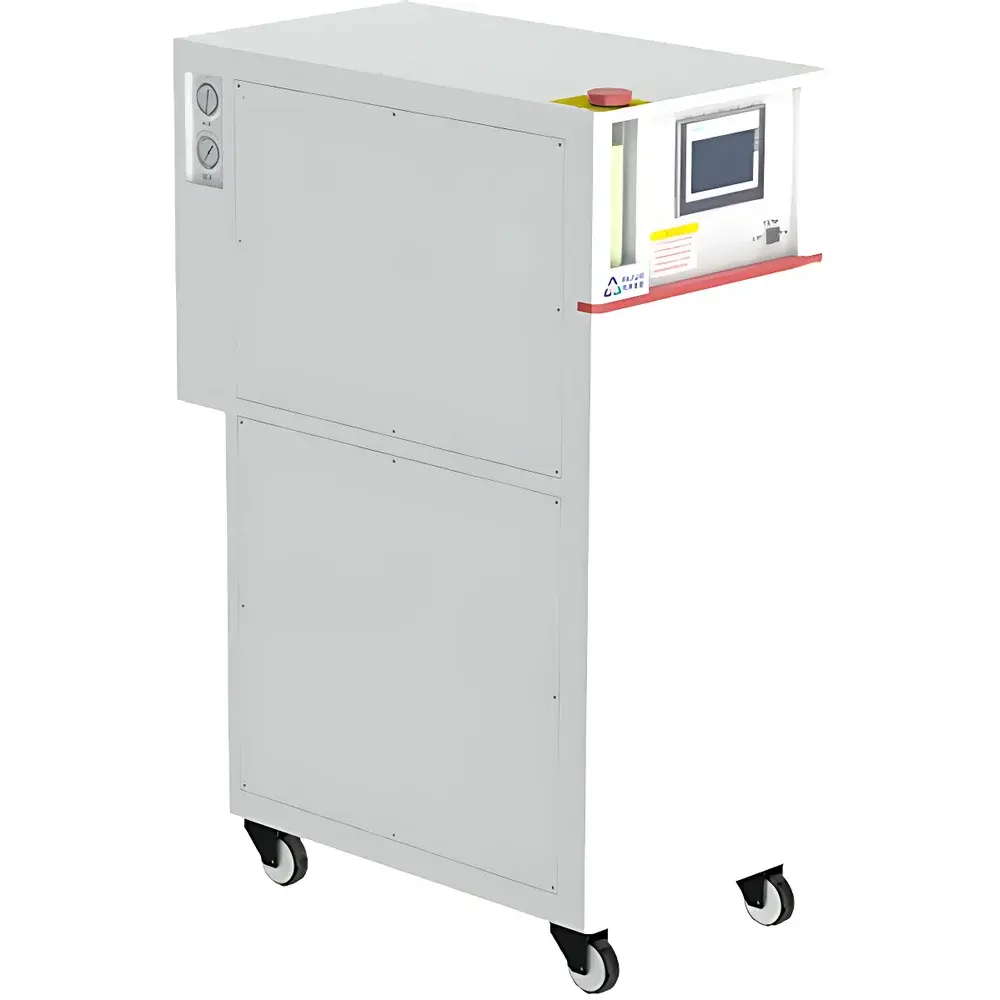
Tongzhou Weipu TL9000 Series Cryogenic Circulating Chiller
| Brand | Tongzhou Weipu |
|---|---|
| Origin | Tianjin, China |
| Manufacturer Type | OEM Manufacturer |
| Country of Origin | China |
| Model | TL9000 |
| Price Range | USD 1,400 – 7,200 (FOB) |
| Temperature Range | −90 °C to −20 °C |
| Refrigeration Capacity | 0.3 kW to 15.0 kW @ −80 °C to −20 °C |
| Pump Flow Rate | 20–75 L/min |
| Max. Pressure | 1.2–2.1 bar |
| Control Interface | 7″ TFT LCD Touchscreen |
| Communication Protocols | Modbus TCP (Ethernet), RS485 Modbus RTU, External PT100 Input |
| Programmable Steps | 100-step ramp/soak profiles |
| Cooling Method | Air-cooled (F) or Water-cooled (W) variants |
| Construction Options | Explosion-proof, Split-system, Stainless-steel cabinet, Custom OEM integration |
Overview
The Tongzhou Weipu TL9000 Series Cryogenic Circulating Chiller is an engineered thermal management system designed for precision low-temperature process control in demanding laboratory and pilot-scale applications. Operating within a stable temperature range of −90 °C to −20 °C, the TL9000 series employs a cascade refrigeration architecture with dual-stage compressors and environmentally compliant HFC/HFO refrigerant blends to achieve deep-cryogenic performance without liquid nitrogen dependency. Unlike single-stage chillers, this cascade design enables consistent heat extraction at ultra-low temperatures while maintaining high coefficient of performance (COP) across the operational envelope. The system integrates a closed-loop circulation path for external process cooling—commonly used to regulate jacketed reactors, cryogenic condensers, material testing chambers, and chromatography columns—where thermal stability, repeatability, and long-term reliability are critical. Its modular mechanical layout supports both air-cooled (TL90xxF) and water-cooled (TL90xxW) configurations, allowing installation flexibility in laboratories with varying HVAC and utility constraints.
Key Features
- Ultra-low temperature capability down to −90 °C with ±0.3 °C typical temperature stability (load-dependent)
- Multi-stage PID control algorithm with adaptive tuning, enabling rapid thermal response (<60 s to recover from ±5 °C disturbance under nominal load)
- 7-inch high-resolution TFT touchscreen interface with real-time graphical display of setpoint, actual temperature, flow rate, pressure, compressor status, and alarm history
- Comprehensive I/O architecture: isolated dry-contact alarm outputs, analog 4–20 mA external temperature feedback input, dual PT100 sensor inputs (internal + external), and configurable digital triggers for interlock integration
- Programmable 100-step temperature profile with ramp rate control (0.1–10 °C/min), soak dwell time (1 s to 999 h), and conditional branching logic
- Robust fluid handling system featuring stainless-steel pump head, corrosion-resistant wetted materials (316L SS, EPDM, PTFE), and adjustable flow regulation (20–75 L/min at up to 2.1 bar)
- OEM-ready mechanical and electrical interfaces—including customizable cabinet dimensions, explosion-proof ATEX/IECEx certification options, and split-system remote condenser configurations
Sample Compatibility & Compliance
The TL9000 series is compatible with synthetic heat transfer fluids rated for continuous operation between −90 °C and +150 °C, including AU-280, AUSI-05, and AUSI-10 formulations—each validated for low vapor pressure, high flash point (>100 °C), and thermal oxidative stability over extended service life. All models comply with IEC 61000-6-2 (immunity) and IEC 61000-6-4 (emission) standards for industrial environments. Electrical safety conforms to IEC 61010-1:2010 for laboratory equipment. Optional configurations meet ATEX II 2G Ex db IIB T4 Gb (gas) and IECEx DBEX 20.0027X for hazardous area deployment. The unit supports GLP/GMP-aligned operation through audit-trail-capable data logging (via USB or Ethernet), user-access-level password protection, and timestamped event records—facilitating compliance with FDA 21 CFR Part 11 when paired with validated software platforms.
Software & Data Management
Internal firmware supports embedded data logging at user-defined intervals (1 s to 60 min), storing up to 1 million data points on removable USB flash media in CSV format. Remote monitoring and control are enabled via Modbus TCP over standard Ethernet (port 502), permitting seamless integration into SCADA, DCS, or LIMS environments. RS485 Modbus RTU provides legacy PLC compatibility. An optional PC-based configuration utility (Windows/Linux/macOS) allows offline program editing, firmware updates, calibration offset adjustment, and export of compliance reports. All communication channels support CRC error checking and configurable timeout/retry logic to ensure data integrity in electrically noisy lab settings.
Applications
- Biopharmaceutical processing: cryoprecipitation, cold-chain validation, low-temperature cell lysis, and lyophilizer condenser cooling
- Material science: thermal cycling of polymers and composites, superconductivity testing, cryogenic tensile/impact characterization per ASTM D746 and ISO 974
- Chemical synthesis: exothermic reaction quenching, low-T Grignard and organolithium chemistry, distillation condensation below −70 °C
- Analytical instrumentation: GC oven precooling, LC column chilling, FTIR sample compartment temperature stabilization
- Gas processing: VOC recovery condensation, helium purification loop cooling, LNG simulation studies
FAQ
What is the minimum sustainable temperature at full load?
The TL9000 series maintains −90 °C continuously at rated capacity only when using approved low-temperature heat transfer fluids (e.g., AUSI-05) and operating in water-cooled mode with inlet cooling water ≤25 °C.
Can the unit be integrated into a building management system (BMS)?
Yes—Modbus TCP and RS485 Modbus RTU protocols allow bidirectional communication with BMS controllers for centralized monitoring, alarm forwarding, and setpoint scheduling.
Is external fluid conditioning required?
A dedicated fluid filtration and degassing station is recommended for long-term operation below −60 °C to prevent microparticle-induced pump wear and vapor lock formation.
How is temperature uniformity verified across the circulation loop?
Uniformity is validated per ISO/IEC 17025-accredited procedures using calibrated PT100 probes at multiple points in the external circuit; typical deviation is ≤±0.5 °C over 2 m of insulated stainless-steel tubing.
What certifications are available for international shipment?
Standard units carry CE marking; optional certifications include UL 61010-1 (North America), UKCA, KC (Korea), and PSE (Japan)—subject to regional voltage and plug configuration requirements.



