
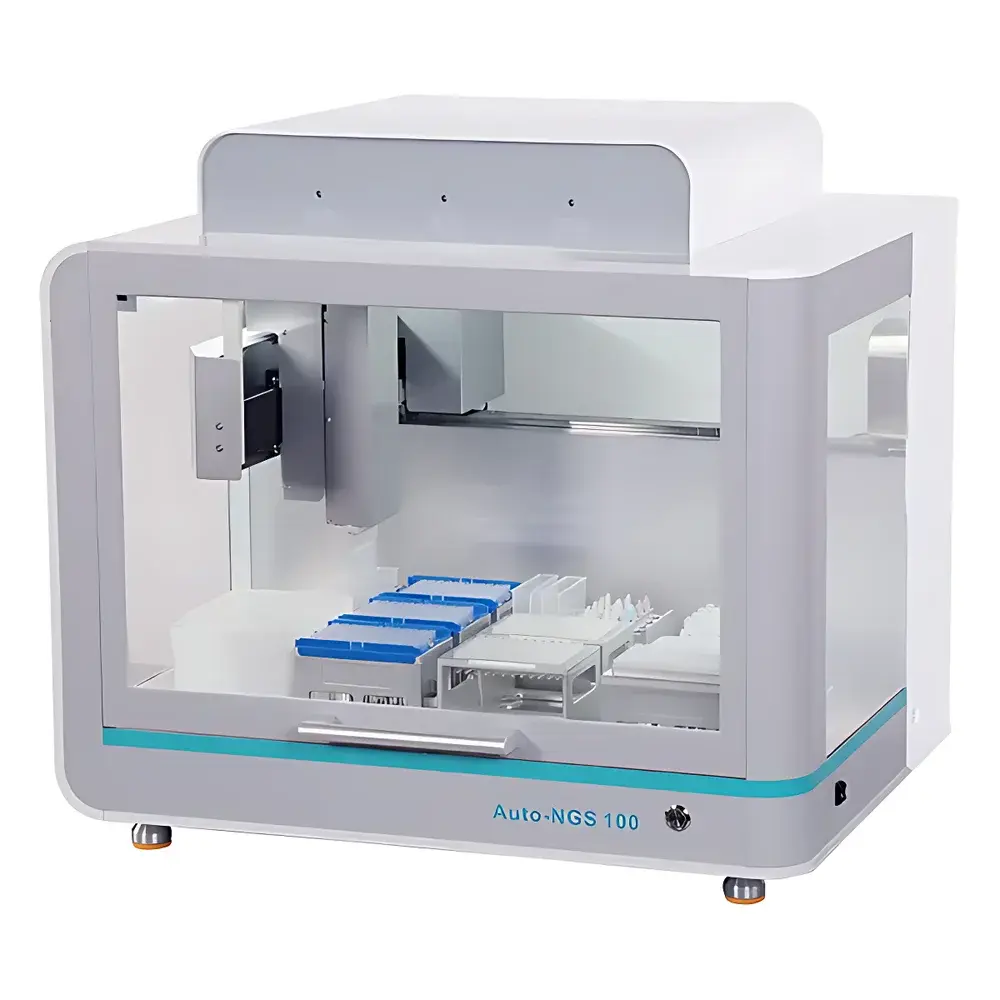
Allsheng Auto-NGS 100 Automated NGS Library Preparation and PCR Setup Workstation
| Brand | Allsheng |
|---|---|
| Origin | Zhejiang, China |
| Model | Auto-NGS 100 |
| Sample Throughput | 1–24 samples per run |
| Plate Positions | 9 standard deck positions + waste tip disposal zone + liquid waste reservoir |
| Pipetting | 8-channel adjustable-volume pipettor (2–200 µL) |
| Pipetting Accuracy | ±15% at 2 µL |
| Pipetting Precision | ≤5% CV at 2 µL |
| Temperature Modules | 1 programmable thermal block (0–105 °C, ±1 °C accuracy at 55 °C, ±1 °C uniformity) |
| Magnetic Separation | Single 96-well ring-style magnetic stand |
| Environmental Control | HEPA-filtered positive-pressure laminar airflow chamber with UV-C sterilization (254 nm) |
| Power Supply | 100–240 VAC, 50/60 Hz, 900 W nominal |
| Operating Conditions | 10–40 °C ambient, ≤80% RH non-condensing |
| Communication | CAN bus architecture with USB host interface |
| Software | Graphical drag-and-drop protocol builder with multi-tier user permission management (operator, supervisor, administrator) |
Overview
The Allsheng Auto-NGS 100 is an integrated, walk-away automated workstation engineered for end-to-end next-generation sequencing (NGS) library preparation and PCR reaction setup in molecular biology and genomics laboratories. It implements a standardized liquid handling architecture based on positive-displacement 8-channel pipetting, combined with precise thermal control, magnetic bead-based nucleic acid purification, and a contamination-controlled processing environment. Designed to meet the operational rigor of high-throughput core facilities and regulated research environments, the system supports full automation of fragmentation, end-repair, A-tailing, adapter ligation, size selection, indexing PCR, and clean-up steps—enabling reproducible, low-variance library construction across diverse sample types including genomic DNA, FFPE-derived DNA, cfDNA, and RNA (with compatible enzymatic modules). Its compact footprint (720 × 620 × 580 mm) and modular deck layout allow seamless integration into existing laboratory workflows without requiring dedicated cleanroom infrastructure.
Key Features
- High-fidelity 8-channel pipetting system with volume range from 2 to 200 µL, calibrated per ISO 8655-6 standards; precision ≤5% CV at 2 µL and ≤1% CV at 200 µL (single aspiration/dispense mode)
- Dual thermal control architecture: one independent temperature-controlled module (0–105 °C, ±1 °C accuracy at 55 °C) and one integrated 48-well Peltier-based thermal cycler (4–99.9 °C, ±0.2 °C accuracy, ±0.2 °C uniformity at 95 °C)
- 96-well compatible magnetic separation station with programmable lift height and dwell time, optimized for consistent bead pelleting across variable binding/wash/elution volumes
- ISO Class 5-equivalent laminar flow chamber featuring HEPA-grade particulate filtration, positive-pressure airflow, and 254 nm UV-C irradiation for routine decontamination between runs
- Modular deck configuration with nine standardized ANSI/SLAS-compliant plate positions—including dedicated zones for tips, reagents, samples, waste tips, and liquid waste—ensuring compatibility with commercial NGS library prep kits (e.g., Illumina TruSeq, NEBNext, IDT xGen)
- Open, scriptable software platform supporting drag-and-drop protocol design, version-controlled method storage, and audit-trail-enabled execution logging compliant with GLP documentation requirements
Sample Compatibility & Compliance
The Auto-NGS 100 accommodates a broad spectrum of input materials: double-stranded genomic DNA (≥10 ng), fragmented dsDNA (Covaris/shearing-derived), formalin-fixed paraffin-embedded (FFPE) extracts, cell-free DNA (cfDNA) isolated from plasma, and reverse-transcribed cDNA. It accepts standard SBS-format microplates (96-well PCR plates, deep-well plates, skirted/unskirted PCR strips), filter tips (10–200 µL), and magnetic bead suspension reagents. The system adheres to mechanical safety standards IEC 61000-6-2 (immunity) and IEC 61000-6-3 (emissions), and its software architecture supports ALCOA+ data integrity principles. While not pre-certified for clinical diagnostics under FDA 21 CFR Part 820 or IVDR, the platform is routinely deployed in research-use-only (RUO) settings where traceability, user access control, and electronic record retention align with ISO/IEC 17025 and CLIA-equivalent internal quality systems.
Software & Data Management
The embedded Allsheng NGS Control Suite provides role-based authentication (operator, supervisor, administrator), granular permission assignment, and time-stamped activity logs for all protocol executions, parameter modifications, and maintenance events. Protocols are built via intuitive graphical workflow editor—supporting conditional branching, loop iterations, and real-time sensor feedback integration (e.g., lid status, temperature stabilization confirmation). All methods are saved in encrypted XML format with SHA-256 checksums; raw log files include pipette calibration history, thermal ramp profiles, and magnetic actuation cycles. Data export options include CSV, PDF reports, and structured JSON for LIMS interoperability. Optional firmware updates are delivered via signed package verification to ensure runtime integrity.
Applications
- Automated whole-genome sequencing (WGS) library construction for population-scale studies
- Targeted panel library prep (e.g., cancer hotspot panels, exome capture) with hybridization or amplicon-based approaches
- RNA-Seq library generation (stranded, poly-A selected, rRNA-depleted) when paired with validated enzymatic modules
- High-sensitivity cfDNA library prep for liquid biopsy applications requiring low-input optimization
- Standardized PCR master mix assembly and qPCR plate setup for validation and QC workflows
- Reproducible ChIP-Seq and ATAC-Seq library generation in epigenetics research labs
FAQ
What consumables are required for daily operation?
Standard SBS-format 96-well plates (PCR, deep-well), filtered universal tips (10–200 µL), magnetic beads (e.g., AMPure XP), and commercially available NGS library prep kits.
Does the system support custom protocol development?
Yes—the software includes a full scripting interface (Python-compatible API) and allows users to define custom pipetting sequences, thermal profiles, and magnetic separation parameters.
Is remote monitoring or IoT integration possible?
The CAN bus architecture supports optional Ethernet gateway modules for SNMP-based status polling, cloud-based alerting, and centralized fleet management in multi-instrument facilities.
How often does the system require calibration or maintenance?
Pipette calibration is recommended every 6 months or after 10,000 dispense cycles; HEPA filter replacement is scheduled every 12 months or after 2,000 operational hours, whichever occurs first.
Can the Auto-NGS 100 be upgraded to higher throughput models like Auto-NGS 200 or 960?
No—deck architecture, thermal cycler configuration, and software licensing are model-specific; migration requires hardware replacement rather than field upgrade.



