
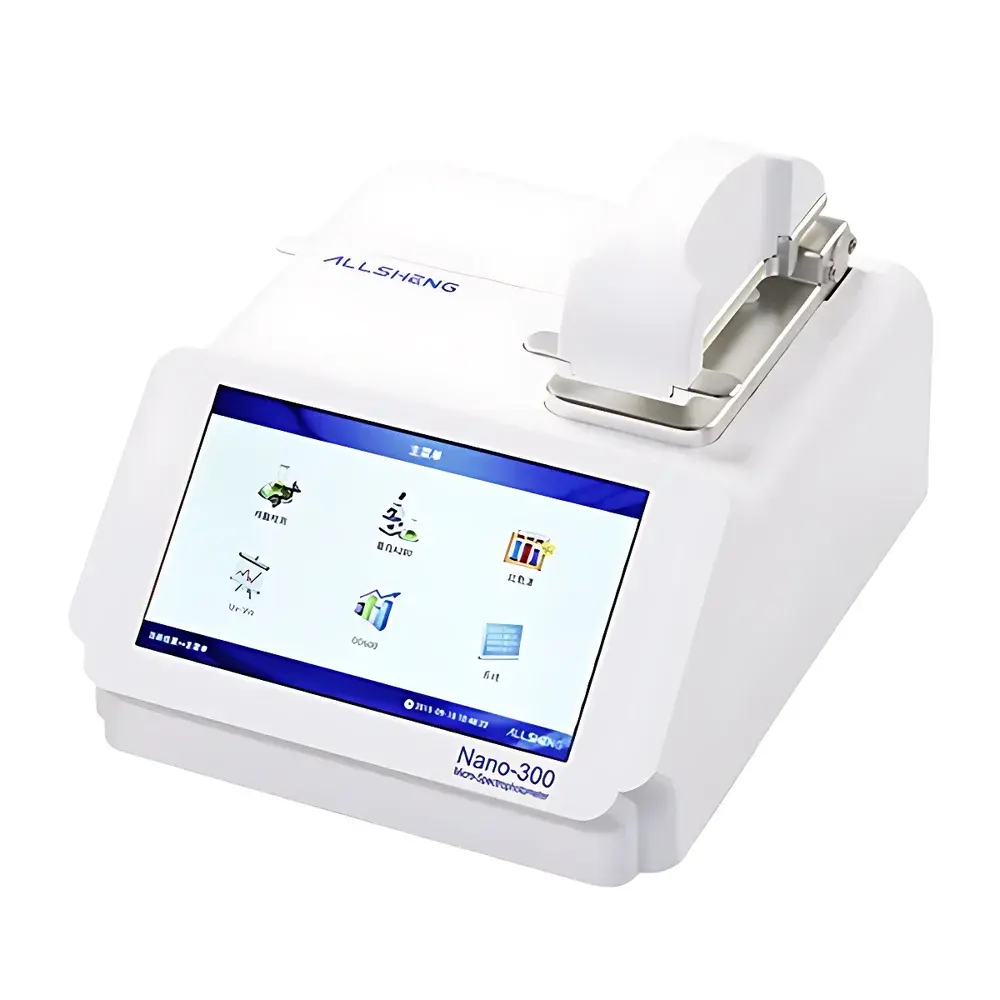
Allsheng Nano-300 Microvolume UV-Vis Spectrophotometer
| Brand | Allsheng |
|---|---|
| Origin | Zhejiang, China |
| Manufacturer Type | Authorized Distributor |
| Product Category | Domestic |
| Model | Nano-300 |
| Instrument Architecture | Single-beam |
| Detector | 2048-element linear CCD array |
| Wavelength Range | 200–800 nm |
| Wavelength Automation | Motorized scanning |
| Spectral Bandwidth | 1.5 nm (100 µm slit) |
| Wavelength Accuracy | ±1 nm |
| Wavelength Repeatability | ±0.5 nm |
| Stray Light | <0.05 % at 400 nm |
| OD600 Mode | LED source at 600 ± 8 nm, Absorbance Range: 0–4 A |
| Sample Volume | 0.5–2.0 µL |
| Optical Path Lengths | 0.2 mm (high-concentration), 1.0 mm (standard) |
| Absorbance Accuracy | ±1 % (at 7.332 A, 260 nm) |
| Absorbance Precision | ±0.003 A |
| Absorbance Range (10-mm equivalent) | 0.04–90 A |
| dsDNA Detection Range | 2–4500 ng/µL |
| Measurement Time | <5 s |
| Light Source | Pulsed xenon lamp (OD600 mode: high-stability LED) |
| Data Interface | USB 2.0 |
| Operating System | Custom Android OS (v8.1), 7-inch capacitive touchscreen |
| Power Supply | DC 24 V, 2 A |
| Max Power Consumption | 25 W |
| Standby Power | 5 W |
| Dimensions (W×D×H) | 210 × 268 × 181 mm |
| Weight | 2.8 kg |
Overview
The Allsheng Nano-300 Microvolume UV-Vis Spectrophotometer is a single-beam, full-spectrum (200–800 nm) analytical instrument engineered for rapid, label-free quantification and quality assessment of nucleic acids, proteins, and microbial suspensions in life science laboratories. It operates on the principle of ultraviolet-visible absorption spectroscopy, leveraging a pulsed xenon lamp and a high-resolution 2048-element linear CCD detector to deliver precise absorbance measurements across the entire spectral range without mechanical wavelength scanning delays. Unlike traditional cuvette-based systems requiring milliliters of sample, the Nano-300 utilizes surface tension-mediated microvolume measurement—enabling accurate analysis from just 0.5–2.0 µL of undiluted sample. Its dual-mode optical architecture integrates drop-based microvolume detection with a dedicated OD600 channel using a stabilized 600 ± 8 nm LED source, allowing direct, interference-resistant monitoring of bacterial culture density—a critical parameter in fermentation optimization, transformation efficiency evaluation, and growth phase determination.
Key Features
- Integrated dual-path optical design: microvolume (0.2 mm / 1.0 mm pathlength) + dedicated OD600 cuvette mode for microbial suspension analysis
- High-fidelity detection: 2048-pixel linear CCD array with ≤3 nm wavelength resolution and ±1 nm accuracy ensures compliance with ISO 8579-1 and ASTM E275 for spectrophotometric validation
- Zero-computer operation: proprietary Android 8.1 OS running on a 7-inch capacitive touchscreen enables standalone method execution, data visualization, and report generation
- Extended dynamic range: measures absorbance from 0.04 A to 90 A (10-mm equivalent), supporting direct quantification of dsDNA up to 4500 ng/µL without dilution
- Robust light source architecture: long-life pulsed xenon lamp (≥10⁹ flashes) minimizes drift and eliminates warm-up time; OD600 LED exhibits <0.5 % intensity variation over 10,000 hours
- Regulatory-ready data handling: USB export supports CSV/TXT formats compatible with LIMS integration; built-in thermal printer provides auditable hard-copy output with timestamp and operator ID fields
Sample Compatibility & Compliance
The Nano-300 accommodates a broad spectrum of biological samples—including purified plasmid DNA, RNA isolates, protein lysates (BSA, IgG), PCR master mixes, and bacterial/fungal cultures in standard LB, TB, or M9 media. Its quartz fiber–aluminum hybrid sample stage resists corrosion from acidic or basic buffers and withstands repeated ethanol decontamination cycles. For regulatory environments, the instrument supports GLP/GMP-aligned workflows: absorbance calibration is traceable to NIST-traceable standards (e.g., potassium dichromate at 235/257/313/350 nm), and measurement logs include metadata such as date/time stamp, pathlength selection, and ambient temperature (monitored via internal sensor). While not FDA 21 CFR Part 11-certified out-of-the-box, audit trail functionality (via exported logs) satisfies ISO/IEC 17025 documentation requirements for accredited testing laboratories.
Software & Data Management
The embedded Android platform hosts a purpose-built application with intuitive workflow navigation—supporting preconfigured assays (dsDNA, ssDNA, RNA, Protein A280, Protein A205, OD600) and customizable user methods. All spectra and quantitative results are stored locally with automatic timestamping and can be exported via USB mass storage mode to external drives or network-attached storage. The software enforces data integrity through checksum-verified file writes and prohibits post-acquisition value editing—ensuring raw data immutability per ALCOA+ principles. Optional PC-based companion software (NanoControl Suite v3.2) enables advanced spectral overlay, baseline correction, and batch statistical reporting (mean, SD, CV%) for QC release testing.
Applications
- High-throughput nucleic acid quantification in NGS library preparation and CRISPR construct verification
- Routine QC of recombinant protein expression batches during upstream bioprocessing
- Real-time monitoring of E. coli, Bacillus, and yeast culture growth kinetics in shake flasks and bioreactors
- Verification of oligonucleotide synthesis yield and purity (A260/A280, A260/A230 ratios)
- Assessment of enzymatic reaction progress via NAD(P)H absorbance at 340 nm
- Support of ISO 15197:2013-compliant assay development for diagnostic reagent characterization
FAQ
Does the Nano-300 require routine wavelength calibration?
No—factory-calibrated wavelength accuracy (±1 nm) remains stable over ≥12 months under standard lab conditions; annual verification using a holmium oxide or didymium reference filter is recommended per ISO/IEC 17025.
Can the OD600 mode be used with turbid or colored media?
Yes—the 600 ± 8 nm narrow-band LED minimizes interference from common chromophores (e.g., phenol red, hemoglobin); however, for highly pigmented samples (e.g., cyanobacterial cultures), a matched blank subtraction protocol is advised.
Is the thermal printer compatible with GLP audit requirements?
Yes—printed reports include instrument ID, serial number, measurement date/time, operator name (if entered), and assay parameters, fulfilling minimum record-keeping criteria under 21 CFR Part 11 Annex 11.
What maintenance is required for the microvolume pedestal?
Wipe clean with >70 % isopropanol after each use; avoid abrasive cleaners. Quartz fiber surface is resistant to scratching but requires periodic inspection under 10× magnification for micro-abrasions affecting droplet geometry.
How does the Nano-300 handle bubbles or debris in the sample droplet?
The software includes real-time spectral anomaly detection; absorbance spikes >3σ from local baseline trigger an alert and recommend re-measurement—preventing erroneous concentration calls due to air entrapment or particulate scattering.
Related Products





