
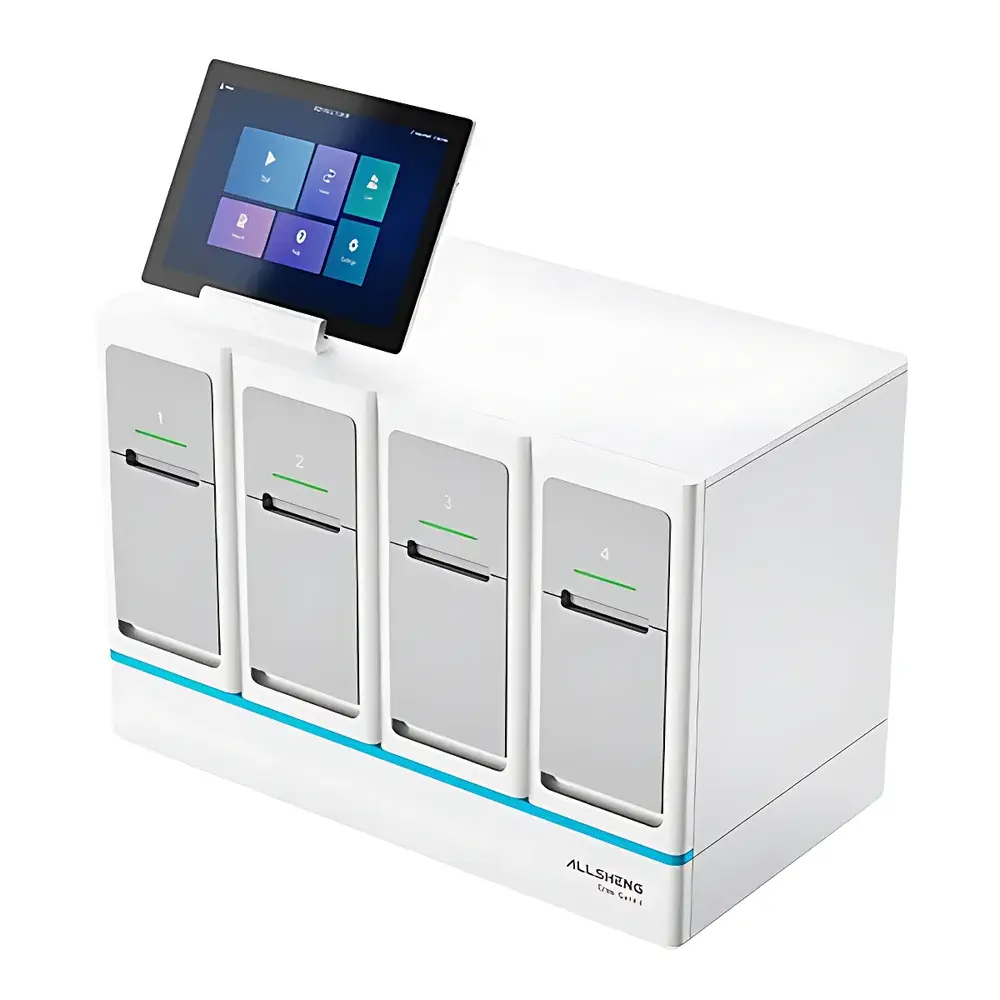
Allsheng Ecos-Gene Automated Nucleic Acid Detection and Analysis System
| Brand | Allsheng |
|---|---|
| Origin | Zhejiang, China |
| Model | Ecos-Gene Automated Nucleic Acid Detection and Analysis System |
| Sample Throughput | 1/2/4 samples per unit (scalable to 16) |
| Fluorescence Channels | 4 (470–510 nm, 530–565 nm, 585–620 nm, 630–665 nm) |
| Thermal Block Temperature Range | Ambient to 120 °C |
| Temperature Accuracy | ±0.2 °C |
| PCR Ramp Rates | ≥6 °C/s (avg. heating), ≥8 °C/s (max. heating), ≥4.5 °C/s (avg. cooling), ≥8 °C/s (max. cooling) |
| Extraction CV | ≤5% |
| Sample Input Volume | Up to 3 mL (working volume ~2.5 mL) |
| Software Platform | Windows-based, LIS- and cloud-database–compatible |
| Compliance | Designed for CLIA-waived and IVD-use environments |
Overview
The Allsheng Ecos-Gene Automated Nucleic Acid Detection and Analysis System is an integrated, cartridge-based molecular diagnostic platform engineered for rapid, walk-away nucleic acid extraction, real-time PCR amplification, and multiplexed fluorescent detection in a single instrument. Leveraging microfluidic cartridge architecture with pre-lyophilized reagents, the system implements a closed-tube workflow that minimizes manual intervention and eliminates cross-contamination risk. Its core measurement principle combines magnetic-bead–based solid-phase nucleic acid purification with quantitative real-time PCR (qPCR) using four independently controlled optical channels—each calibrated for excitation/emission profiles compatible with FAM, HEX, ROX, and Cy5 dyes. The system is designed for deployment in decentralized settings—including point-of-care clinics, field laboratories, and biosurveillance units—where robustness, assay flexibility, and regulatory traceability are essential.
Key Features
- Modular throughput architecture: Ecos-Gene 1, Ecos-Gene 2, and Ecos-Gene 4 units operate independently and can be networked to achieve up to 16-sample parallel processing without shared fluidic or thermal pathways.
- Single-use, sealed microcartridge design: Each sample is processed in an isolated, factory-preloaded cartridge containing lyophilized lysis, binding, wash, elution, and PCR master mix reagents—reducing hands-on time to ≤2 minutes per run.
- Four-channel fluorescence detection: Independent optical paths support simultaneous detection of up to four targets per sample, with excitation/emission bands at 470/510 nm, 530/565 nm, 585/620 nm, and 630/665 nm—enabling multiplexed pathogen identification, SNP genotyping, and absolute quantification.
- Precision thermal control: Peltier-driven heating/cooling modules deliver temperature accuracy ≤±0.2 °C across the full range (ambient to 120 °C), with maximum ramp rates exceeding 8 °C/s for both heating and cooling phases—ensuring stringent compliance with ISO 13485–aligned thermal validation requirements.
- Integrated UV decontamination: A dedicated UV-C lamp (254 nm) is mounted within each sample channel, automatically activated between runs to degrade residual nucleic acids and prevent carryover contamination.
Sample Compatibility & Compliance
The Ecos-Gene platform accepts diverse clinical and environmental sample types—including nasopharyngeal swabs, saliva, whole blood (with optional pretreatment), sputum, and water concentrates—when used with validated magnetic-bead–based extraction kits. Its open-cartridge interface supports third-party reagent kits compliant with ISO 15189, CLSI EP12-A2, and USP guidelines for nucleic acid extraction efficiency and PCR inhibition testing. Software enforces GLP/GMP-aligned operational controls: role-based access (administrator, operator, guest), electronic signatures, full audit trail logging (including parameter changes, user logins, and result exports), and optional 21 CFR Part 11 compliance mode with digital signature enforcement and immutable record retention.
Software & Data Management
The embedded Windows-based operating software provides a 10.5-inch capacitive touchscreen interface with intuitive visual workflow guidance, real-time thermal and optical status monitoring, and context-sensitive help. Data management includes native export in CSV, PDF, and XML formats; direct printing via RS232 or USB-connected thermal printers; and bidirectional HL7/LIS integration through configurable TCP/IP protocols. Cloud synchronization capability enables secure remote data backup, centralized instrument fleet monitoring, and over-the-air firmware updates—all implemented with TLS 1.2 encryption and OAuth 2.0 authentication. Custom assay templates can be imported via JSON schema, supporting flexible Ct thresholding, multi-point standard curve fitting, and ΔΔCt-based relative quantification workflows.
Applications
The Ecos-Gene system serves applications requiring high-fidelity, low-turnaround-time nucleic acid analysis under resource-constrained conditions. Primary use cases include infectious disease screening (e.g., SARS-CoV-2, influenza A/B, RSV, HIV viral load), antimicrobial resistance gene detection (e.g., mecA, vanA, blaKPC), foodborne pathogen verification (e.g., Salmonella spp., Listeria monocytogenes), and environmental microbiological monitoring (e.g., Legionella pneumophila in water systems). Its quantitative output—expressed as copies/µL based on internal calibration curves—meets ISO/IEC 17025 requirements for accredited testing laboratories when paired with NIST-traceable reference materials.
FAQ
Does the Ecos-Gene system support external LIS integration?
Yes—it offers configurable HL7 v2.x messaging and TCP/IP-based API endpoints for seamless two-way communication with laboratory information systems.
Can users develop and validate their own assays on this platform?
Yes—the open software architecture allows import of custom qPCR protocols, standard curve definitions, and reporting templates, subject to internal validation per CLIA and ISO 15189 requirements.
What maintenance is required for long-term reliability?
Routine maintenance includes quarterly optical alignment verification, biannual thermal calibration using NIST-traceable reference blocks, and annual UV lamp intensity testing per IEC 62471 photobiological safety standards.
Is the system compatible with freeze-dried reagent cartridges from other manufacturers?
It supports third-party cartridges meeting mechanical, thermal, and optical interface specifications outlined in the Allsheng Interoperability Design Guide (v3.1), including dimensional tolerances, magnetic bead suspension volume, and fluorophore spectral compatibility.
How is data integrity ensured during power interruption or system crash?
All critical process states—including thermal cycling progress, fluorescence acquisition timestamps, and user actions—are written to non-volatile memory every 2 seconds; recovery resumes from last stable checkpoint without data loss.





