
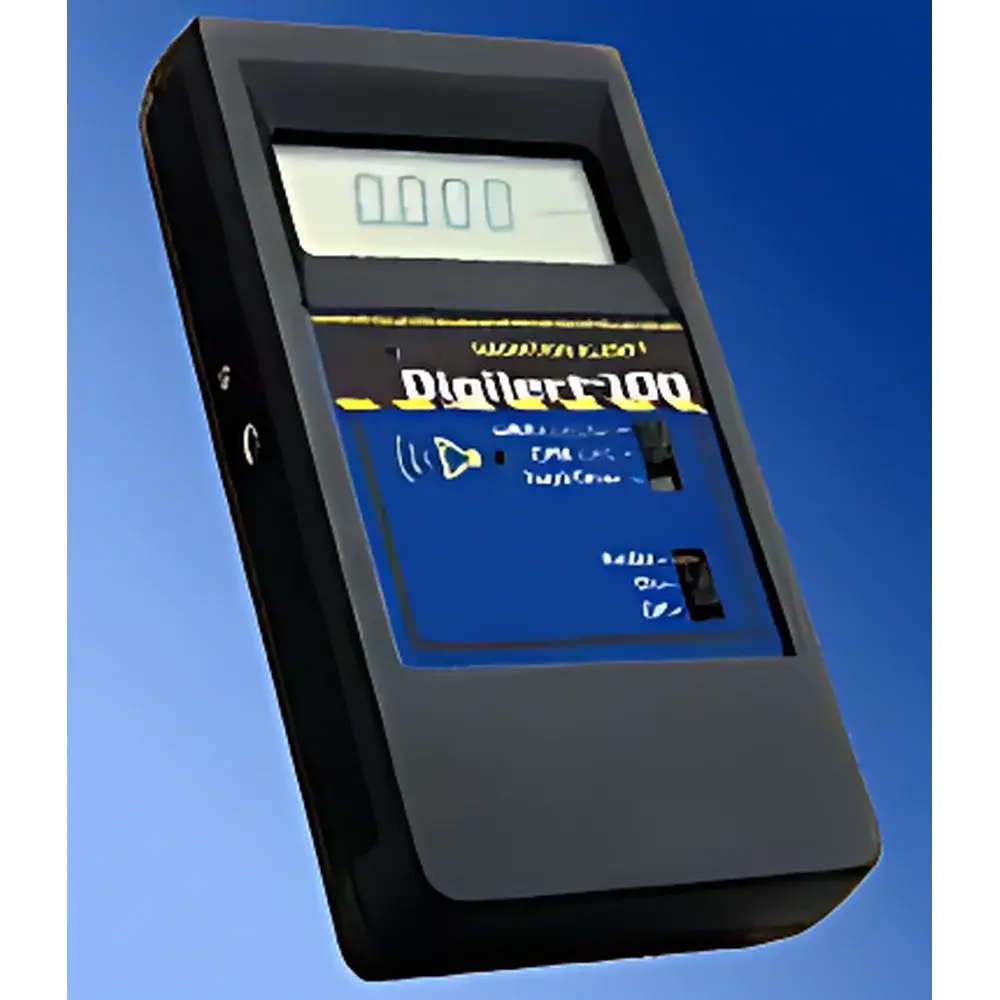
Inspector DIgialert-100 Portable Radiation Detector
| Origin | USA |
|---|---|
| Manufacturer Type | Authorized Distributor |
| Origin Category | Imported |
| Model | DIgialert-100 |
| Pricing | Upon Request |
| Display | LCD digital display with red LED alarm indicator |
| Operating Temperature Range | –10 °C to +50 °C |
| Detector Type | M-type GM tube with integrated beryllium-window (ICA) for alpha/beta/gamma detection |
| Sensitivity | 1000 CPM per mR/hr (calibrated with Cs-137) |
| Accuracy | ±10% typical |
| Dose Rate Range | 0.001–50 mR/hr |
| Count Rate Range | 0–50,000 CPM |
| Accumulated Count Range | 0–9,999,000 counts |
| Radiation Types Detected | Alpha (α), Beta (β), Gamma (γ), and X-rays |
| Audio Output | Audible alarm via 3.5 mm headphone jack |
| Power Supply | One 9 V alkaline battery (IEC 6LR61) |
| Battery Life | Up to 2000 hours (typical continuous operation) |
| Weight | 0.5 kg |
| Probe Integration | Integrated collimated GM detector assembly |
Overview
The Inspector DIgialert-100 Portable Radiation Detector is a field-deployable, general-purpose radiation monitoring instrument engineered for reliable detection and quantification of ionizing radiation in occupational, environmental, and emergency response settings. Based on proven Geiger-Müller (GM) tube technology with a thin beryllium-window (ICA) M-type detector, the DIgialert-100 delivers broad-spectrum sensitivity across alpha, beta, gamma, and X-ray emissions—enabling versatile use in nuclear facility perimeter surveys, radiological contamination screening, radon progeny assessment, and post-event dose rate evaluation. Its solid-state electronics, low-power architecture, and ruggedized handheld form factor ensure operational stability under variable ambient conditions (–10 °C to +50 °C), while maintaining consistent pulse-height-independent counting performance across its full dynamic range.
Key Features
- Integrated M-type GM detector with beryllium entrance window optimized for alpha particle transmission (≥4 MeV) and enhanced low-energy beta/gamma response
- LCD digital display with real-time dose rate (mR/hr) and count rate (CPM) readouts, supplemented by high-visibility red LED alarm indicator
- Calibrated sensitivity of 1000 CPM per mR/hr using 137Cs reference source—traceable to NIST-traceable standards
- Dual-range measurement capability: instantaneous dose rate (0.001–50 mR/hr) and gross count accumulation (0–9,999,000 counts)
- Audible alarm output via standard 3.5 mm headphone jack for integration with external audio systems or personal alert devices
- Low-power design powered by a single 9 V alkaline battery supporting up to 2000 hours of continuous operation—ideal for extended field deployments
- Compact, ergonomic housing weighing only 0.5 kg; IP54-rated enclosure for dust and splash resistance during routine handling
Sample Compatibility & Compliance
The DIgialert-100 is designed for direct surface scanning of materials—including building substrates (granite, concrete), scrap metal, soil samples, air filters, and personnel protective equipment—without sample preparation. Its alpha-sensitive window allows qualitative detection of surface alpha emitters such as 238U, 239Pu, and 222Rn decay products when used in close-proximity mode (<2 cm). While not intended for spectroscopic identification, the instrument meets functional requirements outlined in ANSI N42.33-2022 (Portable Radiation Detection Instrumentation) and supports compliance workflows aligned with IAEA Safety Standards Series No. RS-G-1.8 and OSHA 1910.120 regulations for hazardous waste operations. Data logging and audit trail capabilities are limited to manual recording; for GLP/GMP environments requiring electronic records, supplementary documentation protocols must be implemented per 21 CFR Part 11 guidelines.
Software & Data Management
The DIgialert-100 operates as a standalone analog-digital hybrid instrument with no onboard memory or USB/Bluetooth connectivity. All measurements are displayed in real time and require manual transcription into laboratory notebooks or digital reporting tools. For structured data capture, users may interface the audio alarm output with third-party sound-triggered logging hardware or integrate visual readings into validated mobile applications compliant with ISO/IEC 17025 documentation practices. No proprietary firmware updates or cloud synchronization are supported; calibration verification intervals should follow internal QA procedures per ASTM D3084 or site-specific radiation protection program requirements.
Applications
- Routine contamination surveys in nuclear power plant auxiliary buildings, radiochemistry labs, and hospital radiopharmacy suites
- Screening of imported ferrous/non-ferrous scrap for orphan radioactive sources (e.g., 60Co, 137Cs)
- Radon mitigation verification in residential basements and uranium-bearing geological formations
- First-responder situational awareness during radiological dispersal device (RDD) incidents or transportation accidents involving radioactive material
- Educational demonstrations of inverse-square law, shielding effectiveness, and background radiation variability
- Environmental baseline studies of naturally occurring radioactive material (NORM) in construction aggregates and mining tailings
FAQ
Does the DIgialert-100 provide energy discrimination or isotope identification?
No. It is a non-spectroscopic integrator based on GM counting principles and does not resolve photon or particle energy spectra.
Can it detect radon gas directly?
No. It detects alpha-emitting radon progeny (e.g., 218Po, 214Po) deposited on surfaces or collected on air filters—not gaseous 222Rn itself.
Is calibration traceable to national standards?
Yes—factory calibration uses 137Cs sources certified to NIST-traceable activity; annual recalibration is recommended per ISO/IEC 17025 Clause 6.6.
What is the minimum detectable activity for alpha contamination?
Under optimal geometry (contact, static air), typical MDAs range from 0.1–0.5 Bq/cm² for 241Am, depending on background and counting time.
Is the instrument suitable for food or pharmaceutical screening?
No. It lacks the sensitivity and regulatory validation required for FDA-regulated product release testing; dedicated scintillation or HPGe systems are required for such applications.







