
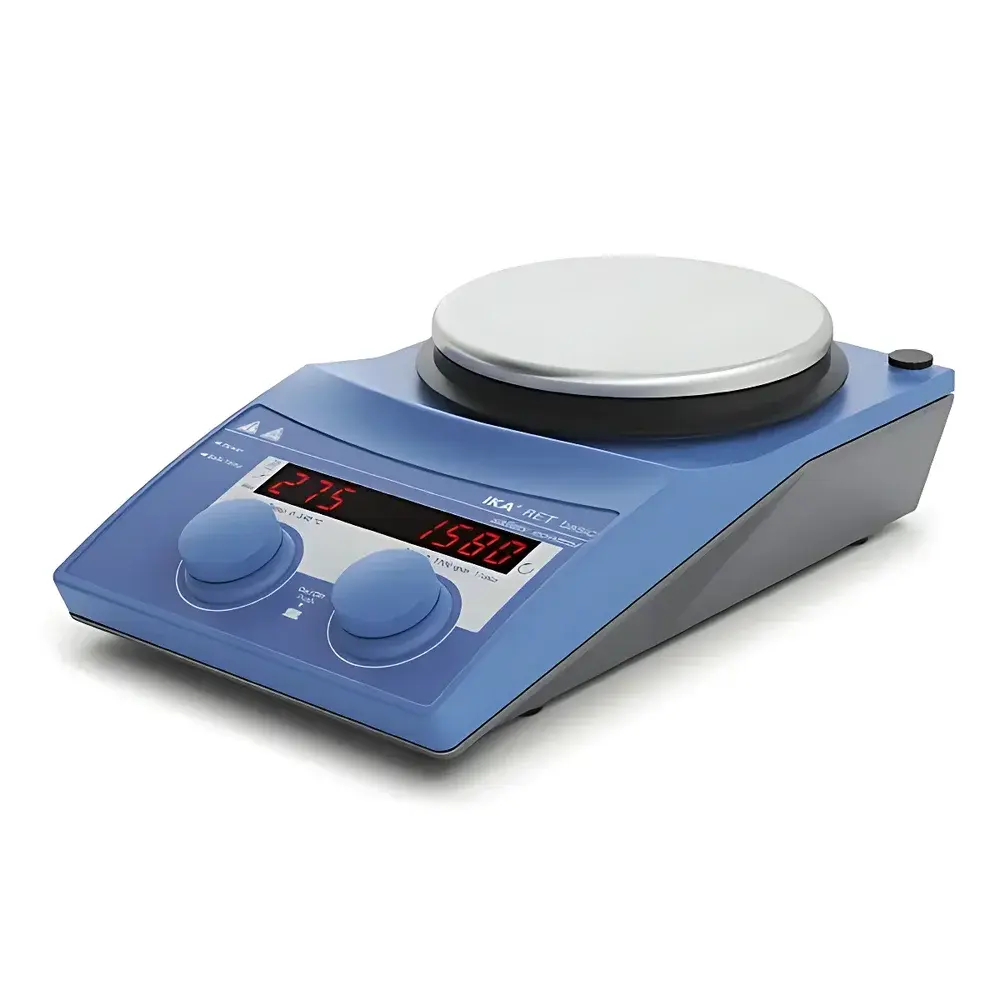
IKA RET basic Magnetic Stirrer with Heating
| Brand | IKA |
|---|---|
| Origin | Germany |
| Model | RET basic |
| Motor Output Power | 9 W |
| Max. Stirring Volume (H2O) | 20 L |
| Speed Range | 50–1500 rpm |
| Speed Setting Accuracy | ±10 rpm |
| Stir Bar Length Compatibility | 30–80 mm |
| Heating Power | 850 W |
| Heating Temperature Range | RT + self-heating to 310 °C |
| Temp. Setting Range | 0–310 °C |
| Temp. Setting Accuracy | ±1 K |
| External Temperature Sensor Interface | PT1000 / ETS-D5 / ETS-D6 |
| Media Temp. Control Accuracy (with ETS-D6) | ±0.2 K |
| Heating Plate Material | Aluminum alloy with ceramic coating |
| Plate Dimensions | 137 × 137 mm |
| Dimensions (W × H × D) | 160 × 85 × 270 mm |
| Weight | 2.6 kg |
| Ambient Operating Conditions | 5–40 °C, ≤80 % RH |
| Protection Class | IP42 (DIN EN 60529) |
| Interfaces | RS232, USB |
| Voltage | 220–230 V AC, 50/60 Hz |
| Total Input Power | 900 W |
| Standby Power Consumption | 1.6 W |
| Safety Features | Adjustable overtemperature cutoff (50–370 °C), automatic reverse rotation, intermittent mode, viscosity trend monitoring, integrated timer (1 s – 143940 min), media detection sensor (Error 5), LCD display for set/actual speed & temperature (°C/°F) |
Overview
The IKA RET basic Magnetic Stirrer with Integrated Heating is an engineered solution for precise, reproducible mixing and temperature-controlled sample preparation in analytical, quality control, and research laboratories. Based on the principle of magnetic coupling—where a rotating permanent magnet beneath a chemically inert ceramic-coated aluminum plate induces rotational motion in a submerged magnetic stir bar—the instrument delivers stable agitation without mechanical shaft penetration. Its dual-control architecture independently regulates stirring speed (50–1500 rpm) and heating plate temperature (0–310 °C), enabling simultaneous kinetic and thermal conditioning of aqueous and organic media up to 20 L. Designed and manufactured in Staufen, Germany, the RET basic adheres to IKA’s long-standing commitment to DIN EN 60529 (IP42) ingress protection, electromagnetic compatibility (EMC), and low-energy standby compliance (≤1.6 W). Its compact footprint (160 × 270 × 85 mm) and lightweight construction (2.6 kg) support flexible benchtop deployment across ISO 17025-accredited labs, GMP environments, and university teaching facilities.
Key Features
- Independent dual-parameter control: motor speed and heating plate temperature are adjusted via dedicated analog knobs, minimizing cross-interference during method development.
- Ceramic-coated aluminum heating plate (137 × 137 mm) provides uniform thermal distribution, chemical resistance, and enhanced scratch resistance compared to standard enamel or stainless-steel surfaces.
- Integrated safety systems include programmable overtemperature cutoff (adjustable from 50 to 370 °C), real-time surface overheating detection with visual alert, and automatic shutdown upon media loss (Error 5 sensor).
- Advanced operational modes: bidirectional rotation (clockwise/counter-clockwise), intermittent stirring, and viscosity trend monitoring—enabling adaptive response to changing rheological conditions during dissolution or polymerization studies.
- High-resolution LCD displays simultaneously show setpoint and actual values for both speed (rpm) and temperature (°C/°F), supporting immediate verification of parameter adherence per SOP requirements.
- Digital connectivity via RS232 and USB interfaces enables integration into lab-wide data acquisition systems, supporting audit-ready logging under FDA 21 CFR Part 11 when paired with compliant software.
Sample Compatibility & Compliance
The RET basic accommodates standard laboratory glassware including beakers (up to 3 L nominal volume), round-bottom flasks, and crystallization dishes. Stir bar length compatibility (30–80 mm) ensures optimal torque transfer across vessel geometries and viscosities—from low-viscosity buffers to moderately viscous polymer solutions. Its heating performance has been validated using standardized test configurations: temperature stability of ±0.2 K at 50 °C is achieved with ETS-D6 external probe feedback in a 600 mL beaker containing 500 mL H₂O (40 mm stir bar, 600 rpm), meeting requirements for USP compounding and ASTM E2912-13 thermal validation protocols. The unit conforms to DIN EN 61326-1 (electromagnetic immunity), DIN EN 61010-1 (safety), and carries CE marking for use in EU-regulated laboratories.
Software & Data Management
While the RET basic operates as a standalone instrument, its RS232 and USB ports support ASCII-based command protocols for remote parameter setting, real-time data streaming (speed, temperature, error status), and event-triggered logging. When connected to IKA LabWorld software or third-party SCADA platforms compliant with IEEE 11073 or HL7 standards, users can generate time-stamped records—including start/stop timestamps, setpoint deviations, and safety event flags—for GLP/GMP traceability. All stored timer values (1 s to 143940 min) persist through power cycles, and the system retains last-used parameters after shutdown—reducing setup time for repeat experiments.
Applications
- Buffer and reagent preparation requiring consistent homogenization and thermal equilibration prior to HPLC or spectrophotometric analysis.
- Dissolution testing per USP , where precise control of agitation rate and bath temperature is critical for drug release profiling.
- Enzyme kinetics assays involving temperature-sensitive catalytic reactions monitored by UV-Vis or fluorescence.
- Synthesis of metal-organic frameworks (MOFs) and nanoparticle dispersions, where intermittent stirring prevents agglomeration while maintaining thermal input.
- Calibration of thermocouples and RTDs using traceable reference fluids under controlled shear and thermal gradients.
FAQ
Does the RET basic support external temperature feedback for improved media temperature accuracy?
Yes—it features dedicated inputs for PT1000, ETS-D5, and ETS-D6 sensors. When used with ETS-D6 under defined test conditions, media temperature control accuracy reaches ±0.2 K.
Can the instrument operate unattended for extended periods?
Yes—its programmable timer (up to 99 days, 99 hours, 59 minutes), automatic shut-off, and error-detection logic (e.g., Error 5 for media absence) enable validated overnight or weekend runs.
Is the heating plate surface resistant to common laboratory solvents?
The white ceramic coating exhibits high resistance to acids, bases, and organic solvents per DIN ISO 2812-2; however, prolonged exposure to hydrofluoric acid or molten alkali metals is not recommended.
What safety certifications does the RET basic carry?
It complies with DIN EN 61010-1 (electrical safety), DIN EN 61326-1 (EMC), and bears CE, UKCA, and cTUVus marks for global laboratory use.
How is speed stability maintained across load variations?
The brushless DC motor maintains ±2% speed deviation (no-load, 1500 rpm, 25 °C) and dynamically compensates for torque fluctuations via closed-loop current regulation—critical for viscosity-sensitive applications.



