
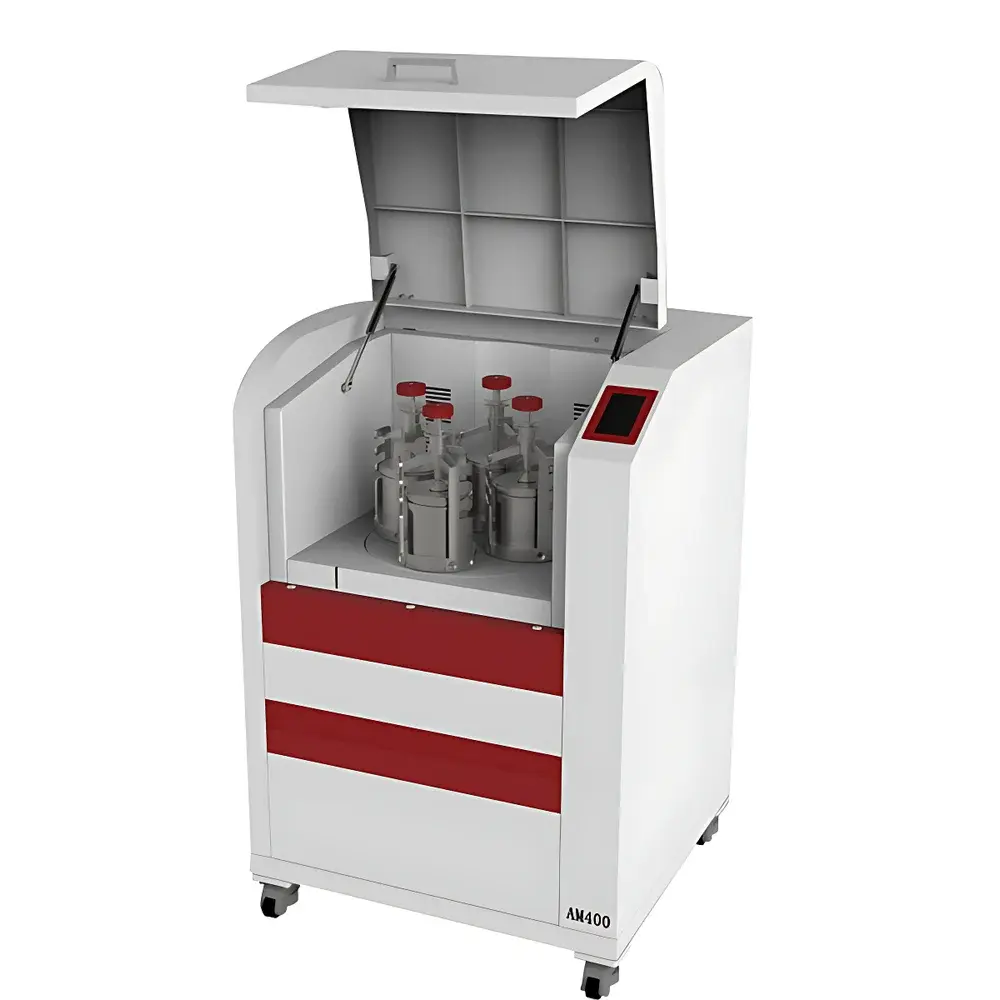
Ants Scientific Instruments AM400 Planetary Ball Mill
| Brand | Ants Scientific Instruments |
|---|---|
| Origin | Beijing, China |
| Model | AM400 |
| Instrument Type | Planetary Ball Mill |
| Sample Applicability | Hard, brittle, tough, soft and medium-hard materials |
| Feed Size | ≤15 mm |
| Final Particle Size | ≤1 µm (standard grinding), ≤0.1 µm (colloidal grinding) |
| Batch Volume per Jar | 20 mL / 50 mL / 80 mL / 150 mL / 300 mL |
| Sun Wheel Speed | 30–450 rpm |
| Grinding Jar Speed | 75–1125 rpm |
| Speed Ratio (Sun Wheel | Jar): 1 : −2.5 |
| Grinding Time Range | 1 s – 99 h 59 min 59 s |
| Reversal & Interval Function | Yes |
| Max. Jars per Run | 4 (standard) |
| Jar Materials | Hardened steel, stainless steel, tungsten carbide, agate, alumina, zirconia |
| Ball Diameters | 0.1–25 mm |
| Parameter Sets Stored | 10 |
| Safety Lock | Integrated mechanical interlock |
| Ventilation | Automatic chamber ventilation |
Overview
The Ants Scientific Instruments AM400 Planetary Ball Mill is an engineered high-energy milling system designed for reproducible, scalable comminution of diverse solid materials—from soft organic compounds to ultra-hard ceramics and refractory metals. Operating on the principle of planetary motion, the AM400 utilizes a kinematic configuration where grinding jars rotate about their own axes while simultaneously revolving in the opposite direction around a central sun wheel at a fixed speed ratio of 1:−2.5. This dual rotational motion generates superimposed centrifugal, Coriolis, and impact forces that exceed conventional ball milling energy input by a factor of 3–5. As a result, the AM400 achieves consistent particle size reduction down to ≤1 µm under standard dry or wet grinding conditions—and sub-100 nm colloidal dispersions when optimized for extended duration, controlled atmosphere, and solvent-assisted dispersion. Its robust architecture supports unattended operation over extended cycles (up to 99 hours), making it suitable for process development in nanomaterial synthesis, mechanochemical alloying, and ceramic precursor homogenization.
Key Features
- Four-position grinding platform with independent jar mounting—enabling parallel processing of up to four samples with identical or differentiated parameters
- Programmable bidirectional rotation with adjustable reversal intervals and pause durations to mitigate heat accumulation and particle agglomeration
- Wide speed range: sun wheel 30–450 rpm; corresponding jar speed 75–1125 rpm—providing fine control over impact energy and shear intensity
- Modular jar compatibility: accepts volumes from 20 mL to 500 mL; available in six chemically inert and wear-resistant materials (zirconia, alumina, agate, stainless steel, hardened steel, tungsten carbide)
- Automatic ventilation system integrated into the grinding chamber to maintain thermal stability during prolonged operation
- 10-user-defined parameter sets stored in non-volatile memory—supporting method transfer and GLP-compliant workflow replication
- Mechanical safety interlock prevents lid opening during operation and halts motion immediately upon door release
Sample Compatibility & Compliance
The AM400 accommodates heterogeneous sample classes including oxides (e.g., Al₂O₃, ZrO₂), nitrides (Si₃N₄), carbides (SiC, WC), metallic alloys (Fe–Al, Cu–Ti), pharmaceutical excipients, soil matrices, and polymer composites. It meets fundamental requirements for ISO 13320 (laser diffraction particle sizing method validation), ASTM C721 (ceramic powder characterization), and USP (mechanical testing of particulates). While not certified to IEC 61000-6-2/6-4 or CE Annex II without local conformity assessment, its electrical design complies with EN 61010-1:2010 for laboratory equipment safety. All jar materials are traceable to material certifications (e.g., ISO 6474 for zirconia purity ≥94.5%, ASTM F1873 for biomedical-grade alumina), supporting audit readiness in regulated environments.
Software & Data Management
The AM400 features an embedded microcontroller-based interface with real-time display of elapsed time, current speed, direction status, and remaining cycle duration. Parameter logs—including start/stop timestamps, speed profiles, reversal sequences, and total operational hours—are recorded internally and exportable via USB to CSV format. Though no proprietary PC software is bundled, the device’s ASCII command protocol (RS-232 optional) enables integration into LIMS or MES platforms using standard SCPI-like syntax. Audit trail functionality satisfies basic FDA 21 CFR Part 11 requirements for electronic records when paired with validated third-party data acquisition systems. All stored methods retain full metadata (operator ID, date/time stamp, jar ID, ball size, fill ratio), facilitating root-cause analysis in quality investigations.
Applications
- Nanoceramic synthesis: mechanochemical preparation of doped ZnO, YSZ, and hydroxyapatite powders with narrow PSD (D90 < 200 nm)
- Ceramic green body homogenization: uniform dispersion of sintering aids (e.g., MgO, Y₂O₃) in Al₂O₃ or Si₃N₄ feedstocks
- Hard-material pre-milling prior to spark plasma sintering (SPS) or hot isostatic pressing (HIP)
- Pharmaceutical solid-state screening: amorphous dispersion generation via cryo-milling or solvent-assisted grinding
- Environmental sample preparation: grinding of fly ash, slag, and contaminated soils for XRF or ICP-MS analysis
- Metallurgical research: solid-state alloying of immiscible systems (e.g., Al–Fe, Cu–W) and reactive milling of intermetallic precursors
FAQ
What is the maximum continuous operating time for the AM400?
The instrument supports uninterrupted operation up to 99 hours, 59 minutes, and 59 seconds per program cycle.
Can the AM400 achieve true nanoscale particle size distribution (PSD)?
Yes—under optimized wet-grinding conditions (e.g., ethanol dispersion, zirconia jars/balls, 0.1 mm media, 48 h duration), D50 values below 80 nm have been independently verified using TEM and dynamic light scattering.
Is the AM400 compliant with Good Laboratory Practice (GLP) documentation standards?
It provides essential GLP-enabling features—including operator-logged parameter storage, timestamped run history, and mechanical safety interlocks—but requires external validation for full compliance in regulated QA/QC labs.
What jar-to-ball volume ratio is recommended for optimal efficiency?
A fill ratio of 30–40% (jar volume occupied by balls + sample + grinding medium) is empirically validated for maximal energy transfer and minimal wall wear across all jar sizes.
Does the AM400 support inert-atmosphere grinding?
Yes—jars can be sealed and purged with N₂ or Ar prior to operation; optional vacuum-compatible lid kits are available for oxygen-sensitive syntheses.



