
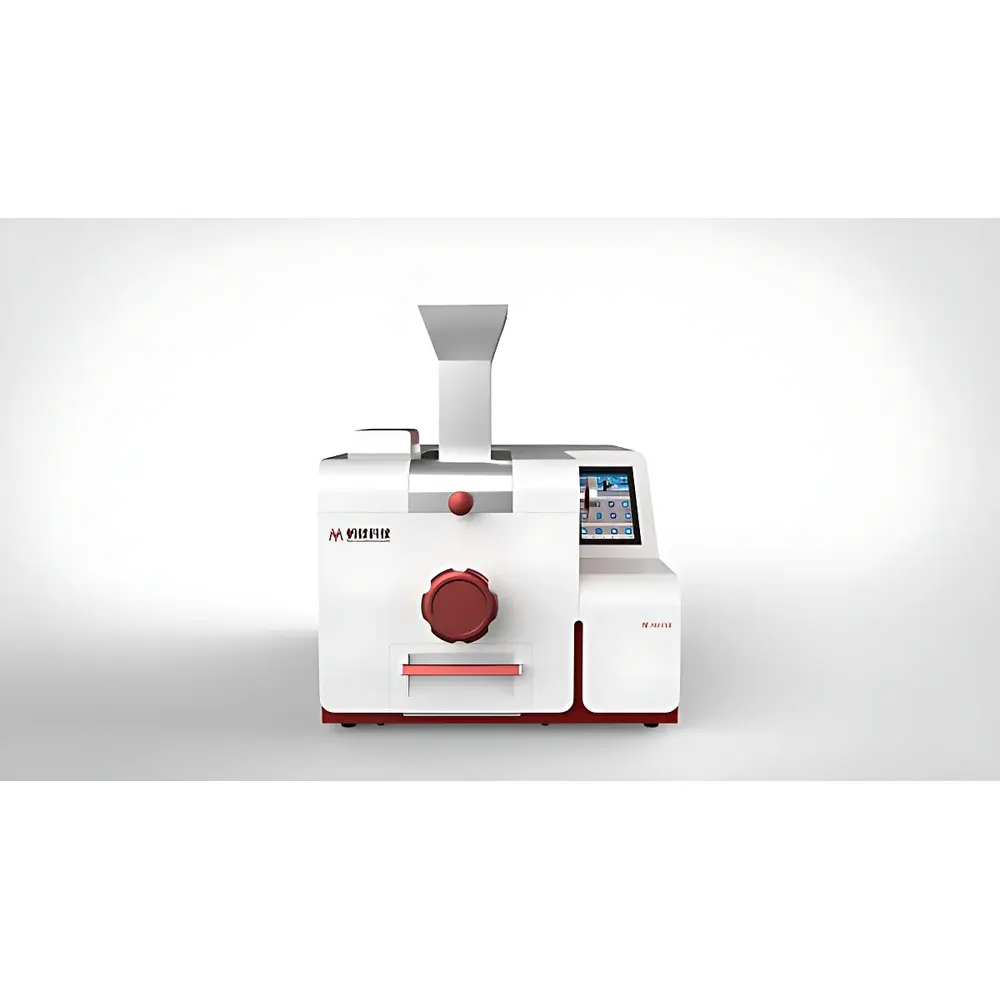
Ants Scientific Instruments AM750 Jaw Crusher
| Brand | Ants Scientific Instruments |
|---|---|
| Origin | Beijing, China |
| Manufacturer Type | Authorized Distributor |
| Country of Origin | China |
| Model | AM750 |
| Instrument Type | Jaw Crusher |
| Sample Applicability | Hard and Brittle Materials |
| Feed Size | ≤ 40 mm |
| Output Particle Size | 0.01–0.5 mm (adjustable) |
| Batch Capacity | 3 L |
| Jaw Gap Adjustment | Continuously Variable with Digital Display |
| Jaw Plate Materials | Six Options Available (e.g., Manganese Steel, Carbide-Tipped, Stainless Steel, Ceramic, Cast Iron, Hardened Alloy) |
| Safety Features | Interlocked Hopper Lid & Removable Collection Tray with Position Sensing |
| Operational Modes | Forward/Reverse Rotation Selection |
Overview
The Ants Scientific Instruments AM750 Jaw Crusher is an engineered laboratory-scale primary crushing device designed for consistent, controlled size reduction of hard, brittle, and moderately abrasive solid samples. Operating on the principle of compressive crushing—where material is fed between two opposing jaw plates, one fixed and the other moving in an elliptical motion driven by an eccentric shaft—the AM750 delivers reproducible particle size distribution through mechanical force and gravitational feed dynamics. Its robust cast-iron frame and precision-machined jaw assembly ensure long-term dimensional stability under repeated loading cycles. The crusher is intended for use in analytical sample preparation workflows prior to downstream analysis—including X-ray fluorescence (XRF), inductively coupled plasma (ICP) spectroscopy, sieve analysis, or geochemical assay—where representative sub-sampling and minimal contamination are critical.
Key Features
- Continuously adjustable jaw gap (0.1–20 mm range) with integrated digital position indicator, enabling precise control over final output particle size (typically 0.01–0.5 mm)
- Zero-point calibration function compensates for jaw plate wear over time, maintaining dimensional accuracy without requiring recalibration against external gauges
- Reversible motor drive allows forward/reverse operation—reducing jamming risk, improving throughput for fibrous or layered materials, and extending jaw plate service life by distributing wear evenly
- Hopper features a hinged, interlocked lid that must be fully closed before motor activation; prevents sample back-splash and ensures operator safety per IEC 61000-6-2 EMC and EN 61000-6-4 emission standards
- Removable collection tray incorporates position-detection switches that halt operation if tray is not properly seated—compliant with ISO 13857 safety distances and EN ISO 14119 guard locking requirements
- Six interchangeable jaw plate material options—including manganese steel (for high-impact toughness), tungsten carbide-tipped (for extreme abrasion resistance), and ceramic (for ultra-low contamination in trace-metal applications)—support method-specific regulatory compliance
Sample Compatibility & Compliance
The AM750 is validated for processing geological specimens (e.g., basalt, quartzite, limestone), ceramics, slag, concrete cores, and sintered metal alloys—materials with Mohs hardness up to 7. It is not recommended for ductile, elastic, or highly moisture-sensitive samples. All wetted components comply with USP Class VI biocompatibility testing when specified with stainless-steel or ceramic jaw sets. The instrument meets CE marking requirements for machinery (2006/42/EC) and electromagnetic compatibility (2014/30/EU). For GLP/GMP environments, optional audit-trail-enabled firmware supports 21 CFR Part 11-compliant electronic records when paired with Ants’ LabControl Suite v3.2+.
Software & Data Management
While the base AM750 operates via front-panel controls, optional integration with Ants LabControl Suite enables remote parameter logging (jaw gap setting, runtime, direction sequence, cycle count), automated calibration timestamping, and export of CSV-formatted operational logs. All settings are stored in non-volatile memory with battery-backed retention (>10 years). Firmware updates are performed via USB-C interface with SHA-256 signature verification to prevent unauthorized modification—supporting data integrity requirements outlined in ISO/IEC 17025:2017 Clause 7.7.
Applications
- Preparation of homogenized rock powders for whole-rock geochemistry (ASTM D5744, ISO 12743)
- Size reduction of construction aggregates prior to Los Angeles abrasion testing (ASTM C131/C535)
- Crushing of catalyst pellets or spent reforming media for elemental leaching studies
- Primary comminution step in certified reference material (CRM) production workflows
- Routine QC sample splitting in cement manufacturing (ISO 679, ASTM C114)
FAQ
What is the maximum allowable feed size?
The AM750 accepts feed particles up to 40 mm in largest dimension. Oversized material must be pre-screened or manually broken prior to feeding.
Can the crusher handle wet or oily samples?
No. The AM750 is designed exclusively for dry, free-flowing solids. Moisture content above 1% may cause clogging and inconsistent crushing due to adhesion between particles and jaw surfaces.
Is routine maintenance required beyond jaw plate replacement?
Yes. Monthly inspection of eccentric shaft bearings, torque verification of jaw mounting bolts (recommended torque: 45 ± 3 N·m), and lubrication of gear train per ISO 6743-9 class L-XCBB 2 specifications are mandatory for rated service life.
How is trace-metal contamination minimized during operation?
By selecting ceramic or electropolished 316L stainless-steel jaw plates and using dedicated, non-recycled collection trays—validated via blank runs followed by ICP-MS analysis per EPA Method 6020B.
Does the unit support integration into automated sample prep lines?
Yes. Optional 0–10 V analog input/output ports and Modbus RTU (RS-485) interface enable synchronization with robotic sample handlers and upstream/downstream conveyors under PLC control.



