
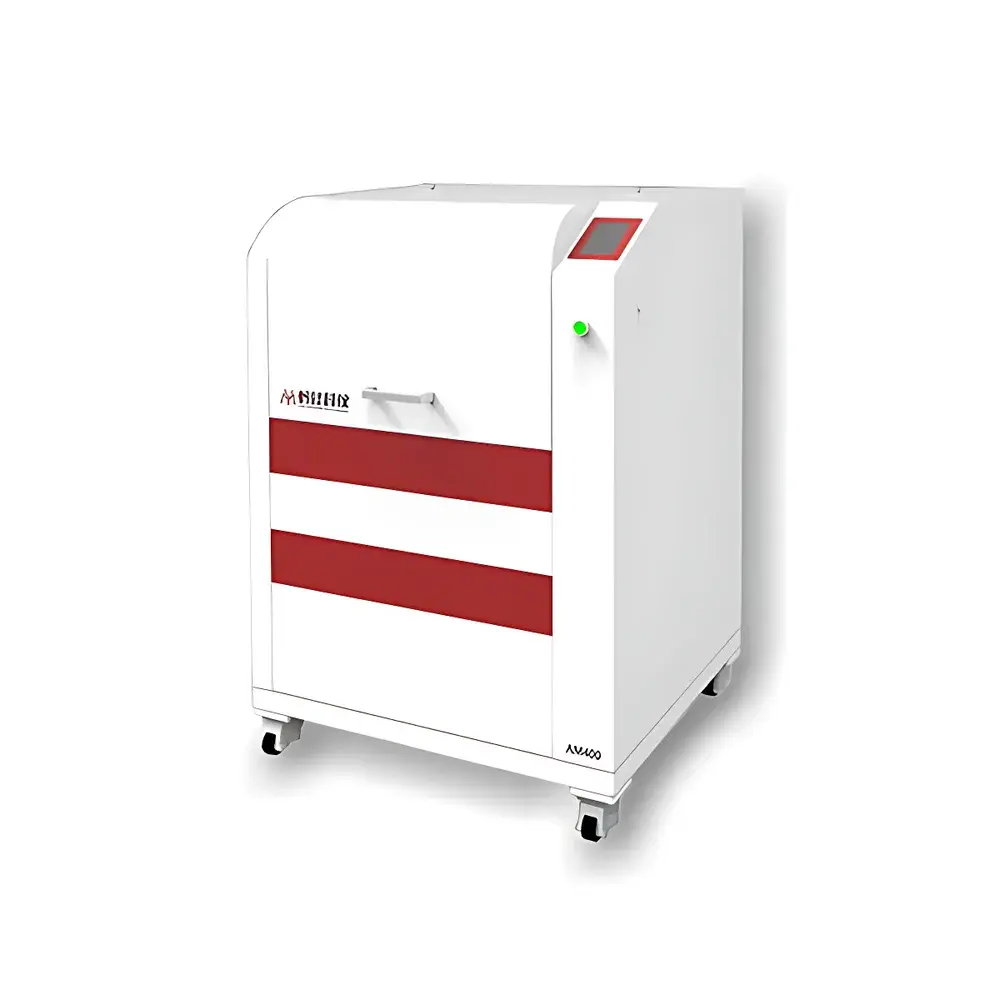
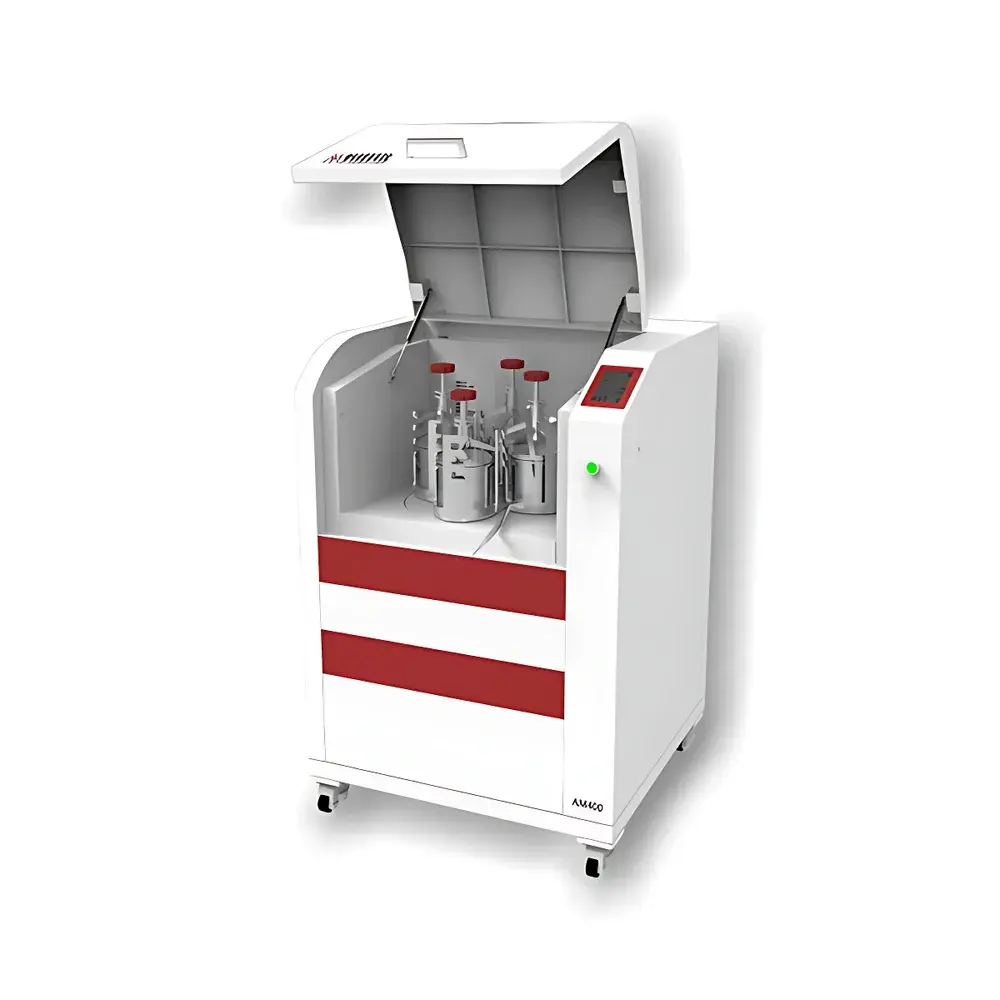
Ants Scientific Instruments AM400 Planetary Ball Mill
| Brand | Ants Scientific Instruments |
|---|---|
| Origin | Beijing, China |
| Manufacturer Type | Authorized Distributor |
| Product Category | Domestic |
| Model | AM400 |
| Instrument Type | Planetary Ball Mill |
| Sample Suitability | Hard, Brittle, Tough, and Intermediate-Hard Materials |
| Final Particle Size | < 1 µm (dry/wet grinding), < 0.1 µm (colloidal grinding) |
| Feed Size | < 15 mm |
| Batch Capacity | ≤ 4 × 220 mL |
| Sun Wheel Speed | 30–450 rpm |
| Speed Ratio | 1:−2.5 |
| Grinding Time Range | 1 s – 99 h 59 min 59 s |
| Programmable Segments | 2 independent stages with adjustable speed/duration |
| Memory Slots | 10 parameter sets |
| Grinding Jar Volume Options | 50–500 mL |
| Jar Materials | Hardened Steel, Stainless Steel, Tungsten Carbide, Agate, Alumina, Zirconia |
| Max Jar Stacking | 8 × 50 mL or 4 × 220 mL |
| Ball Diameters | 0.1–30 mm |
| Ventilation | Automatic chamber ventilation |
| Safety | Interlocked lid with mechanical safety lock |
| Display | Full-color capacitive touchscreen interface |
| Ergonomics | Integrated casters, low-center-of-gravity chassis, angled control panel |
Overview
The Ants Scientific Instruments AM400 Planetary Ball Mill is an engineered high-energy milling system designed for reproducible, scalable comminution of diverse solid materials—from soft organic compounds to ultra-hard ceramics and intermetallic alloys. It operates on the principle of planetary motion: four grinding jars are mounted eccentrically on a rotating sun wheel, each jar simultaneously revolving around its own axis in the opposite direction to the sun wheel’s rotation. This counter-rotational kinematics generates superimposed centrifugal, Coriolis, and impact forces—resulting in energy intensities significantly exceeding those of conventional horizontal or vibratory mills. The AM400 achieves consistent sub-micron particle size distributions (PSD) under dry or wet conditions, with verified output down to <1 µm for general applications and <0.1 µm in optimized colloidal grinding protocols. Its robust architecture supports uninterrupted operation over extended durations, making it suitable for process development, quality control, and nanomaterial synthesis in regulated laboratory environments.
Key Features
- Four independent grinding stations with programmable dual-stage operation—each stage permitting distinct rotational speeds (30–450 rpm), durations, and directional modes (forward/reverse)
- Automated bidirectional rotation with configurable pause intervals and dwell times to mitigate thermal accumulation and prevent sample agglomeration
- Capacitive touchscreen interface with intuitive icon-driven navigation, eliminating mechanical buttons and supporting glove-compatible operation
- Integrated active ventilation system that regulates internal chamber temperature during prolonged runs, enhancing thermal stability and operator safety
- Interlocked safety lid with mechanical locking mechanism compliant with IEC 61000-4-2 ESD and EN 61000-6-2 immunity standards
- Ten user-definable method storage slots, enabling rapid recall of validated SOPs across shifts or operators
- Ergonomic mobile base with industrial-grade casters and low-profile chassis for seamless relocation within shared lab spaces
- Modular jar compatibility: accepts volumes from 50 mL to 500 mL across six chemically inert and wear-resistant materials (zirconia, tungsten carbide, agate, alumina, stainless steel, hardened steel)
Sample Compatibility & Compliance
The AM400 accommodates heterogeneous sample classes including metallic powders (e.g., Fe, Al, Ni-based alloys), ceramic precursors (Al2O3, SiC, TiO2), pharmaceutical actives (APIs), soil matrices, geological specimens, and polymeric composites. Its design adheres to ISO 13320:2020 (laser diffraction particle sizing methodology prerequisites) and supports GLP-compliant workflows through audit-trail-capable parameter logging. While not certified to FDA 21 CFR Part 11 out-of-the-box, the instrument’s deterministic parameter recall, non-volatile memory retention, and timestamped method execution facilitate validation against Part 11 Annex 11 requirements when integrated into validated LIMS or ELN ecosystems. All grinding jars meet ISO 8502-3 for surface cleanliness and are supplied with traceable material certificates.
Software & Data Management
The embedded firmware enables full method definition—including ramp profiles, acceleration/deceleration rates, real-time RPM monitoring, and cycle completion alerts. Parameter sets are stored in non-volatile flash memory with write-protection logic to prevent accidental overwrites. Export functionality supports CSV-formatted logs (time-stamped speed, direction, duration, jar ID) via USB 2.0 port for downstream statistical process control (SPC) analysis. No proprietary cloud service is required; all data remains resident on-device unless explicitly exported. Firmware updates are delivered via signed binary packages validated using SHA-256 checksums, ensuring integrity during field deployment.
Applications
- Nanoparticle synthesis via mechanical alloying (e.g., Mg2Ni–Ni composites for hydrogen storage)
- Homogenization of heterogeneous catalyst formulations prior to BET or XRD characterization
- Preparation of ultrafine reference standards for SEM-EDS calibration and laser diffraction validation
- Cell disruption and nucleic acid extraction support in environmental microbiology (soil/sediment samples)
- Particle size reduction of brittle APIs to improve dissolution kinetics per USP
- Recycling feedstock conditioning for battery cathode material reprocessing (LiCoO2, NMC)
- Production of amorphous phases in oxide glasses and chalcogenide systems for optical property studies
FAQ
What is the maximum continuous runtime supported by the AM400?
The system is rated for unattended operation up to 99 hours 59 minutes 59 seconds per program; thermal management and automatic ventilation ensure stable performance across multi-shift campaigns.
Can the AM400 be validated for GMP manufacturing environments?
Yes—when paired with documented IQ/OQ protocols, electronic log export, and periodic performance verification (e.g., using NIST-traceable glass microspheres), it meets core requirements for equipment qualification in pharmaceutical and advanced materials production.
Is wet grinding compatible with all jar materials?
Wet grinding is fully supported in zirconia, agate, alumina, and stainless steel jars; tungsten carbide and hardened steel jars are recommended only for dry or low-solvent applications due to potential corrosion in acidic/alkaline media.
How does the 1:−2.5 speed ratio affect energy input?
This fixed kinematic ratio maximizes relative velocity between grinding media and jar wall, increasing collision frequency and shear stress—critical for achieving uniform nanostructuring without excessive amorphization.
Does the instrument include calibration documentation?
Each unit ships with factory-verified speed calibration certificate (traceable to NIM Beijing), jar volume tolerance report, and mechanical safety test record.



