
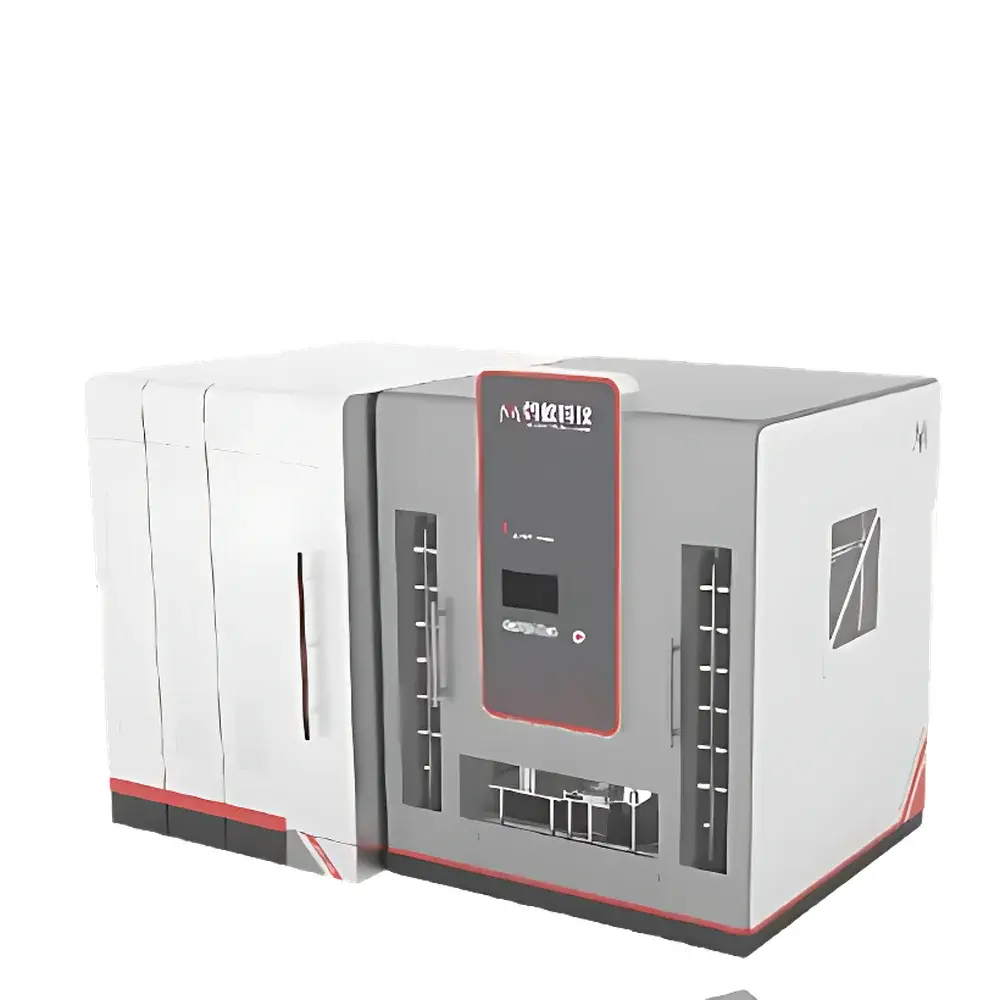
Ants Scientific Instruments AISP1700SC Intelligent Single-Channel Soil Sample Preparation System
| Brand | Ants Scientific Instruments |
|---|---|
| Origin | Beijing, China |
| Manufacturer Type | Authorized Distributor |
| Country of Origin | China |
| Model | AISP1700SC |
| Instrument Type | Automated Soil Sample Processing System |
| Sample Applicability | Rigid soil and sediment samples |
| Maximum Feed Size | ≤100 mm (sample-dependent) |
| Output Particle Size | 0.075–2 mm (standard configuration |
| Sample Capacity | 14 positions (expandable) |
| Feed Mass per Position | 3 kg |
| Sieve Compatibility | 10 × φ200 mm standard nylon sieves (2 mm, 1 mm, 0.25 mm, 0.15 mm, 0.075 mm included |
| Power Supply | 220 V, 50–60 Hz, 7000 W |
Overview
The Ants Scientific Instruments AISP1700SC Intelligent Single-Channel Soil Sample Preparation System is a fully integrated, modular automation platform engineered for standardized, traceable, and operator-independent processing of soil and sediment samples in environmental laboratories. It implements a sequential, closed-loop workflow grounded in ISO/IEC 17025-aligned sample integrity principles — from initial identification and controlled drying to size reduction, sieving, homogenization, subsampling, labeling, and sealed packaging. The system operates on a core architecture of synchronized robotic handling, programmable thermal control, and gravimetric feedback loops, ensuring reproducible compliance with regulatory preparation protocols including GB 17378.5–2007 (Marine Monitoring Specifications), HJ/T 166–2004 (Soil Environmental Monitoring Technical Guidelines), and the China National Environmental Monitoring Centre’s Document No. [2018] 407. Unlike conventional grinders or manual workflows, the AISP1700SC does not function as a standalone comminution device; rather, it is a process-integrated system where grinding is one controlled step within a validated chain that preserves geochemical fidelity, minimizes cross-contamination risk, and enables full digital traceability.
Key Features
- Modular, decoupled architecture: Independent operation of drying, coarse crushing, fine grinding, sieving, weighing, mixing, splitting, labeling, capping, and cleaning modules — enabling flexible configuration based on lab throughput, regulatory scope, and matrix-specific requirements.
- Robotic sample handling: Motorized drawer-style sample rack (14-position capacity, expandable) with integrated RFID or 2D barcode recognition; automatic sample retrieval, transport, and positioning across modules.
- Controlled thermal drying: Optional vacuum microwave or freeze-drying integration; precise temperature regulation (35 ± 5 °C) with real-time logging of initial mass, final mass, duration, and ambient conditions — automatically calculating moisture content and generating audit-ready reports.
- Contaminant-aware size reduction: Coarse crusher equipped with mechanical separation for removal of gravel, stones, and root fragments; segregated waste collection into dedicated discard bins with optional return-to-rack functionality.
- Gravimetric precision: High-resolution load cells (±0.1 g typical) integrated into weighing and splitting modules; programmable subsampling ratios (1–5 fractions) with maximum fraction mass up to 500 g per vial.
- Traceable packaging: 48-position preloaded 500 mL HDPE vial carousel; automated laser marking (alphanumeric + QR code), bottle dispensing, screw-cap sealing, and stack-based orientation for downstream LIMS integration.
- Heavy-metal-safe construction: All wetted and contact surfaces fabricated from non-reactive, low-leaching materials (e.g., 316L stainless steel, food-grade PTFE, and electrostatic-dissipative polymers); validated for trace metal analysis (e.g., EPA Method 6020B).
- Dust-controlled cleaning: Integrated negative-pressure dust extraction system with HEPA filtration; module-specific auto-cleaning cycles using compressed air or ultrasonic agitation.
Sample Compatibility & Compliance
The AISP1700SC is validated for use with heterogeneous, high-moisture, clay-rich, organic-laden, and gravel-containing soils and sediments — including dredged materials, agricultural topsoil, industrial site matrices, and marine sediment cores. Its design conforms to national and international standards governing sample representativeness and procedural fidelity: GB 17378.5–2007 mandates “no loss of volatile organics, no preferential segregation of particle fractions, and documented mass balance at each stage” — all enforced through the system’s embedded weight verification, sieve calibration logs, and timestamped event tracking. For GLP/GMP environments, the system supports 21 CFR Part 11-compliant electronic signatures, audit trails, and user-access-level permissions when paired with compatible laboratory information management systems (LIMS). All modules undergo factory calibration against NIST-traceable reference standards, with certificates provided per unit.
Software & Data Management
The system runs on a Linux-based embedded control platform with a 10.1″ capacitive touchscreen interface. Software includes built-in SOP enforcement (with configurable step-by-step workflows), real-time status dashboards, alarm escalation (email/SMS via optional gateway), and local data storage (≥1 year of raw event logs, mass records, temperature profiles, and image captures from optional onboard cameras). Export formats include CSV, PDF (for QC reports), and XML (for LIMS ingestion). Audit trail functionality records user ID, action timestamp, parameter values changed, and reason-for-change fields — satisfying ISO/IEC 17025 clause 7.10.2 and CNAS-CL01:2018 requirements. Firmware updates are delivered via secure HTTPS and require dual-authentication approval.
Applications
- Regulatory soil monitoring programs (national soil surveys, contaminated site assessments, agricultural land quality evaluation)
- Third-party environmental testing laboratories performing accredited analyses per GB, HJ, or ISO standards
- Research institutions conducting long-term soil biogeochemistry, microplastic quantification, or speciation studies requiring strict particle-size fractionation
- Reference material producers requiring certified homogeneity and inter-laboratory comparability
- Environmental forensics labs needing chain-of-custody documentation and unambiguous sample lineage reconstruction
FAQ
Does the AISP1700SC support multi-channel parallel processing?
No — it is a single-channel system optimized for sequential high-fidelity preparation. However, two samples may be processed concurrently in staggered phases (e.g., drying one while grinding another), improving effective throughput without compromising traceability.
Can the system integrate with existing LIMS or ELN platforms?
Yes — via standardized RESTful API or HL7-compatible data export; custom middleware development support is available upon request.
Is method validation documentation provided?
Yes — including Installation Qualification (IQ), Operational Qualification (OQ), and Performance Qualification (PQ) templates aligned with ISO/IEC 17025 Annex A.2, plus sieve calibration certificates and gravimetric accuracy test reports.
What maintenance intervals are recommended?
Daily visual inspection and dust filter cleaning; quarterly verification of sieve mesh integrity and load cell linearity; annual full calibration by certified field service engineers.
Are spare parts and consumables (e.g., sieves, vials, grinding media) available globally?
Yes — Ants Scientific Instruments maintains regional distribution hubs in Asia, Europe, and North America; standard φ200 mm nylon sieves and 500 mL HDPE vials are stocked with 48-hour dispatch.



