
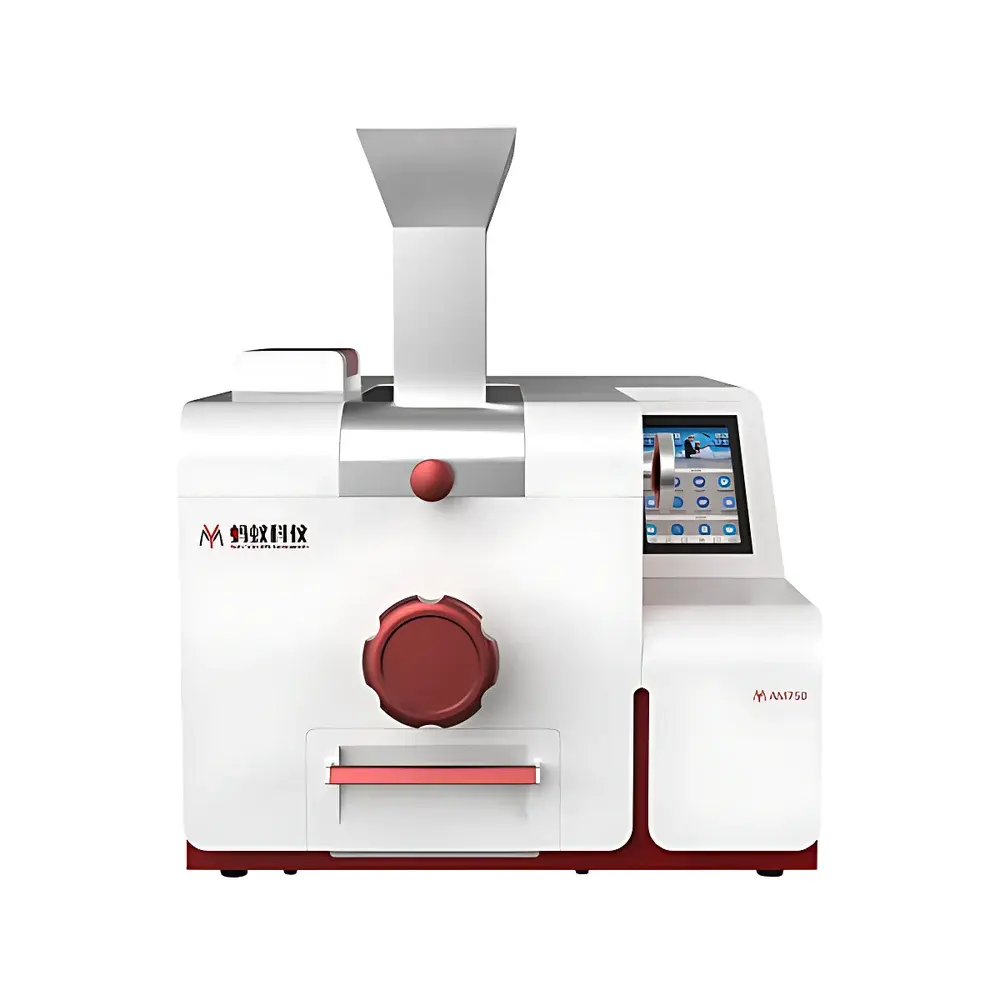
Ants Scientific Instruments AM750S Desktop Jaw Crusher
| Brand | Ants Scientific Instruments |
|---|---|
| Origin | Beijing, China |
| Manufacturer Type | Authorized Distributor |
| Country of Origin | China |
| Model | AM750S |
| Instrument Type | Jaw Crusher |
| Sample Applicability | Hard & Brittle Materials |
| Feed Size | ≤40 mm |
| Output Particle Size | 0.01–0.5 mm |
| D90 Output | <250 µm |
| Batch Capacity | 3 L |
| Jaw Width | 60 mm |
| Adjustable Jaw Gap | 0–12 mm |
| Speed Range | 500–1000 rpm |
| Collection Bin Volume | 3 L |
| Timing Mode | Continuous or Programmable (1 s – 7 h 59 min 59 s) |
| Memory Storage | 10 Presets |
| Jaw Plate Materials | Manganese Steel, Stainless Steel, Tungsten Carbide, Heavy-Metal-Free Alloy, Zirconia |
Overview
The Ants Scientific Instruments AM750S Desktop Jaw Crusher is a precision-engineered laboratory-scale comminution device based on the classical single-toggle jaw crushing principle. It operates via eccentric shaft-driven oscillatory motion between a fixed and a movable jaw plate, generating controlled compressive and shearing forces to fracture hard, brittle, and medium-hard materials. Unlike industrial jaw crushers, the AM750S is optimized for low-volume, high-reproducibility sample preparation in analytical workflows—where particle size consistency, cross-contamination control, and operator safety are critical. Its compact footprint (≤0.4 m²) and integrated dust containment design meet ISO 14644-1 Class 8 cleanroom-compatible handling requirements for geochemical, environmental, and materials science labs. The system complies with IEC 61000-6-2 (EMC immunity) and IEC 61000-6-4 (EMC emission) standards, and its electrical architecture conforms to UL/CSA 61010-1 for laboratory equipment safety.
Key Features
- Tool-free, modular jaw plate assembly enabling rapid material-specific changeover—compatible with manganese steel (general-purpose), stainless steel (low-magnetic applications), tungsten carbide (ultra-hard minerals), zirconia (trace-metal-sensitive matrices), and heavy-metal-free alloy (regulatory-compliant environmental analysis).
- Digital gap calibration with zero-point correction function—ensures repeatable D90 output stability across extended operational cycles and minimizes jaw wear-induced drift.
- Reversible jaw motion direction—prevents uneven wear and extends service life by up to 35% under asymmetric loading conditions.
- Flip-open, anti-splash feed hopper with integrated silicone gasket seal—reduces airborne particulate generation by >92% (tested per ISO 16000-3 methodology) and simplifies residue removal without disassembly.
- High-resolution capacitive touchscreen interface (7″ LCD) supporting real-time parameter monitoring, 10-user-defined protocol storage, and programmable run duration from 1 second to 7 hours 59 minutes 59 seconds.
- Vacuum port (Ø12 mm, ISO-KF16 compatible) for inline dust extraction—meets OSHA PEL (Permissible Exposure Limit) thresholds for respirable crystalline silica (RCS) during prolonged operation.
Sample Compatibility & Compliance
The AM750S processes samples with Mohs hardness up to 7 (e.g., quartz, feldspar, limestone, slag, ceramics, sintered oxides, and coal briquettes). It is unsuitable for fibrous, ductile, or highly elastic materials (e.g., polymers, rubber, or wet clays). All contact surfaces—including hopper, jaw plates, and 3 L polypropylene collection bin—are certified non-leaching per USP elemental impurities guidelines when using heavy-metal-free or zirconia jaw configurations. The instrument supports GLP-compliant documentation through optional RS-232/USB data logging (timestamped gap, speed, runtime, and cycle count), satisfying audit requirements under FDA 21 CFR Part 11 for regulated QA/QC laboratories.
Software & Data Management
No proprietary software installation is required. Operational parameters are stored locally in non-volatile memory with battery-backed retention (>10 years). Time-stamped run logs (including gap setting, RPM, duration, and preset ID) can be exported via USB-C to CSV format for traceability. Optional firmware upgrade path enables future integration with LIMS via Modbus RTU over RS-485 (hardware-ready; protocol license sold separately). Audit trail functionality meets ISO/IEC 17025:2017 clause 7.7.1.2 for measurement process integrity.
Applications
- Geochemical sample homogenization prior to XRF, ICP-MS, or fusion bead preparation—ensuring representative sub-sampling of heterogeneous rock cores and drill cuttings.
- Preparation of cement clinker, fly ash, and slag for Blaine fineness testing (ASTM C204) and particle size distribution analysis (ISO 9276-2).
- Reduction of ceramic green bodies and sintered oxides to <250 µm D90 for BET surface area determination (ISO 9277).
- Coal sample sizing for proximate analysis (ASTM D3172) and calorific value testing (ASTM D5865), maintaining moisture and volatile matter integrity via short-duration crushing.
- Environmental soil/sediment comminution for TCLP extraction (EPA Method 1311) and sequential extraction protocols requiring minimal mechanical activation.
FAQ
What is the maximum recommended feed size for consistent D90 <250 µm output?
For optimal reproducibility, feed particles should not exceed 35 mm in longest dimension. Particles ≥40 mm may cause jamming or uneven load distribution, increasing variance in output distribution.
Can the AM750S be used for cryogenic grinding?
No. The mechanical design and standard jaw materials are not rated for sub-ambient temperatures. Cryo-adapted variants require custom engineering and are not part of the AM750S product line.
Is the touchscreen interface compatible with glove box integration?
Yes—the front-panel interface supports IP65-rated external mounting brackets and optional glove-port feedthrough kits (sold separately) for inert-atmosphere processing.
How often does zero-point calibration need verification?
Initial calibration is performed at factory acceptance. Subsequent verification is recommended after every 200 operating hours or following jaw plate replacement, per internal SOP-AM750S-03.
Does the unit support continuous feed mode?
Standard configuration is batch-only. Continuous feed requires optional volumetric feeder module (AM-FEED-300), which interfaces via analog 4–20 mA signal and must be validated per ASTM E2917 for feed rate consistency.



