
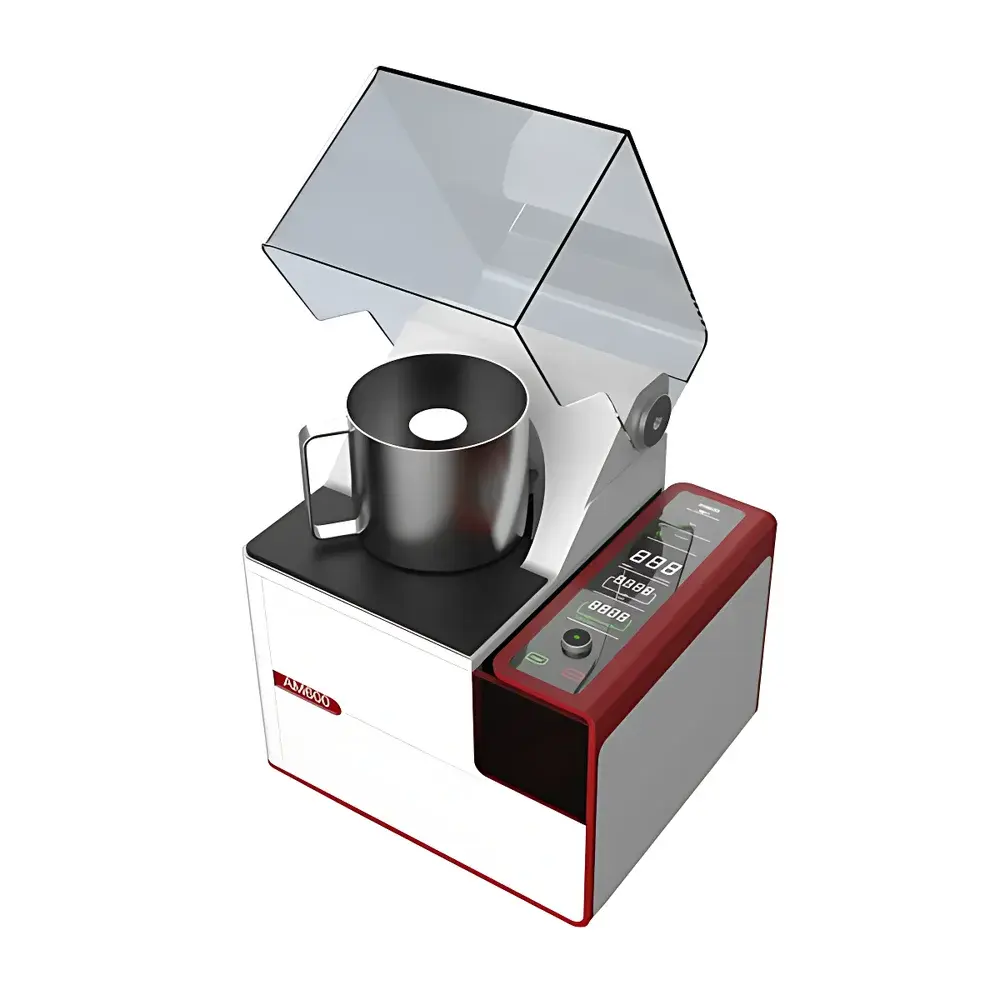
Ants Scientific Instruments AM600 Blade Grinder
| Brand | Ants Scientific Instruments |
|---|---|
| Origin | Beijing, China |
| Manufacturer Type | Authorized Distributor |
| Product Category | Domestic |
| Model | AM600 |
| Instrument Type | Blade Grinder |
| Sample Suitability | Soft, Elastic, Fibrous, Medium-Hard, High-Moisture, High-Oil, High-Fat Samples |
| Output Particle Size | 0.01–0.5 mm |
| Feed Particle Size | < 50 mm |
| Final Output Particle Size | < 300 µm |
| Batch Processing Volume | 700 mL |
| Rotational Speed Range | 2,000–16,000 rpm (customizable) |
| Blade Diameter | 118 mm |
| Peripheral Blade Speed | ~12.4–62 m/s |
| Grinding Cup Capacity | 1 L |
| Cup Materials | Stainless Steel, Polypropylene (PP), Polycarbonate (PC) |
| Grinding Time Setting | 1 s–99 min (digital display) |
| Operating Modes | Forward Rotation, Reverse Rotation, Intermittent, Momentary, Linked Mode |
| Pre-stored Parameter Sets | 4 or 9 user-defined protocols |
| Blade Types | Dual-surface stainless steel (sharp edge + blunt edge), serrated stainless steel, titanium alloy |
| Sterilization Compatibility | Autoclavable (121 °C, 2 bar, 20 min) |
| Safety Features | Electromagnetic lid lock, interlocked start/stop, overheat protection, torque monitoring |
| Display | High-resolution LCD with real-time parameter feedback |
| Base Design | IPX4-rated splash-resistant housing with integrated liquid drainage channel |
| Power Supply | 220 V AC, 50 Hz |
| Ambient Operating Conditions | 0–40 °C, 20–70% RH (non-condensing) |
Overview
The Ants Scientific Instruments AM600 Blade Grinder is an engineered laboratory grinding system designed for high-efficiency mechanical size reduction and homogenization of diverse biological and food-grade materials. It operates on the principle of high-shear impact and cutting action generated by a dynamically balanced rotating blade assembly mounted coaxially at the base of a sealed grinding cup. Unlike planetary or ball-mill systems, the AM600 employs a fixed-axis rotational architecture optimized for rapid throughput and minimal thermal accumulation—critical when processing heat-sensitive, lipid-rich, or hydrated samples such as fresh fruits, meat tissues, seafood, nuts, and dairy-derived matrices. Its core mechanism leverages controlled angular velocity (2,000–16,000 rpm), variable blade geometry (dual-surface and serrated configurations), and precise cup-to-blade clearance to deliver reproducible particle size distributions in the 10–500 µm range. The instrument is purpose-built for routine QC/QA workflows in food safety labs, agricultural research centers, and R&D departments requiring GMP-aligned sample preparation prior to downstream analysis (e.g., HPLC, GC-MS, DNA extraction, or proximate composition testing).
Key Features
- High-torque industrial motor enabling sustained operation across full speed range without thermal derating
- Dual-surface rotor blades featuring both sharp cutting edges and blunt shearing surfaces—enabling selection between coarse fragmentation and fine homogenization within a single platform
- Serrated stainless-steel blades specifically engineered to prevent slippage and improve dispersion efficiency in high-fat, high-viscosity matrices (e.g., avocado pulp, oily seeds, rendered animal fat)
- Quick-release, plug-and-play grinding cup assembly compatible with autoclaving (121 °C, 20 min, 2 bar steam sterilization)—ensuring compliance with GLP/GMP sample traceability requirements
- Electromagnetically interlocked lid system: physical engagement verified prior to rotation; automatic shutdown upon lid displacement during operation
- IPX4-rated base housing with integrated sloped drainage channels—mitigating risk of liquid ingress during wet-grinding protocols
- Programmable operation with up to nine user-defined method presets—including linked forward/reverse/intermittent sequences for optimized cell lysis or fibrous tissue disruption
- Real-time digital LCD interface displaying RPM, elapsed time, remaining cycle duration, and active safety status indicators
Sample Compatibility & Compliance
The AM600 accommodates a broad spectrum of organic and semi-solid specimens without pre-drying or cryogenic conditioning. Validated use cases include raw and cooked muscle tissue, whole grains, soft cheeses, leafy vegetables, frozen berries, fish fillets, roasted nuts, candied fruits, and emulsified spreads. Its ability to process feedstock ≤50 mm in maximum dimension—while delivering final particles <300 µm—supports direct integration into ISO 5725-2 validated analytical workflows. All contact surfaces comply with FDA 21 CFR §177.1520 (food-contact plastics) and EU Regulation (EC) No. 1935/2004. Grinding cups made from medical-grade polycarbonate meet USP Class VI biocompatibility standards. The system supports audit-ready documentation via timestamped parameter logs—facilitating adherence to ISO/IEC 17025 accreditation requirements for testing laboratories.
Software & Data Management
While the AM600 operates via embedded firmware without external PC dependency, its control module maintains non-volatile memory for method recall, operational history, and error event logging. Each protocol stores RPM setpoint, total runtime, pause intervals, direction sequence, and activation timestamp. Data export is achievable via optional RS-232 or USB-C interface (firmware upgrade required), enabling synchronization with LIMS platforms compliant with 21 CFR Part 11 through third-party middleware. Audit trails record operator ID (via optional RFID badge reader), method version, and deviation flags (e.g., lid open event, overtemperature alert). All stored parameters are checksum-verified to prevent unauthorized modification.
Applications
- Routine homogenization of food samples prior to pesticide residue analysis (AOAC 2007.01, EN 15662)
- Preparation of uniform test portions for nutritional labeling compliance (FDA 21 CFR §101.9)
- Cell disruption and organelle isolation from plant and animal tissues under non-denaturing conditions
- Particle size standardization for rheological characterization of starch gels or protein suspensions
- Feedstock conditioning for near-infrared (NIR) calibration model development
- QC sampling in meat processing plants—enabling rapid detection of adulterants or species substitution via PCR
FAQ
Is the AM600 suitable for cryogenic grinding?
Yes—when paired with optional liquid nitrogen-cooled grinding cups (stainless steel variant only) and modified blade retention hardware, the AM600 supports sub-zero operation down to –80 °C for brittle fracture of thermolabile polymers and elastomeric biomaterials.
Can grinding parameters be exported for regulatory submission?
Method definitions and execution logs can be retrieved via serial interface and formatted into CSV or XML for inclusion in FDA eCTD modules or ISO 17025 technical records.
What maintenance intervals are recommended for the drive shaft and bearing assembly?
Under continuous daily use, lubrication-free ceramic bearings require inspection every 12 months; blade wear assessment is advised after 500 operational hours or 2,000 cycles—whichever occurs first.
Does the system support multi-language UI firmware?
Standard firmware includes English and Simplified Chinese interfaces; custom localization (e.g., Spanish, German, French) is available under OEM agreement with minimum order quantity.
How is cross-contamination prevented between sequential runs?
Autoclavable cup assemblies, combined with programmable “cleaning cycles” (high-RPM air purge + ethanol rinse mode), reduce carryover to <0.001% per ASTM D7213-18 validation protocols.



