
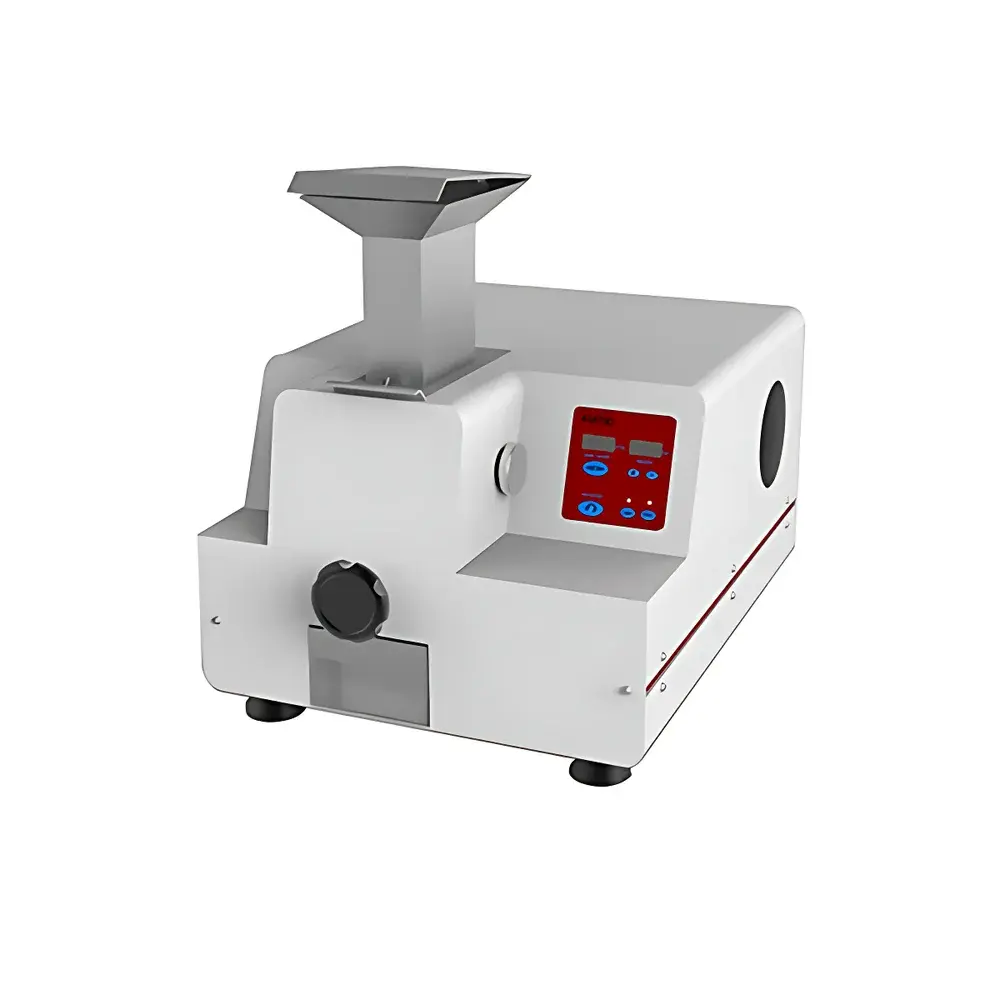
Ants Scientific Instruments AM750 Desktop Jaw Crusher
| Brand | Ants Scientific Instruments |
|---|---|
| Origin | Beijing, China |
| Manufacturer Type | Authorized Distributor |
| Country of Origin | China |
| Model | AM750 |
| Instrument Type | Jaw Crusher |
| Sample Suitability | Medium-hard to hard, brittle materials |
| Feed Size | ≤40 mm |
| Output Particle Size | D90 < 250 µm |
| Batch Capacity | 3 L |
| Jaw Gap Adjustment Range | 0–12 mm |
| Jaw Speed | 500–1000 rpm (adjustable) |
| Jaw Width | 60 mm |
| Display | Digital gap and speed readout with zero-point calibration |
| Dust Control | Integrated dust shield and optional vacuum port |
| Jaw Materials | Manganese steel, stainless steel, tungsten carbide, heavy-metal-free alloy, zirconia |
| Hopper & Collection Vessel | Heavy-metal-free construction |
| Operating Modes | Continuous or timed (1 s – 7 h 59 min 59 s) |
| Jaw Removability | Tool-free |
| Jaw Reversibility | Yes |
Overview
The Ants Scientific Instruments AM750 Desktop Jaw Crusher is a precision-engineered laboratory-scale comminution device based on the classical jaw crushing principle—utilizing reciprocating elliptical motion between a fixed and a moving jaw plate driven by an eccentric shaft. This mechanical configuration subjects feed material to controlled compressive and shearing forces, enabling reproducible size reduction of medium-hard to hard, brittle samples without thermal degradation or contamination. Designed explicitly for low-to-medium throughput applications (up to 3 L per batch), the AM750 occupies minimal bench space while delivering consistent particle size distribution with D90 < 250 µm under optimized operating conditions. Its compact architecture integrates ergonomic handling, operator safety, and regulatory-compliant sample integrity—making it suitable for routine sample preparation in environmental testing labs, geological survey units, building materials R&D centers, and academic research facilities requiring trace-metal-clean workflows.
Key Features
- Tool-free, rapid jaw plate replacement system enables swift material-specific changeover and thorough cleaning between batches.
- Digital real-time display of jaw gap (0–12 mm range) and rotational speed (500–1000 rpm), both independently adjustable via front-panel controls.
- Zero-point calibration function compensates for jaw wear over time, maintaining dimensional accuracy and extending service life of critical wear components.
- Reversible jaw motion prevents unilateral abrasion and supports uniform wear distribution across the crushing surface.
- Anti-splash, flip-up feed hopper with integrated dust shield minimizes airborne particulate release; compatible with standard lab vacuum systems via dedicated port.
- Heavy-metal-free construction options for hopper, collection vessel, and select jaw plates (e.g., zirconia, specialized stainless alloys) ensure compliance with ISO 17025 traceability requirements and USP / elemental impurity testing protocols.
- Two operational modes: continuous run or programmable timing (1 second to 7 hours, 59 minutes, 59 seconds) for repeatable process validation.
Sample Compatibility & Compliance
The AM750 accepts feed particles up to 40 mm in maximum dimension and is validated for use with medium-hard to hard, brittle matrices—including silicates, feldspars, limestone, coal, ceramics, glass, cement clinker, and metallurgical slags. Jaw plate material selection (manganese steel, stainless steel, tungsten carbide, zirconia, or heavy-metal-free alloys) allows tailoring to sample chemistry and downstream analytical requirements (e.g., ICP-MS, XRF, leaching studies). All wetted and contact surfaces comply with ISO 8502-3 for soluble salt residue control and are compatible with GLP-aligned cleaning verification procedures. The unit meets CE machinery directive 2006/42/EC and carries RoHS 2011/65/EU conformity documentation.
Software & Data Management
While the AM750 operates as a stand-alone instrument, its digital interface supports manual logging of key parameters—including jaw gap, speed, runtime, and batch ID—for inclusion in laboratory notebooks or LIMS-integrated electronic records. Optional RS-232 or USB-to-serial adapters enable automated data capture into custom scripts or validated software platforms compliant with FDA 21 CFR Part 11 (audit trail, electronic signature, and data integrity controls). Calibration logs, maintenance history, and jaw usage metrics can be archived to satisfy internal QA/QC review cycles and external accreditation audits (e.g., ISO/IEC 17025:2017 Clause 7.7).
Applications
- Preparation of homogenized sub-samples for geochemical analysis (XRF, ICP-OES, ICP-MS) in geological survey and mining laboratories.
- Size reduction of construction aggregates prior to sieve analysis, Los Angeles abrasion testing, or petrographic examination per ASTM C136/C702.
- Crushing of ceramic and refractory raw materials to achieve defined particle size distributions for sintering trials.
- Processing of coal and coke samples for proximate and ultimate analysis per ASTM D3172–D3176.
- Routine sample conditioning in environmental labs handling soil, sediment, and waste matrices prior to TCLP or SPLP extraction (EPA Method 1311/1312).
- Feedstock preparation for subsequent milling or fusion bead synthesis in analytical chemistry workflows.
FAQ
What is the maximum feed size the AM750 can accept?
The AM750 accepts feed particles with a maximum dimension of ≤40 mm.
Can the jaw gap be calibrated in situ?
Yes—the instrument includes a zero-point calibration function accessible via the front panel to compensate for mechanical drift or jaw wear.
Is the AM750 suitable for trace-metal analysis sample prep?
When equipped with zirconia or certified heavy-metal-free alloy jaw plates and collection vessels, the AM750 supports trace-level elemental analysis workflows compliant with USP / and ISO 17025 requirements.
Does the unit support GMP/GLP documentation requirements?
Yes—its programmable timer, digital parameter logging, and compatibility with Part 11–compliant data acquisition systems enable full audit-trail capability for regulated environments.
How is dust controlled during operation?
The integrated anti-splash hopper, sealed dust shield, and optional vacuum port collectively suppress airborne particulate generation and meet OSHA PEL and ACGIH TLV exposure guidelines for respirable dust.



