
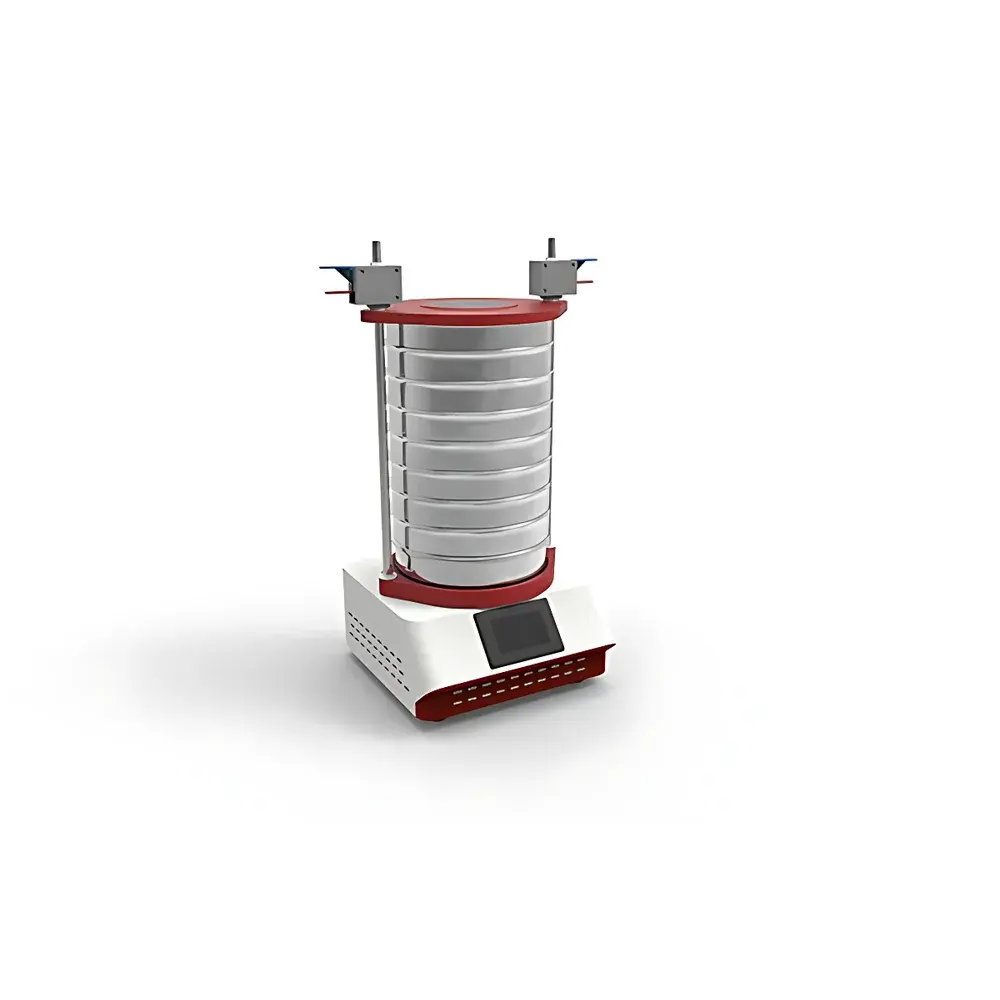
Ants Scientific Instruments AF100S 3D Vibratory Sieve Analyzer
| Brand | Ants Scientific Instruments |
|---|---|
| Origin | Beijing, China |
| Manufacturer Type | Authorized Distributor |
| Product Category | Domestic |
| Model | AF100S |
| Price Range | USD 2,800 – 7,000 |
| Sample Types | Powders, Granular Materials, Suspensions |
| Measurement Range | 20 µm – 25 mm |
| Max. Sample Load | 6 kg |
| Max. Sieving Stages | 9 |
| Max. Sieve Stack Mass | 10 kg |
| Amplitude Adjustment | 0.2 – 3 mm |
| Timer Display | Digital, 1–99 min |
| Intermittent Pause | 5 s – 99 s |
| Programmable Methods | 9 stored protocols |
| Sieve Diameters | 200 mm and 300 mm |
| Sieve Mesh Range | 20 µm – 25 mm |
| Sieve Materials | Stainless Steel, Nylon |
| Sieving Modes | Dry Sieving, Wet Sieving |
Overview
The Ants Scientific Instruments AF100S 3D Vibratory Sieve Analyzer is an engineered solution for precise, reproducible particle size distribution (PSD) analysis of dry and wet particulate systems. Unlike conventional linear or circular vibratory sievers, the AF100S employs a true three-dimensional motion profile—combining horizontal oscillation with vertical acceleration—to generate controlled抛掷 (toss-and-drop) dynamics across the sieve surface. This motion ensures uniform sample dispersion, minimizes particle agglomeration and blinding, and significantly improves separation efficiency—particularly for cohesive, irregular, or near-size particles. The instrument operates on electromagnetic drive technology, delivering consistent, low-maintenance excitation without mechanical wear associated with eccentric motor systems. Designed for compliance with ISO 2591-1, ASTM E11, and ISO 3310-1 standards for test sieves and sieving methods, the AF100S supports both routine QC testing and method development in regulated environments.
Key Features
- True 3D vibratory motion—simultaneous horizontal and vertical displacement—for enhanced particle stratification and reduced sieve clogging.
- Dual-diameter sieve compatibility: Accepts standard 200 mm and 300 mm diameter test sieves, enabling flexible throughput scaling—from R&D-scale samples to production batch verification.
- Programmable operation: Stores up to nine independent sieving protocols—including amplitude (0.2–3 mm), duration (1–99 min), and intermittent pause settings (5 s–99 s)—supporting GLP-compliant method traceability.
- Tool-free quick-lock sieve clamping system: Ergonomic lever mechanism secures multi-tier sieve stacks in seconds, minimizing operator fatigue and ensuring repeatable compression force across runs.
- Dry/wet sieving capability: Integrated splash guard and optional liquid collection tray enable compliant wet sieving per ISO 565 and ASTM C136 procedures—critical for fine mineral, pharmaceutical, or ceramic slurries.
- Robust mechanical architecture: Aluminum alloy frame with reinforced base and vibration-damping feet ensures stable operation at full load (up to 10 kg sieve stack + 6 kg sample).
Sample Compatibility & Compliance
The AF100S accommodates a broad spectrum of industrially relevant materials—including metal powders (e.g., Ti-6Al-4V, Inconel), agrochemical granules, polymer flakes, soil aggregates, catalyst supports, and pharmaceutical excipients. Its 20 µm–25 mm dynamic range covers USP , ISO 13320 laser diffraction correlation ranges, and serves as a primary reference method for validating automated image analysis or dynamic light scattering results. All stainless steel and nylon sieves comply with ISO 3310-1 tolerances for aperture accuracy and wire diameter. When operated with calibrated, certified test sieves (e.g., ISO/IEC 17025-accredited), data generated meets audit requirements under FDA 21 CFR Part 11 (with optional electronic log integration) and GMP Annex 19 documentation practices.
Software & Data Management
While the AF100S operates via intuitive front-panel controls, its parameter memory function enables standardized method execution without external software dependency—a key advantage in cleanroom or explosion-proof zones where PC-based interfaces are restricted. Each stored protocol retains timestamped amplitude, time, and pause values, allowing direct correlation with laboratory notebooks or LIMS entries. For facilities requiring digital audit trails, optional RS-232 or USB-to-serial output supports connection to validated data acquisition systems. All operational logs—including total run count, cumulative runtime, and last-used method ID—can be exported for preventive maintenance scheduling and ISO 9001 internal audits.
Applications
- Quality control of additive manufacturing feedstocks: Verifying D10/D50/D90 distributions prior to powder bed fusion processing.
- Soil texture classification per USDA and ASTM D422 protocols for geotechnical and environmental remediation labs.
- Fertilizer granule uniformity assessment to ensure consistent nutrient release kinetics and spreader calibration.
- Pharmaceutical blend homogeneity screening via endpoint sieving of API-excipient mixtures (dry) or suspension stability evaluation (wet).
- Recycled construction aggregate grading in accordance with EN 12620 and ASTM C33 specifications.
- Seed viability and purity testing in agricultural seed certification laboratories.
FAQ
Can the AF100S be used for regulatory submissions under ICH Q5a or USP <786>?
Yes—when paired with certified ISO 3310-1 sieves and documented SOPs covering calibration, maintenance, and operator training, the AF100S satisfies method suitability requirements for particle size reporting in biopharmaceutical raw material qualification.
Is wet sieving compatible with corrosive solvents such as acetone or THF?
Wet sieving is supported only with chemically resistant nylon sieves and PTFE-coated collection trays; stainless steel components are not recommended for prolonged exposure to halogenated or strong organic solvents.
How does the 3D motion improve recovery for fine, electrostatically charged powders?
The vertical component disrupts interparticle adhesion forces, while horizontal shear prevents localized compaction—resulting in >95% mass recovery for materials like fumed silica or micronized lactose, as verified per ISO 9276-2 repeatability guidelines.
Does the instrument support cascade sieving with more than nine fractions?
The hardware supports up to nine physical sieve layers; additional fractionation requires sequential runs with reconfigured stacks or offline splitting of intermediate fractions.
What maintenance intervals are recommended for electromagnetic drive longevity?
No scheduled lubrication or bearing replacement is required; annual verification of coil impedance and amplitude linearity using certified shaker calibrators is advised per ISO 16276-2.



