
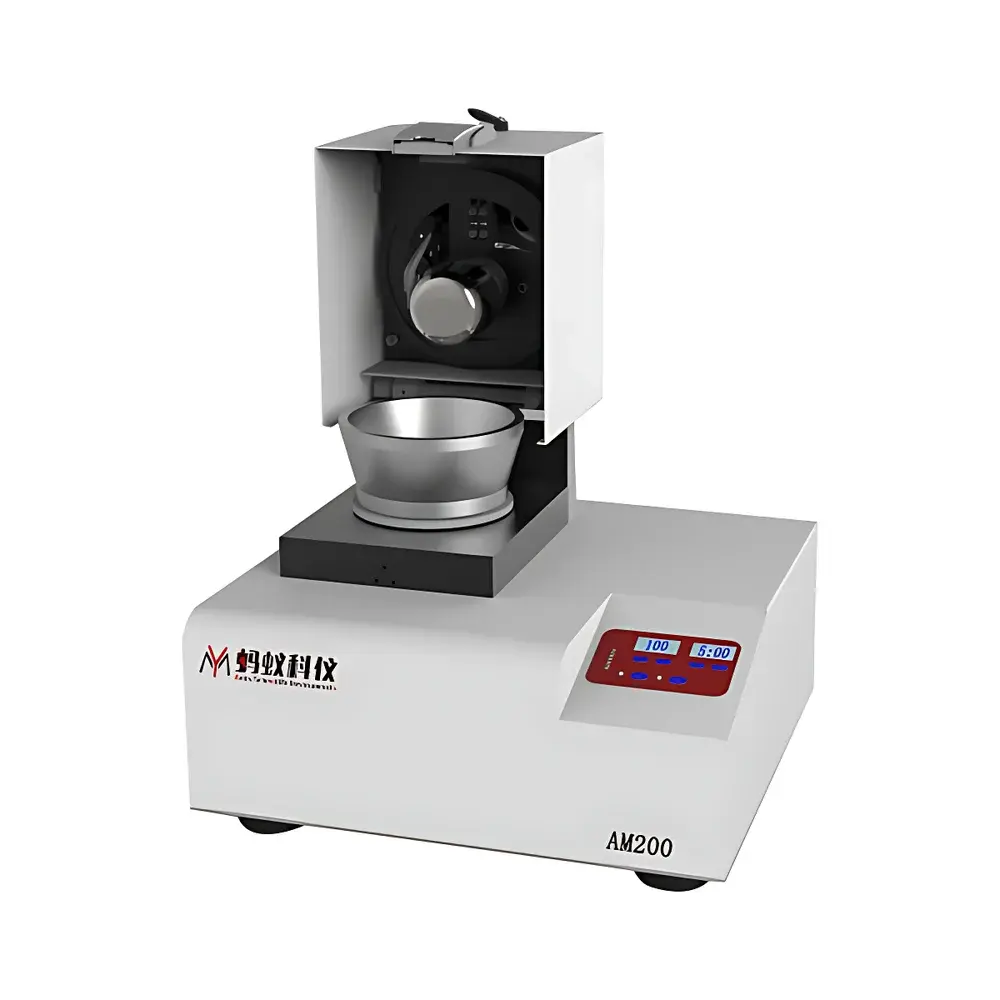
Ants Scientific Instruments AM200 Mortar Grinder
| Brand | Ants Scientific Instruments |
|---|---|
| Origin | Beijing, China |
| Manufacturer Type | Authorized Distributor |
| Country of Origin | China |
| Model | AM200 |
| Instrument Type | Mortar Grinder |
| Sample Suitability | Hard, Brittle, Soft, and Paste-like Materials |
| Feed Size | <15 mm |
| Final Particle Size | ≤10 µm (typical, sample-dependent) |
| Batch Volume | 10–200 mL |
| Operating Speed | 50–150 rpm (customizable) |
| Grinding Modes | Dry, Wet, Cryogenic (LN₂-compatible) |
| Mortar & Pestle Materials | Hardened Steel, Stainless Steel, Tungsten Carbide, Agate, Alumina, Zirconia, Hard Porcelain |
| Pestle Pressure Adjustment | Calibrated Scale |
| Scraper Blade Adjustment | Knob-controlled |
| Display | Digital LCD with Time/Load Monitoring |
| Safety | Integrated Load & Position Sensors, Sealed Grinding Chamber, LED Illuminated Viewing Window |
| Compliance | Designed for GLP-compliant labs |
Overview
The Ants Scientific Instruments AM200 Mortar Grinder is an engineered laboratory grinding system that replicates the mechanical action of traditional manual mortar-and-pestle preparation—while delivering precise, reproducible, and scalable particle size reduction. Unlike high-energy impact mills or bead-based homogenizers, the AM200 employs controlled frictional compression and shear between a rotating, eccentrically mounted pestle and a stationary mortar bowl. This low-shear, high-contact-area mechanism minimizes thermal degradation and amorphization, making it especially suitable for temperature-sensitive, crystalline, or phase-sensitive materials such as pharmaceutical actives, geological minerals, ceramic precursors, and botanical extracts. The instrument operates on the principle of quasi-static compression combined with tangential motion: as the mortar rotates, the offset pestle both orbits and presses axially—generating adjustable normal force and dynamic shearing across two distinct contact zones (front and rear interface). This dual-path material flow—guided by an adjustable scraper blade—ensures continuous re-circulation and uniform exposure to grinding surfaces.
Key Features
- Three-mode operation: dry grinding, wet grinding (slurry-compatible), and cryogenic grinding (LN₂-cooled mortar assembly supported)
- Digital LCD interface with real-time load monitoring, programmable time (1–99 min), and speed control (50–150 rpm)
- Tool-free, plug-in mortar–pestle assembly with rapid interchangeability—enabling cross-contamination mitigation and workflow flexibility
- Calibrated pestle pressure adjustment via linear scale; independent scraper blade pressure tuning for optimized feed dynamics
- Sealed, dust-tight grinding chamber with transparent polycarbonate viewport and integrated LED illumination for in-process visual verification
- Seven certified grinding kit options—including agate (for trace-metal-free analysis), zirconia (high wear resistance), tungsten carbide (for ultra-hard alloys), and alumina (for alkaline stability)—each qualified per ISO 17025 traceable material certifications
- Integrated safety sensors: automatic shutdown upon lid opening, overload detection, and pestle misalignment recognition
- Compliance-ready architecture: event logging (start/stop/torque/time), password-protected parameter locking, and optional RS-232/USB output for integration with 21 CFR Part 11–compliant electronic lab notebooks (ELNs)
Sample Compatibility & Compliance
The AM200 accommodates heterogeneous sample classes without pre-sizing beyond 15 mm maximum feed dimension—including brittle ceramics (e.g., silicon carbide), hard metals (e.g., stainless steel swarf), fibrous plant tissues, hydrated gels, and sticky pastes. Its gentle yet effective comminution preserves polymorphic integrity critical for XRD, DSC, and dissolution testing. The instrument meets structural and electrical safety requirements per IEC 61010-1 and is routinely deployed in laboratories adhering to USP , ASTM E11, ISO 13320 (laser diffraction sample prep), and pharmacopeial grinding protocols (e.g., EP 2.9.12). All grinding kits are supplied with CoA specifying hardness (HV), impurity profile (ICP-MS tested), and dimensional tolerance (±5 µm). Optional IQ/OQ documentation packages support GMP validation in API manufacturing environments.
Software & Data Management
While the AM200 operates as a standalone benchtop unit, its embedded microcontroller logs timestamped operational metadata—including actual rpm, elapsed time, peak load percentage, and cycle completion status—to non-volatile memory. USB export enables CSV-formatted data transfer for trend analysis in statistical process control (SPC) software. When interfaced with validated laboratory information management systems (LIMS), the device supports full audit trail generation, user-level access control, and electronic signature capture—fulfilling ALCOA+ principles (Attributable, Legible, Contemporaneous, Original, Accurate, Complete, Consistent, Enduring, Available). Firmware updates are delivered via signed binary packages to prevent unauthorized modification.
Applications
- Pharmaceutical R&D: Pre-formulation milling of APIs prior to tablet compression or suspension development
- Materials Science: Homogenization of composite precursors (e.g., LiFePO₄ + carbon black) without carbon graphitization
- Geochemistry: Preparation of rock powders for XRF and ICP-OES with minimal elemental fractionation
- Food & Agriculture: Grinding of dried spices, seeds, and mycotoxin-contaminated grains under chilled conditions
- Environmental Testing: Reduction of soil/sediment samples to <10 µm for TCLP extraction or sequential leaching protocols
- Academic Research: Reproducible sample prep for SEM-EDS mapping, BET surface area analysis, and rheological slurry characterization
FAQ
What is the typical throughput for a 100 mL batch of quartz sand?
Under standard dry-grinding conditions (120 rpm, 15 min, tungsten carbide kit), median particle size (D50) reaches ~8.2 µm with a span (D90/D10) of 1.9 — verified by laser diffraction (Malvern Mastersizer 3000).
Can the AM200 be used for cryo-milling of polymer blends?
Yes. With optional LN₂ jacketing and zirconia grinding components, it achieves sub-10 µm dispersion of PEEK/PTFE composites while suppressing thermal creep and chain scission.
Is pestle pressure calibration traceable to national standards?
Pestle loading is mechanically referenced to NIST-traceable dead-weight calibration kits (supplied optionally); pressure scale resolution is ±0.2 kgf over 0–25 kgf range.
How often does the scraper blade require replacement during routine use?
Under daily 8-hour operation with abrasive silica, service life exceeds 6 months; wear is monitored visually via engraved depth markers on the blade mount.
Does the sealed chamber meet IP54 ingress protection rating?
Yes — validated per IEC 60529 for dust resistance and splash protection, enabling safe operation in shared analytical suites without local exhaust ventilation (LEV).



