
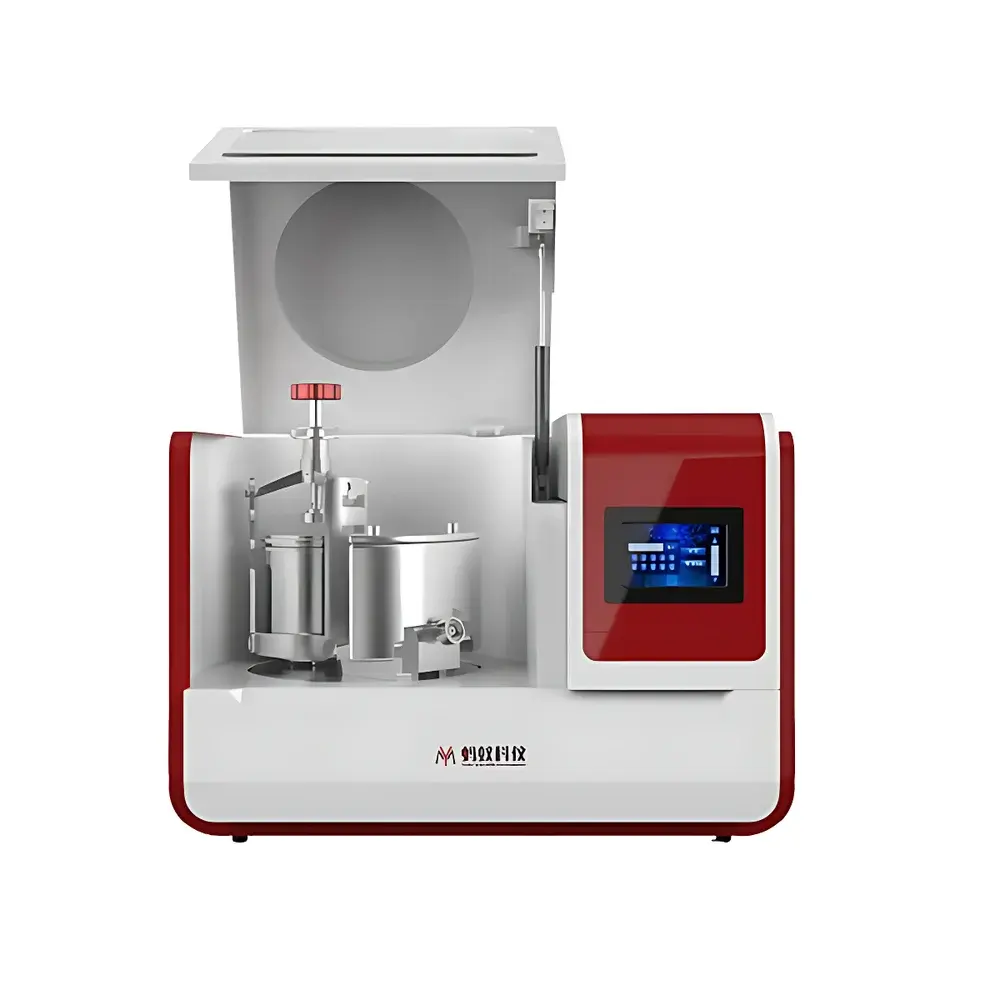
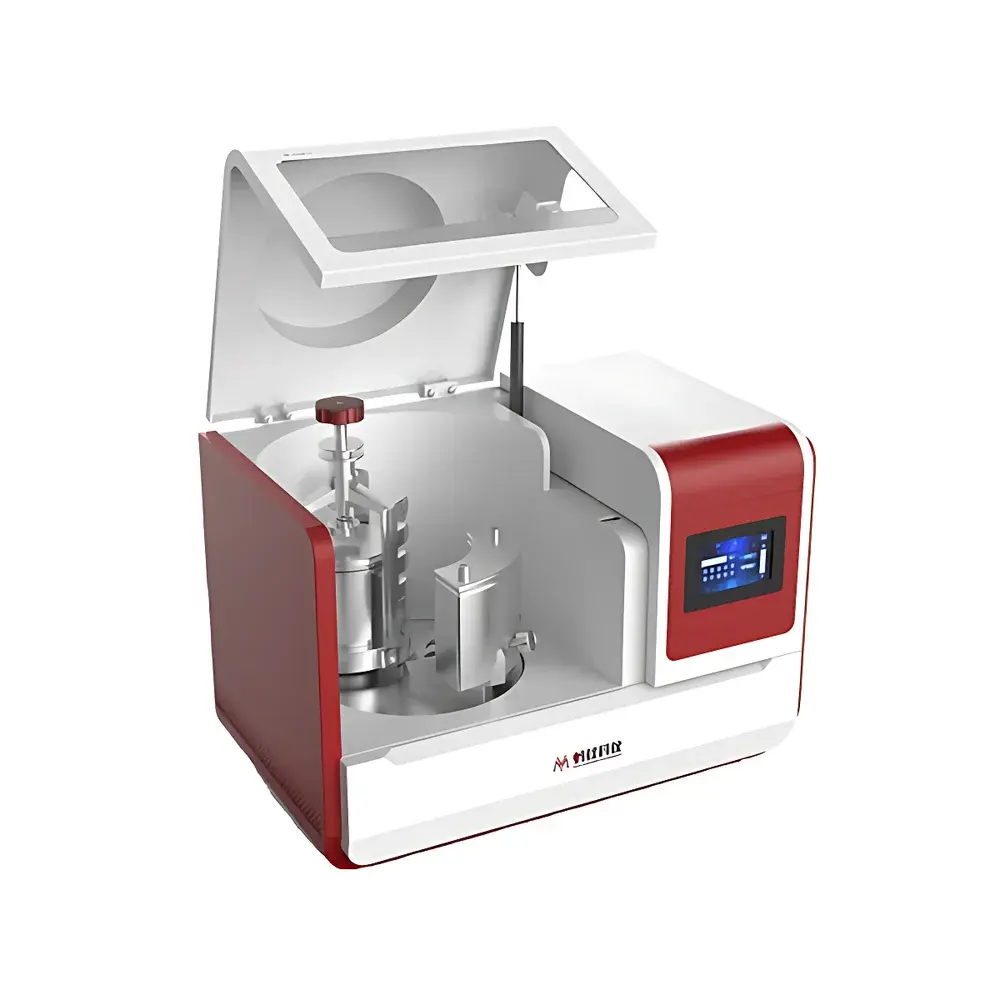
Ants Scientific Instruments AM410 Planetary Ball Mill
| Brand | Ants Scientific Instruments |
|---|---|
| Origin | Beijing, China |
| Manufacturer Type | General Distributor |
| Product Origin | Domestic (China) |
| Model | AM410 |
| Price Range | USD 7,000 – 14,000 |
| Instrument Type | Planetary Ball Mill |
| Sample Suitability | Hard, brittle, tough, and medium-hard materials |
| Final Particle Size | < 1 µm (dry grinding), < 0.1 µm (colloidal/wet grinding) |
| Feed Particle Size | < 15 mm |
| Batch Processing Volume | ≤ 220 mL |
| Sun Wheel Speed | 100–650 rpm |
| Speed Ratio | 1:−2 |
| Grinding Jar Capacity Options | 50, 80, 125, 250, 500 mL |
| Jar Materials | Hardened steel, stainless steel, tungsten carbide, agate, silicon nitride, zirconia |
| Grinding Media Diameter | 0.1–30 mm |
| Programmable Segments | 2 independent grinding stages with adjustable speed/time |
| Total Memory Profiles | 10 |
| Cycle Repetition | 1–20 times |
| Timer Range | 1 s – 99 h 59 min 59 s |
| Ventilation | Automatic chamber ventilation |
| Display | Touchscreen LCD interface |
| Safety | Interlocked lid with mechanical safety lock |
| Compliance | Designed for GLP-compliant operation |
Overview
The Ants Scientific Instruments AM410 Planetary Ball Mill is an engineered high-energy milling system designed for reproducible size reduction of diverse solid materials—from soft organic compounds to ultra-hard ceramics and metallic alloys. It operates on the principle of planetary motion: grinding jars rotate around a central sun wheel while simultaneously rotating on their own axes in the opposite direction (speed ratio 1:−2). This dual rotational motion generates intense centrifugal and Coriolis forces that accelerate grinding media (balls) against the jar walls and sample material, resulting in combined impact, shear, and frictional energy transfer. The AM410 achieves final particle sizes down to <1 µm under standard dry grinding conditions and sub-100 nm (<0.1 µm) in optimized wet or colloidal grinding protocols—making it suitable for nanomaterial synthesis, mechanochemical alloying, and advanced ceramic precursor preparation.
Key Features
- High-speed planetary drive system with digitally controlled sun wheel rotation (100–650 rpm), enabling precise kinetic energy modulation across sample classes.
- Dual-stage programmable grinding: Independent control of speed, duration, direction (forward/reverse), pause intervals, and rest periods per stage—critical for heat-sensitive or aggregation-prone samples.
- Thermally stable grinding chamber with automatic ventilation to dissipate exothermic energy during extended operation (up to 99 h 59 min).
- Ergonomic touchscreen LCD interface with intuitive navigation, eliminating mechanical buttons and supporting glove-compatible operation in controlled environments.
- Interlocked safety lid with mechanical locking mechanism compliant with IEC 61000-6-2/6-4 electromagnetic compatibility and EN 61010-1 laboratory equipment safety standards.
- Storage for up to 10 complete parameter sets—including speed profiles, time sequences, directional logic, and cycle repetition counts—for rapid method recall and cross-laboratory protocol consistency.
- Modular jar platform accommodating five standard volumes (50–500 mL) and six chemically inert, wear-resistant jar materials (zirconia, tungsten carbide, agate, etc.) to prevent contamination and ensure compatibility with aggressive solvents or reactive precursors.
Sample Compatibility & Compliance
The AM410 processes a broad spectrum of inorganic and organic solids: oxides, metals, polymers, pharmaceutical APIs, soil matrices, biological tissues (freeze-dried), and composite precursors. Its design accommodates both dry grinding and solvent-based (wet) milling—including aqueous, alcoholic, and non-polar suspensions—supporting ASTM E2908-13 (standard guide for mechanochemical processing) and ISO 13320:2020 (laser diffraction particle size analysis preparation). All electronic controls meet CE marking requirements for laboratory instrumentation. Parameter logging includes timestamps, operator IDs, and versioned method files—facilitating FDA 21 CFR Part 11–compliant data integrity when integrated with validated LIMS or ELN platforms.
Software & Data Management
While the AM410 operates as a standalone instrument with embedded firmware, its parameter memory architecture enables seamless integration into regulated workflows. Each stored profile retains full metadata: start/stop timestamps, actual vs. setpoint rpm deviations, total operational cycles, and thermal event logs (via internal temperature monitoring). Exportable CSV reports support traceability for GLP/GMP audits. Optional RS-232 or USB-C connectivity allows remote configuration and batch log retrieval—compatible with third-party lab automation middleware (e.g., LabVantage, Thermo Fisher SampleManager).
Applications
- Nanomaterial synthesis: Mechanical alloying of Ni–Fe, Ti–Al, and Mg–H systems; top-down exfoliation of 2D materials (e.g., graphene oxide, MoS₂).
- Pharmaceutical development: Amorphization of crystalline APIs, co-grinding with excipients for enhanced dissolution kinetics (aligned with USP & Ph. Eur. grinding validation guidelines).
- Geochemical and environmental analysis: Homogenization of heterogeneous soils, sediments, and fly ash prior to XRF or ICP-MS digestion.
- Ceramic & battery R&D: Synthesis of solid-state electrolyte powders (e.g., LLZO, LATP) with controlled stoichiometry and narrow PSD distribution.
- Materials failure analysis: Preparation of fracture surface replicas or cross-sectional polishing slurries requiring sub-micron uniformity.
FAQ
What is the maximum continuous operating time for the AM410?
The instrument supports uninterrupted operation up to 99 hours, 59 minutes, and 59 seconds, with programmable cooling intervals to maintain thermal stability.
Can the AM410 perform cryogenic grinding?
Yes—when used with liquid nitrogen–cooled jars (optional accessory), it enables cryo-milling of thermolabile polymers and biological samples without degradation.
Is method validation documentation available?
Ants Scientific Instruments provides IQ/OQ templates and calibration certificates traceable to NIST standards for GxP-aligned installations.
How does the 1:−2 speed ratio affect grinding efficiency?
This fixed kinematic ratio maximizes relative velocity between balls and jar wall, increasing collision frequency and energy transfer—verified via DEM (Discrete Element Method) simulations in the AM410’s engineering design phase.
What maintenance intervals are recommended?
Biannual inspection of gear train lubrication, sun wheel bearing preload, and jar clamping torque is advised; no routine recalibration is required due to factory-trimmed encoder feedback loops.



